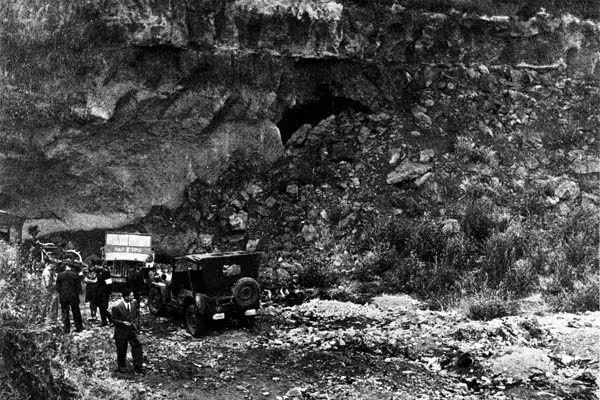
The massacre of Fosse Ardeatine (Rome), which took place on March 24, 1944represents one of the deepest and most painful wounds in twentieth-century Italian history. That day the German occupation troops massacred 335 people including civilians, political prisoners and Italian Jews, in retaliation for the partisan attack in Via Rasella, carried out the day before by some members of the Roman GAP, in which 33 policemen from the “Bozen” regiment belonging to the Ordnungspolizei (the German police) were killed. But it was not only the Germans who carried out this crime: in fact, the complicity of the fascist authorities was decisive.
The brutality of the event and the high number of victims make the Fosse Ardeatine massacre a symbol of the era of Nazi occupation of our country during the Second World War. The Fosse, ancient pozzolana quarries located in the area of Via Ardeatina chosen as a place of execution and concealment of the corpses of the victims, can still be visited today and are a place for public ceremonies for commemorations.
The background: the attack in via Rasella
On 23 March 1944, the partisans of the GAP (Patriotic Action Groups, urban wing of the Resistance linked to the Communist Party) organized an attack in via Rasella against the “Bozen” battalion, a unit of the German police.
With the help and organization of 11 partisans, comrade Rosario Bentivegna, disguised as a street cleaner, triggered a fuse bomb (12 kg of TNT mixed with scrap metal) inside a garbage cart. The explosion occurred as the German column passed in via Rasella, a narrow street near Piazza Barberini.
The explosion killed 33 South Tyrolean soldiers who every day paraded in war gear through the streets of central Rome singing military songs. Two Italian civilians also died during the explosion, Antonio Chiaretti, a partisan of the Bandiera Rossa formation, and a young boy, thirteen-year-old Piero Zuccheretti.
The order of retaliation and the choice of victims: 10 Italians shot for every German killed
Immediately after the attack, General Kurt Mälzer, commander of the Rome square, arrived on site and flew into a rage shouting “revenge for my poor kameraden”.
The commander, Colonel Kappler and General Eberhard von Mackensen (direct superior of General Mälzer and responsible for the war zone of the Anzio bridgehead) mutually decided to shoot ten Italians for each of the German soldiers killed. It was also decided that the victims of the reprisal should have been the “Todeskandidaten” i.e. the “people to be eliminated” (Roman citizens of Jewish origins, political prisoners and partisans detained in via Tasso and at the Regina Coeli already sentenced to death or life imprisonment and those guilty of acts that would probably have led to a death sentence). The reprisal was organized in just a few hours, with the officers of the Rome Gestapo section working frantically to draw up the list of victims and have it ready before dawn, avoiding any type of announcement (no request was made to the free partisans to hand themselves in to avoid the massacre of innocents, as had already happened in other cases) for the sake of the surprise effect.
The execution of the 335 victims and the hiding of the bodies
At noon on March 24, German officers began rounding up the Todeskandidaten. The prisoners locked up in Via Tasso were led out of their cells and gathered together with their hands tied behind their backs, without giving them any other instructions. Death, however, could already be smelled in the air.
Around 2.00 pm a series of vehicles with prisoners on board left from Via Tasso towards Via Ardeatina (four kilometers further), in the direction of the catacombs of San Callisto and Domitilla, quarries chosen for the massacre.
At 3.30 pm the prisoners of the Regina Coeli and 75 Jews also arrived, led into the tunnels of the pits illuminated by the German soldiers’ electric torches. There, the victims were called by name, made to kneel and then shot at the neck. Little by little, the execution area filled with corpses, piled one on top of the other. As there was almost no space available, the last condemned men were forced to climb onto the mass of corpses. The situation became increasingly chaotic, and some prisoners tried to resist, but were forcibly subdued and shot repeatedly. Due to some disturbances that occurred during the roundup of the death row inmates, five more men than the expected number (330) had been taken, whom Colonel Kappler had decided to kill because “they had seen everything“.
The last twenty-five executions ended at 8pm, with Colonel Kappler stating that it had been difficult but that “the reprisal had been carried out in accordance with the laws of war”.
At the end of the operation, the Germans detonated mines to block the entrance to the quarries and hide the atrocities committed, but the explosions reached the ears of the Salesians not far away (who acted as guides to the catacombs), who had noticed the coming and going of military vehicles. During the night they entered the quarries and saw the havoc committed by the Nazis, and the rumor spread rapidly, creating great confusion and horror in Rome.
The oldest victim was Moses Di Consiglio, 74 years old. The youngest one was Duilio Cibei, only 15 years old.
An unjustifiable massacre even by the laws of the time
Later, Benito Mussolini justified the incident by saying that the retaliation was legal, but it was not entirely true.
In fact, the Duce did not take into consideration what was written in the document of the Hague Convention of 1907, which prohibited reprisals against an entire population “for actions for which it is not responsible”, nor that of the Geneva Convention of 1929 (relating to the treatment of prisoners of war), which prohibited acts of reprisal against prisoners of war.
Retaliation was indeed contemplated in the national codes of war law, but within them reference was made to a series of criteria: from proportionality with respect to the extent of the offense suffered to the selection of hostages (which should not be indiscriminate) and the protection of civilian populations. But none of these criteria were met by Keppler and company:
- The Nazis did not carry out any investigation to ascertain the identity of those responsible for the attack on Via Rasella
- The retaliation was decidedly disproportionate
- The victims were indiscriminate: they had nothing to do with whoever had carried out the attack
- During the selection of victims, healthcare workers and patients were also shot, and civilians were taken prisoner simply because they were Jews
Memory and Justice
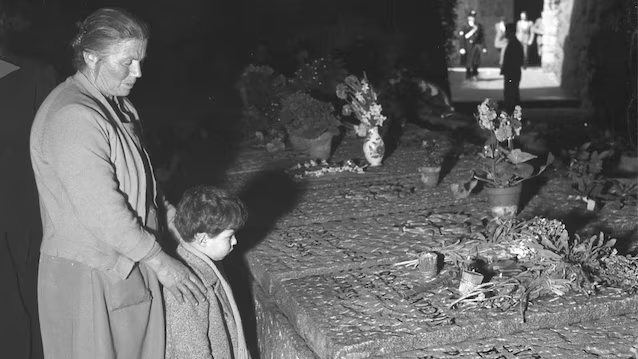
After the war, those mainly responsible for the massacre were put on trial, although the path to justice was long and controversial.
In 1944 the National Association of Italian Families of Martyrs Fallen for the Freedom of the Homeland (ANFIM) was born, with the aim of giving a name and a dignified burial to the victims. Today the Fosse Ardeatine site is a Military Shrinea place of silence and reflection where the remains of the victims rest, who are commemorated every March 24th during a solemn ceremony by the President of the Republic.