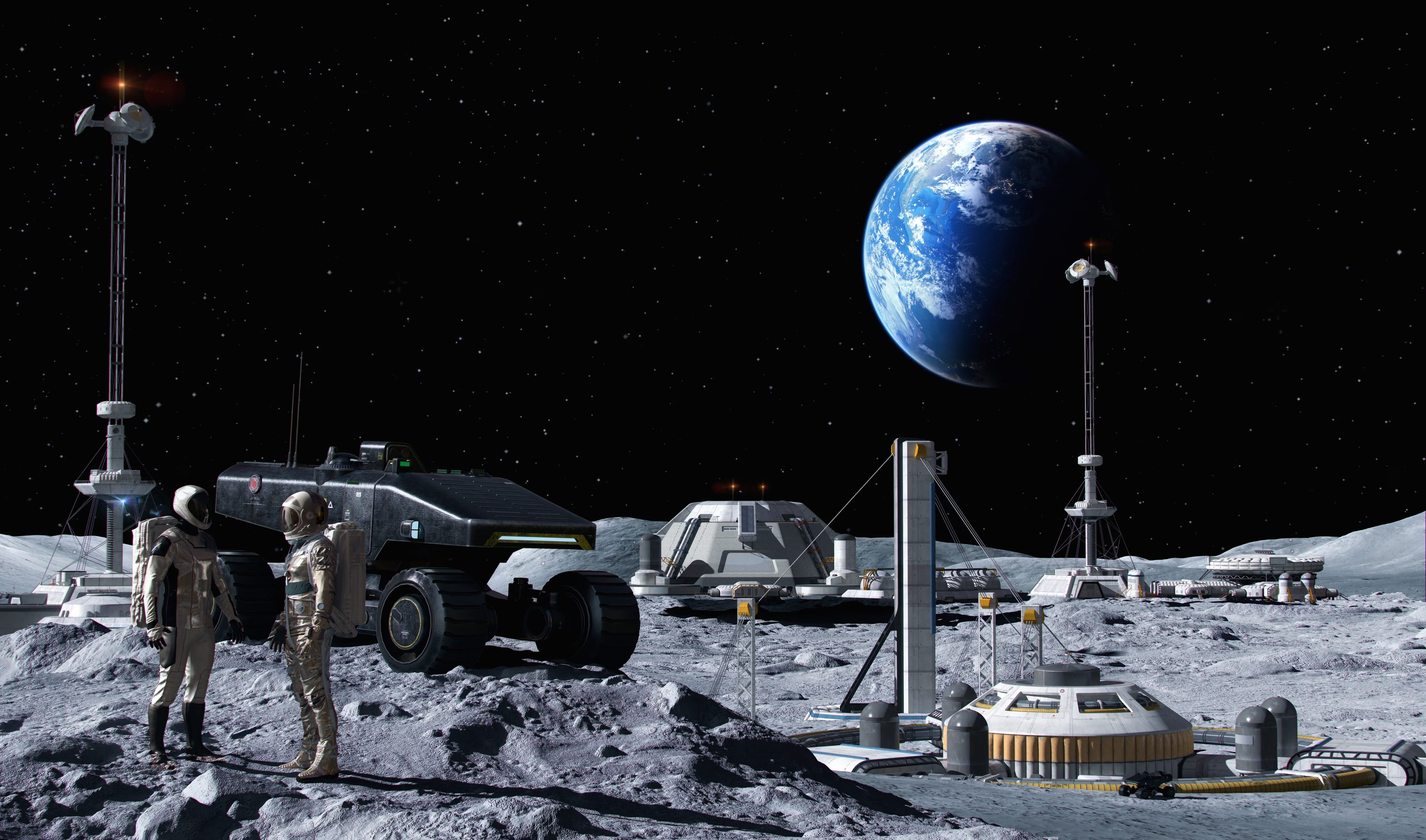
Coinciding with the launch of Artemis II towards the Moon, NASA reiterated that the ultimate objective of the Artemis program remains the construction of bases and infrastructure on the lunar surface. However, the Moon is not just an objective of the USA: China and Russia, for example, are also interested in our natural satellite, often in the same strategic areas, such as the lunar South Pole region. It is therefore easy to imagine that in a more or less near future problems could arise that today we only find on Earth. For example, what would happen if two lunar rovers from two different nations had an accident? How would we deal with disputes or even actions that would give rise to conflicts here on Earth? To date there is no regulation: we can rely on what international space law states.
How an accident on the Moon could be managed: the risk of conflicts
Therefore, currently the rules of international law discourage and prohibit war actions on the Moon but do not provide a clear legal framework in the case of conflicts based on mineral or territorial exploitation. This certainly requires an update of the international treaties that regulate outer space. In this regard, a group of scientists formed by Kevin M. Hubbard, Linda T. Elkins-Tanton and Tanja Masson-Zwaan published in the journal PNAS (Proceedings of the National Academy of Sciences) a draft space code for ice mining of the lunar poles. In fact, there is a lack of international laws that regulate extraction and protection activities in the lunar environment (as for example the International Seabed Authority – ISA does), also taking an interest in the environmental plan.
Looking then at cases such as collisions, for example, in the event of a collision between a Chinese rover and an American one, according to the current Treaties the procedure that the two States should follow is exchanges of diplomatic information, analysis of telemetry data and if there is damage, compensation mechanisms by the respective States and dialogue between the respective space agencies, in this case CNSA and NASA.
The 1967 treaty: legal aspects and “grey areas”
There are comics, like Mooncop by Tom Gauld, about lunar policemen. But does a lunar police exist in reality? The answer is no. In fact, surveillance and jurisdiction over lunar activities are regulated by international space treaties, primarily by the 1967 Outer Space Treaty. According to Article 1 of this Treaty, there is free access to all regions of celestial bodies and this means that outer space, including the Moon, can be freely explored and used by all States, who must promote scientific research and international cooperation in this field.
The art. 4, however, underlines that on the Moon and on celestial bodies it is forbidden to install military bases, military defense instruments or test weapons and military maneuvers. What is permissible, however, is the use of military personnel for scientific research missions or in any case exploration missions that have a peaceful purpose. The Outer Space Treaty therefore prohibits the use of weapons of mass destruction and nuclear weapons both in Earth orbit and in space, therefore also on the Moon. This leaves a gray area regarding everything that does not fall within the scope of armaments, which is in contradiction with the exclusively peaceful purposes permitted by international space law.