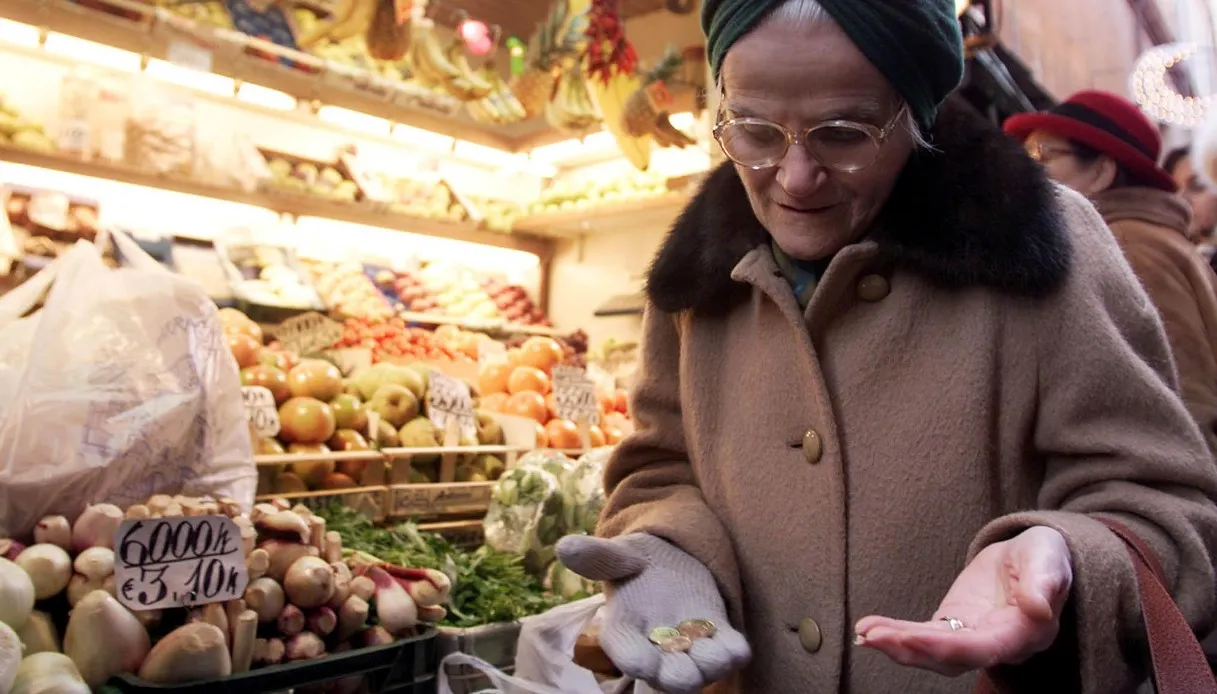
There are signs of improvement in the living conditions of Italians, but 1 in 5 is still at risk of poverty. The latest Istat report on the living conditions and income of families, relating to the years 2024-2025, shows an improvement in general conditions. In 2025, the population at risk of poverty or social exclusion decreased, falling to 22.6% compared to 23.1% in 2024. The share of individuals at risk of poverty remains stable, going from 18.9% to 18.6%, but the share of those who find themselves in conditions of serious material and social deprivation increases slightly.
There are several confirmations, such as the North-East which is confirmed as the territory with the lowest incidence of risk of poverty or social exclusion, while the South is the one with the highest percentage. Another confirmation is a lower risk if you live as a couple and without children, compared to couples with children or single-parent families. The average family income is rising again, but remains 4.9% lower than in 2007.
Poverty and social exclusion at 22.6%
Istat’s strong opening data is that relating to the risk of poverty and social exclusion. This figure drops from 23.1% in 2024 to 22.6%. A percentage that can be translated into numbers: that is, 13,265,000 people are in conditions of risk.
To be included in the data, you must be in at least one of the three conditions, which are:
- at risk of poverty;
- in severe material and social deprivation;
- low labor intensity.
The “risk of poverty” share remains stable at around 18.6%, while the share of individuals living in “low work intensity” families decreases, going from 9.2% in 2024 to 8.2%. However, the share of those in conditions of serious material and social deprivation increased slightly, rising from 4.6% to 5.2%.
This translates into an average annual income of families that grows again in 2024 compared to 2023 and is positioned around 39,501 euros. A growth that is associated with the reduction of inequalities in distribution.
In fact, Istat confirms:
The amount of income received by the 20% of families with the highest incomes is 5.1 times that received by the 20% of families with the lowest incomes (in 2023 it was 5.5 times).
Who is the most fragile subject: family and residence
The photograph of the most fragile subjects portrays a couple with two children, while the other family types see their condition improving, thanks also to support for births for large families such as the Single Allowance.
The risk of poverty and social exclusion is:
- by 31.6% for single-parent families;
- by 30.6% for couples with three or more children;
- by 41.6% for families with at least one foreign member;
- by 28.6% for single people;
- by 17.4% for couples with one child;
- by 20.6% for couples with two children;
- by 16% for young couples without children.
However, the risk of poverty and social exclusion for single people remains stable.
The geographical data, however, confirms previous reports, with the most affected area remaining the South with a 38.4% risk of poverty or social exclusion. This is three times higher than that of the North-East, which stops at 11.3%.
Incomes are growing again
The income data weighs on the elements of fragility. Families in the South, for example, receive on average 32,427 euros per year compared to 44,290 euros in the North-East. On average, Italian families receive 39,501 euros net per year, equal to approximately 3,290 euros per month, an increase of +5.3% in nominal terms and +4.1% in real terms compared to 2023.
It is the first growth figure after two consecutive years of contraction. It is an encouraging number, but one that comes after many negative data. Just make a comparison with 2007: the 2024 data are -4.9% lower, with peaks of -9.3% in the Center and -6.9% in the South compared to the average annual incomes of 2007.