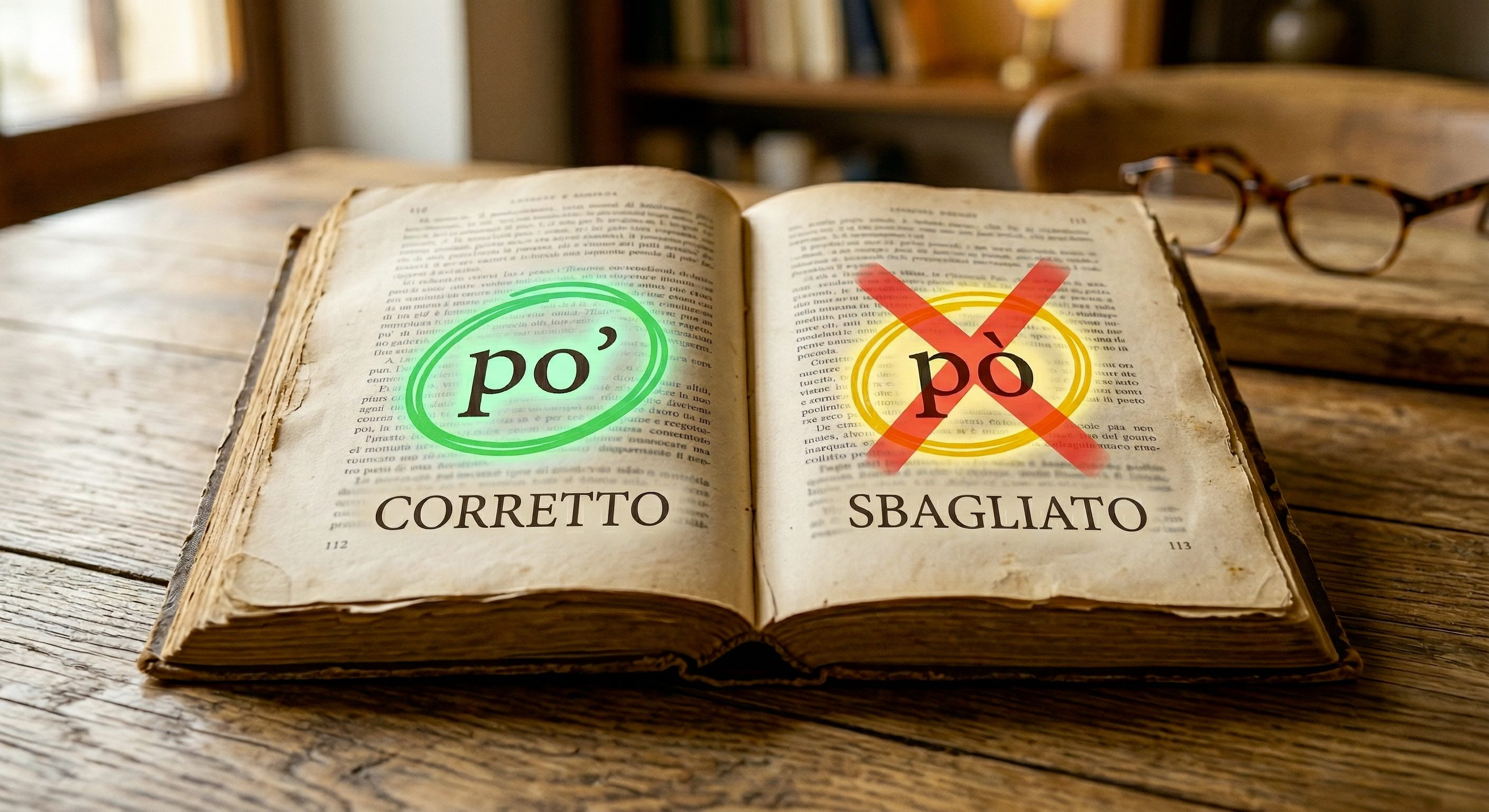
Almost all of us remember that a bit it is written with an apostrophe, as it is an abbreviated form of a little: they teach it to us in the first years of school so that we never forget it again. Yet, there are those who still get it wrong: it is in fact among the ten most common errors made in grammar. When typing on the smartphone keyboard, the option also appears bit with the accent, as if the two signs were interchangeable. Well (truncated form of Wellalso accepted with spelling Well), they are not: apostrophe and accent exist for different reasons and once you understand the difference it will be easier to immediately understand which one to use. In this article we will help you resolve your doubts once and for all.
The apostrophe indicates the lack of something
The apostrophe always signals an absence (in this case of the letter toan absence, where the elision of the vowel occurs): a letter or syllable that has been eliminated for convenience of pronunciation. A bit’ is the truncated form of a little: the final part -co it has fallen and the apostrophe leaves traces of the truncation. There are those who still use, especially in more dialectal forms, littlefor example by saying wait a littlebut it is more common in the Italian language to use the truncated form wait a bit. In this case the sign serves to remind us that that coda exists, even if we no longer pronounce it.
The same mechanism applies to other truncations that we use every day without paying attention anymore: well in the place of Well (e.g. “well, I don’t know what to tell you”), go, from’, ago’, is’, Of’which are the truncated imperatives of go, give, do, stay, say (e.g. “go to sleep”, “tell the truth”, “do as you want”, “stay still for a second”, “listen to me”). In all these cases, the apostrophe only tells us that the original word was longer, and that a shortened version remained.
The accent gives us an indication of how to read and pronounce
The graphic accent has two distinct functions: in words with several syllables it can indicate where the stressed syllable falls and distinguish words that would have the same spelling but different meaning, e.g. Still (the object of the vessel) e Still (adverb, “once again”), or the fishing (the fruit) and the fishing (the activity of fishing). This use appears above all in dictionaries and educational texts, while in everyday writing the accent is not normally marked.
On monosyllables, the accent allows us to distinguish words that are pronounced exactly the same, but which with or without the accent mean different things and without which in writing we would have no way of distinguishing them.
- and and: And with the accent it is always the third person singular of the verb to be, while And without accent corresponds to the conjunction. E.g. “Marco has arrived” and “Marco and Luca have arrived”.
- yes / yes : Yes with the accent is the affirmative adverb, while Yes without accent it is the reflexive pronoun. So, “Yes, I’m coming tonight”, “yes, of course” and “it’s getting late”.
- there / there And there/them: there And there with the accent they indicate place. There And there without accent they are articles or pronouns. E.g. “put it over there on the table” and “I see it every day”, “sit there” and “I met them yesterday”.
- gives / gives: from with the accent is the third person of the present indicative of dare, while “da” without the accent is the preposition. “It bothers me” and “I come from Milan”. This is one of the most frequent mistakes ever!
- say / say / say: Of with accent is the noun synonymous with day, while Of without accent it is the preposition. E.g. “Il giorno di festa” and “This jacket is Massimo’s”. There is also the version with an apostrophe, Of’, second person singular of the present imperative of the verb dire.
- neither / nor: nor with the accent is the negative conjunction which is equivalent to “and not”. No without accent it is the pronoun or adverb. As we had already explained to you in this article, “neither fowl nor fish”, “neither one nor the other” and “I talked about it with her”, in addition to the form “ce n’è”, elision of “there is”, in which we use the apostrophe.
- self/if: if with the accent is the tonic reflexive pronoun, while if without accent is the hypothetical conjunction. “Think only of yourself” and “if you want, come”. The forms “himself” and “itself” can be written without an accent, because the presence of same eliminates the ambiguity, but the form with an accent is accepted and now more recommended by the Accademia della Crusca.
- tea/tea: tea with the accent is the drink, tea without accent it is the pronoun. “Do you want some tea?” and “I’m telling you”.
As the Accademia della Crusca reminds us, in all other words of one syllable the accent should not be used.
The difference between acute accent and grave accent
The acute accent, which goes from bottom to top (from left to right), graphically indicates the closed pronunciation of the vowel And (phoneme /e/), as for example in words Why, until in all compounds of three (thirty-three, one hundred and threeetc.) and in the third person singular of the past tense of verbs such as repeat (he repeated), candies (he could), etc.
The grave accent, which goes from top to bottom (from left to right), is the one that must be pronounced with an open vowel (phoneme /ɛ/) and which we find not only in the word coffeein the third person singular of the verb to be (And) and in other words like Meaning what And Alas. The acute and grave accent also regulates open pronunciation or closing of the letter or within words (e.g. beating And blow). In practice, however, this difference is reported almost only in dictionaries and phonetic texts: at the end of the word la or it is almost always open and the insertion is mandatory in truncated words, i.e. accented on the last syllable. For the other stressed vowels (a, i, u), the distinction between open and closed pronunciation is not relevant in Italian, and the graphic convention dictates that the grave accent is used in any case: we therefore find it in all words that end with a tonic vowel, such as truth, so, however and Peru.
A trick to remember how to write accents? Think of the low one (`) as a stone falling, from top to bottom, and the high one (´) as a plane taking off, from bottom to top.
The most common errors, including accents and apostrophes
Beyond bit in the place of bitthere are other recurring mistakes we can make: first of all, using the accent where it is not needed. The prepositions on, Between, between or adverbs of place here And here they never have an accent – also because, unlike the previous examples, they have no double spellings to distinguish!
It also often happens that we forget the apostrophe in imperative forms: ago And is without apostrophe are verb forms of the third person in the present indicative, while ago‘ And is‘ correspond to the second person of the imperative (you do And you are), for example “shut up”. From And Ofhowever, are prepositions, while from’ And Of’ are the truncated versions of come on And you sayfor example “listen, listen to me”.
In short, the trick to not making mistakes
To understand whether we should use the apostrophe or the accent, we can ask ourselves a simple question: are we reporting an absence or are we distinguishing two different words?
If it is a truncation and something is missing compared to the full form, an apostrophe is needed (bit in the place of little And go in the place of go). If the word is complete, but risks being confused with another, then the accent is needed: Andverb to be, so as not to confuse it with And conjunction o Yesaffirmative particle, so as not to confuse it with Yesreflexive pronoun. In all other cases (su, qui, tra etc.) it is not needed, and adding the apostrophe or the accent would be a mistake.