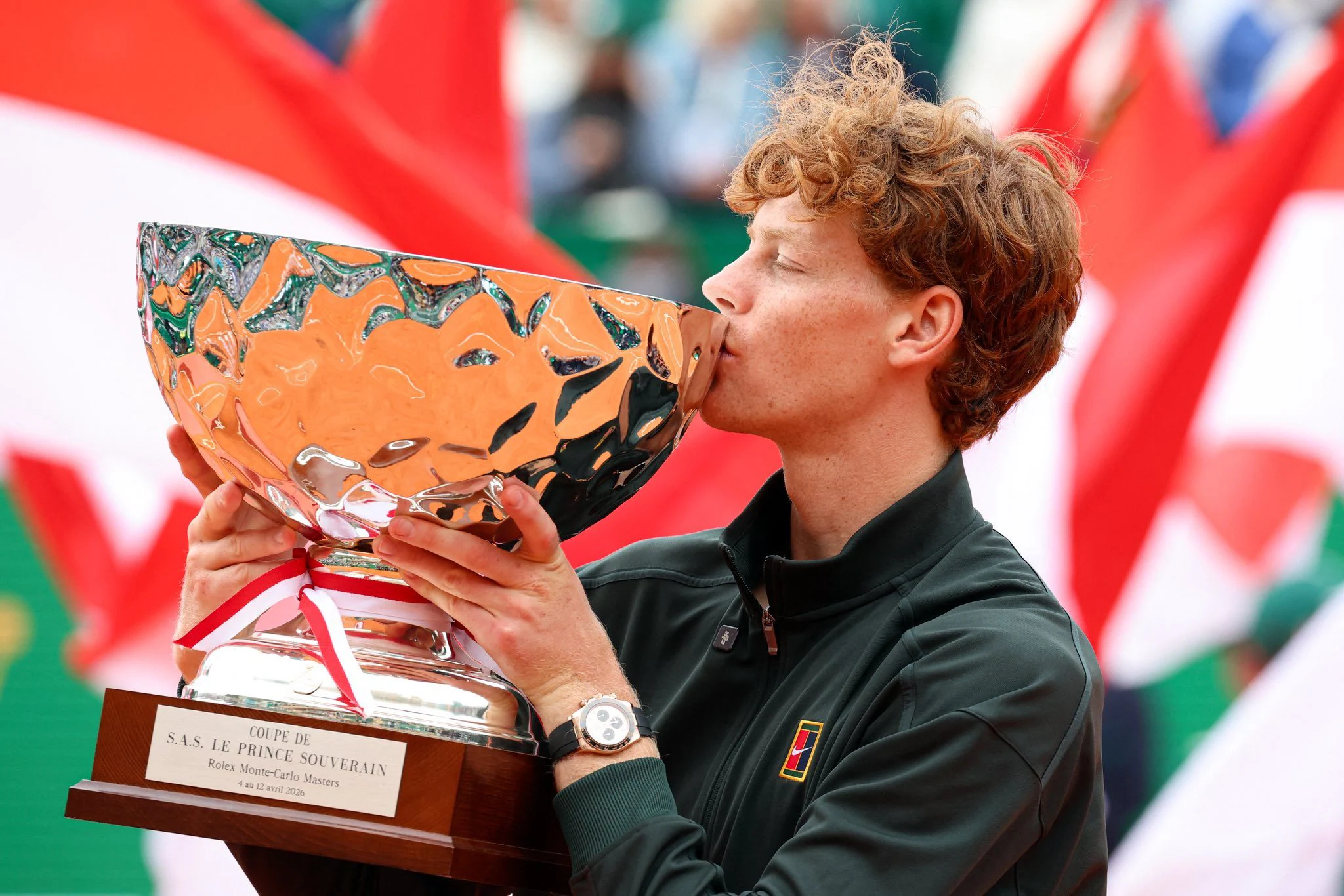
Only one man in the history of tennis had managed to complete the Indian Wells-Miami-Monte Carlo hat-trick in the same season before Jannik Sinner: the most successful tennis player of all time, Novak Djokovic, in 2015. This figure would be enough to tell the story of the golden period of the Italian who on Monday 13 April returned to world No. 1 against his rival Carlos Alcaraz. In 68 days the student of Vagnozzi and Cahill has recovered 3,350 points in the ranking from the Spaniard, dominating his opponents, surfaces, conditions and time zones. Nothing and no one could stop him. Not even the little habit of winning on clay.
The victory on clay against Alcaraz is a first for Sinner
Before the triumph in the Principality, the 24-year-old from San Candido had only won one title, a minor one, on clay, going a little against the grain with respect to the tradition of Italian tennis which sees us as a nation of landlubbers. This is the ATP 250 in Umag (Croatia) in 2022, again in the final against Alcaraz. In 2025 the gap with the Spaniard had narrowed with the two finals lost in Rome and Paris (with three wasted match points) and Sinner himself had repeatedly indicated that the main objective for 2026 was the clay court season and Roland Garros. The dominance both from a technical-tactical point of view and from a mental point of view in the Monte Carlo final opened a new chapter in his young career, highlighted in the conference by Alcaraz himself: “He’s reaching a level on this surface that makes him very dangerous for everyone. Now he can win anywhere.”
Chameleonic Sinner: his greatest gift is adaptation
We had already dedicated a focus to how complicated it was to achieve the Sunshine Double in the North American swing, going from the desert heat of Indian Wells to the humidity of Miami, but we never thought we would find ourselves two weeks later talking about the success of the same Sinner also on clay. The transition from hard courts to clay (which Jannik carried out directly during the tournament also playing a doubles match, with a few days of training at the Monte Carlo Country Club) is the most complicated of the year for a series of reasons. The first is the slowness of the surface which makes it more difficult to find the winner: rallies become longer and physical stability becomes a priority. The second is the unpredictability of the rebound given by the irregularity of the grains. The third is the habit of sliding in recovery shots. The fourth and last: the difference in the conditions of the earth depending on the weather and time of day (heavy with humidity and at night, “faster” during the day and in the heat).
«We started working on the court on Tuesday (after the final in Miami), starting to become familiar with the court, with sliding, because movement is the most different aspect in the transition from hard court to clay. Then we started to play a little with more rotation, to open up the corners more, to sometimes try some dampeners, some kick serves. So, day after day, we improved all these tactical and movement aspects, which we then put into practice in the match. We are really very happy because, after the first two games, he started to feel better on the court: more dampening, more variations in the height of the ball, in the serve. We are really impressed by his level here.” (Simone Vagnozzi, coach of Jannik Sinner, in the press conference after the Monte Carlo final).
Vagnozzi himself, Sinner’s coach since February 2022, revealed during the Monegasque week how his student’s greatest gift is being “chameleon-like”. And that his improvements arise from the analysis of his defeats (see the one in the US Open final) rather than his victories. Opponents (and records) are warned…