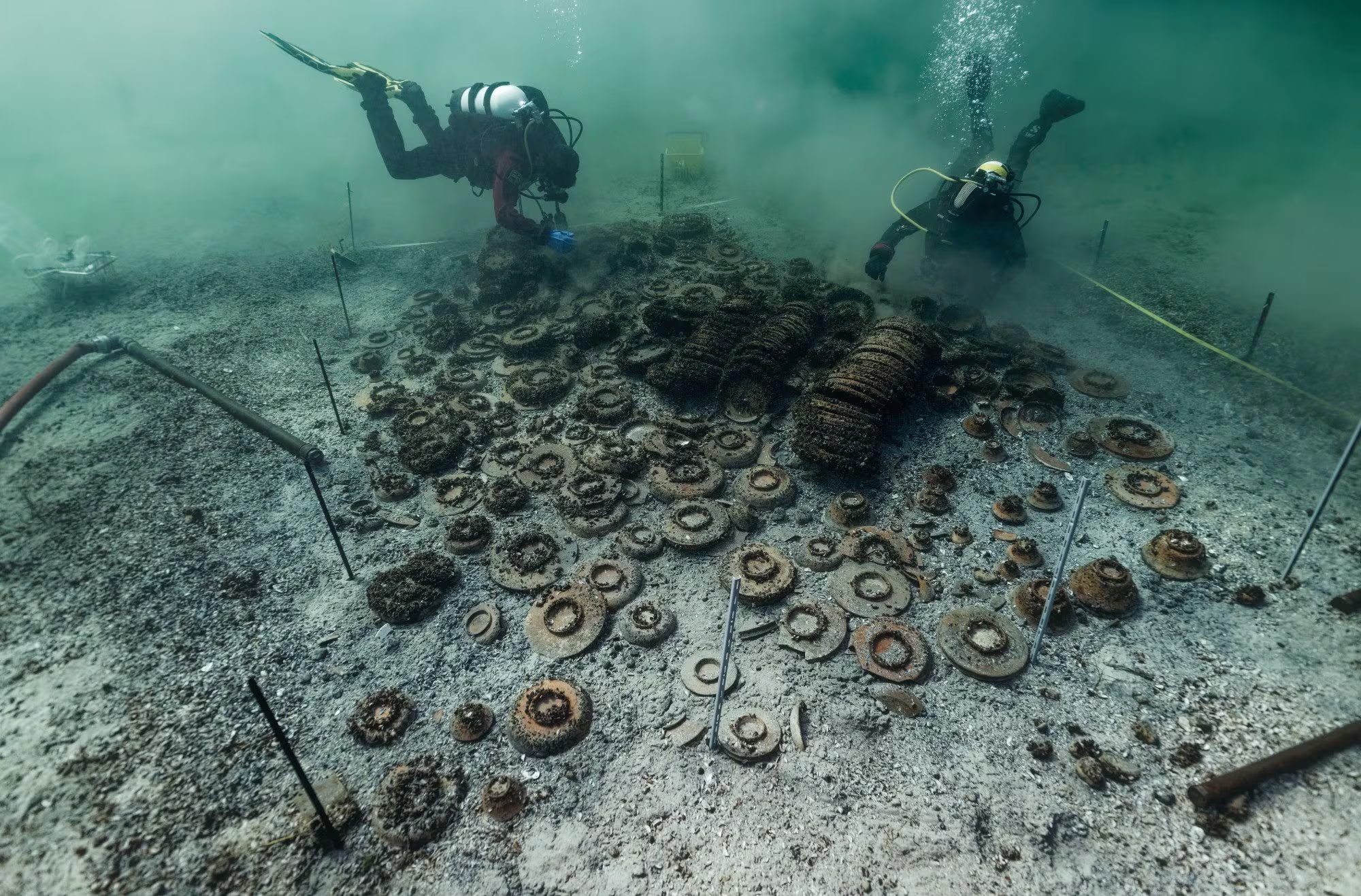
The cargo of a wreck was discovered on the bottom of Lake Neuchâtel, Switzerland. As part of the conservation program Vulnerable Wrecks of Lake Neuchâtel – started in 2018 – the external collaborator Fabien Droz identified an anomaly on the lakebed via drone. In the following days, in November 2024, the archaeologist Fabien Langenegger and the president of the Octopus Foundation (a non-profit association which aims to safeguard marine heritage) Julien Pfyffer carried out the first verification dive, confirming the presence of a vast accumulation of ancient ceramics, probably pertaining to the cargo of an ancient wreck, later revealed to be from the Roman era.
A sample of wood was subjected to carbon-14 dating: the results place the wreck between 50 BC and 50 AD. A fibula found on site, a particular type of military brooch, which appeared under the reign of Tiberius (14-37 AD), and dendrochronological dating (a procedure through which, by comparing the growth rings of a trunk, it is possible to date the wood with a certain precision) of a wooden board found under the ceramics have provided a fairly precise dating, after 17 AD
The excavations of the wreck took place in two campaigns. The first, in March 2025, involved a work area measuring 60 meters by 24 meters at a depth of 8 metres, divided into squares of 4 meters each. 42 peripheral squares were excavated, recovering approximately 150 objects pertaining to the cargo of the ancient vessel. The second campaign, in March 2026 and lasting almost a month, completed the 19 remaining squares in the central area, bringing the total to over 1,000 recovered objects.
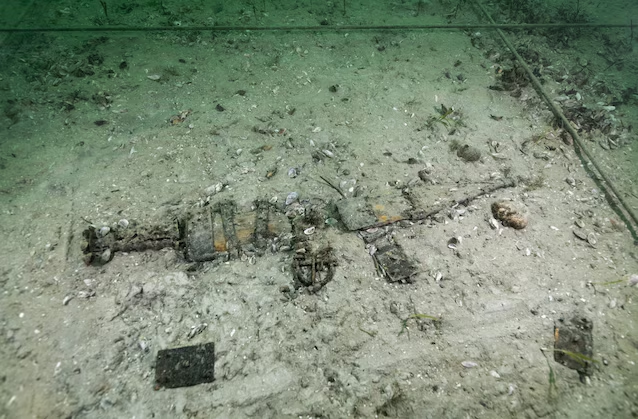
The load includes hundreds of intact ceramics (plates, bowls, cups, trays), probably of local production, coming from the Swiss plateau; fragments of amphorae for oil or wine; a wicker basket containing six ceramics of different manufacture, interpreted as pottery from the boat’s crew; metal kitchen items such as a cauldron and crucible; elements of equine harness, such as bits, bars, pins; four wooden and metal wagon wheels, dated to the same period as the load; objects of legionary equipment: a belt buckle, a dolabra (axe-pickaxe, used by legionaries for various jobs), a fibula and two complete gladii, one of which is still in its original wooden and metal sheath.
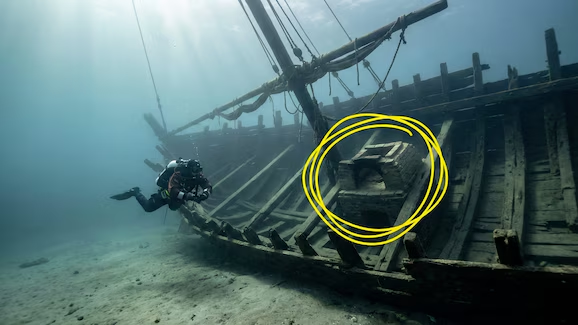
No trace of the hull was found nearby. Archaeologists do not rule out that the ship managed to reach the shore or sank elsewhere. The prevailing hypothesis is that the cargo was intended for the XIII Gemina Legion, stationed since 16 AD in Vindonissa (today’s Windisch, in the canton of Aargau, in central-northern Switzerland) with the task of guarding the border of the Rhine river. The goods would have left from the port of Yverdon, in the canton of Vaud (the ancient Eburodunum), at the southern end of Lake Neuchâtel, headed north through the lakes and canals, and would have sunk at the mouth of the Thielle canal, perhaps due to a sudden gust of wind.
The site of the shipwreck had long been protected by layers of lake sediments, subsequently eroded during two water regulation interventions, in the 19th and 20th centuries. For this reason it was decided to proceed quickly with the recovery. During the year between the two campaigns, an underwater camera system developed by the Octopus Foundation monitored the site continuously to prevent looting. The finds, currently undergoing conservative treatment in demineralised water at around 5-6°C, will be exhibited at the Laténium, the archaeological museum and park of Neuchâtel. The Octopus Foundation also plans to publish a book and documentary in 2027.