More than forty days after the start of the war in the Middle East between the United States, Israel and Iran, the Strait of Hormuz remains effectively blocked, preventing the transit of approximately a fifth of the world’s oil and liquefied natural gas. Making the situation even more complex is the presence of naval mines laid at the beginning of the conflict by the Islamic Revolutionary Guards (the Pasdaran), which transformed the main chokepoint energy of the planet in an area of very high risk for navigation.
This is why a military summit was organized in Paris in which a series of countries participate, including Italy, with the aim of planning future operations for demining the Strait. A possible mission, however, would start only after the end of hostilities between Iran and the United States – to avoid direct involvement of EU countries in the war – and after having verified the minimum safety conditions for the crews.
Meanwhile, on April 11 the American destroyers USS Frank E. Peterson and USS Michael Murphy began a mine-clearing process, with the aim of creating a safe passage corridor to be shared with the maritime industry to facilitate the free movement of goods.
What we know about Iranian mines in the Strait of Hormuz: the typologies
To understand why mines in the Strait of Hormuz pose such a great threat to shipping, we must first know the characteristics of this Strait, a channel approximately 167 km long and wide from a minimum of 39 km, at its narrowest point, to a maximum of over 100 km.
There are only two commercial shipping lanes, about 3 km wide and separated by a “buffer zone” of similar dimensions, while the navigable seabed varies between 40 and 60 meters deep, going down to 15-30 meters near the Iranian coasts. Its geological conformation, combined with the presence of numerous Iranian islands (such as Qeshm, Hormuz, Larak), further restricts navigable corridors and forces international traffic to navigate particularly narrow channels and therefore more vulnerable in the event that mines are present.
It is precisely the limited depth of the seabed of the Strait that has allowed Iran to easily place mines which, among other things, are extremely cheap weapons compared to the damage they are capable of causing. According to estimates by maritime analysts cited by Al JazeeraIran boasts an arsenal of between 2,000 and 6,000 mines, largely of internal production.
More specifically, these mines are divided into three main categories, depending on the activation mechanism:
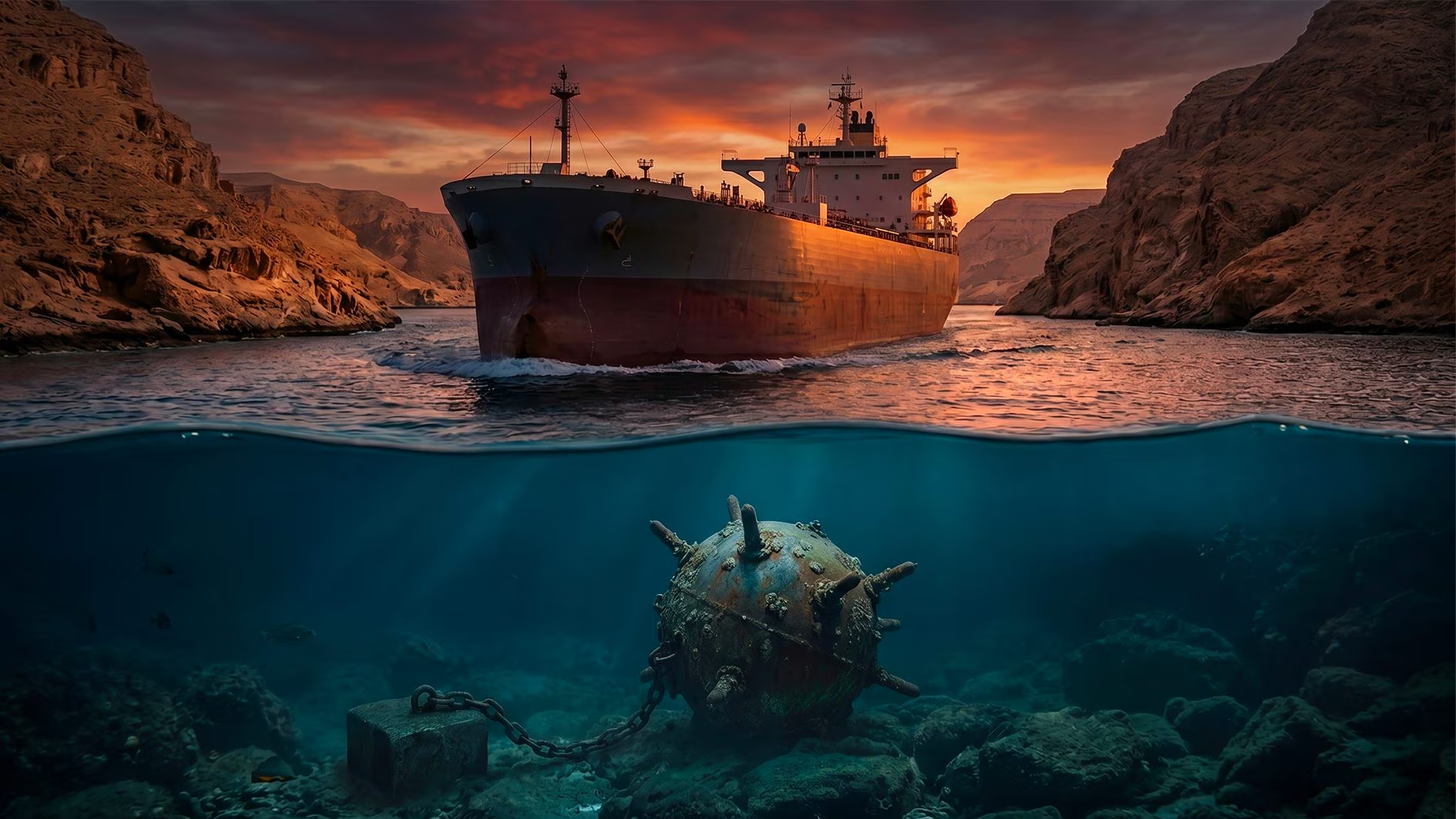
- Contact mines, i.e. those that explode only upon direct physical contact with the hull of a ship. Mines of this type can be anchored to the seabed (which in Hormuz are shallow) or installed on top of gods floating spherical in shape: in the latter case, the explosive is located in the lower half of the warhead, while in the upper half there is an air pocket to make it float.
- Bottom mines: this type of mine also rests on the seabed, but unlike the previous ones, they are activated thanks to a series of sensors (magnetic, seismic or acoustic), which detect the presence of a ship, then explode. They are significantly harder to spot than anchored ones and also more dangerous, because they do not require direct contact.
- “Intelligent” mines: in this case, the mines can be anchored to the seabed up to a depth of 200 meters and, once the passage of a ship is detected, they are able to launch a rocket that hits the vessel from below.
Clearly, Iran has never revealed the exact location of the mines in the Strait of Hormuz, limiting itself to publishing a map showing a route defined as “safe” and which directs ships to a route closer to the Iranian coast than the traditional one, which instead involves sailing close to the coast of Oman.
The presence of mines, therefore, also serves as a psychological warfare strategy: even just the suspicion of their presence is enough to paralyze commercial traffic, because a single mine is enough to induce operators to consider the entire area at risk.
How they can be removed: US minesweepers
But, therefore, what would be the operations to be carried out to clear mines from the Strait of Hormuz? Naval mine clearance activities, indicated with the technical acronym MCM (Mine Countermeasures) can be conducted using two complementary techniques: the mine hunting (literally “mine hunting”), which uses high-resolution sonar to locate and identify individual devices, and the minesweeping (dredging), which instead uses mechanical or magnetic systems to cause controlled detonation and, therefore, eliminate the mines.
The problem is that these are procedures that require great precision, very long times and specialized means: it must also be considered that the MCM naval units are in fact targets during the reclamation operations and therefore need a military escort to be protected from possible attacks.
Added to all this is the issue of the “mine gap”: the US Navy, in fact, decommissioned the last four MCM ships located in Bahrain last September, and in August the MH-53E Sea Dragon helicopters, essential for air mine clearance operations, were also withdrawn from service. This is why US President Donald Trump has repeatedly asked for help from NATO allies for operations in the Strait of Hormuz, while the ships USS Tulsa and USS Santa Barbara are on their way to the Middle East.
The Italian Navy, among other things, has a long experience in minesweeping, with specialized operators using modern technologies capable of guaranteeing three fundamental requirements for mine clearance operations: silence during immersion, a low magnetic signature (so as not to trigger magnetic sensor devices) and long autonomy under water.