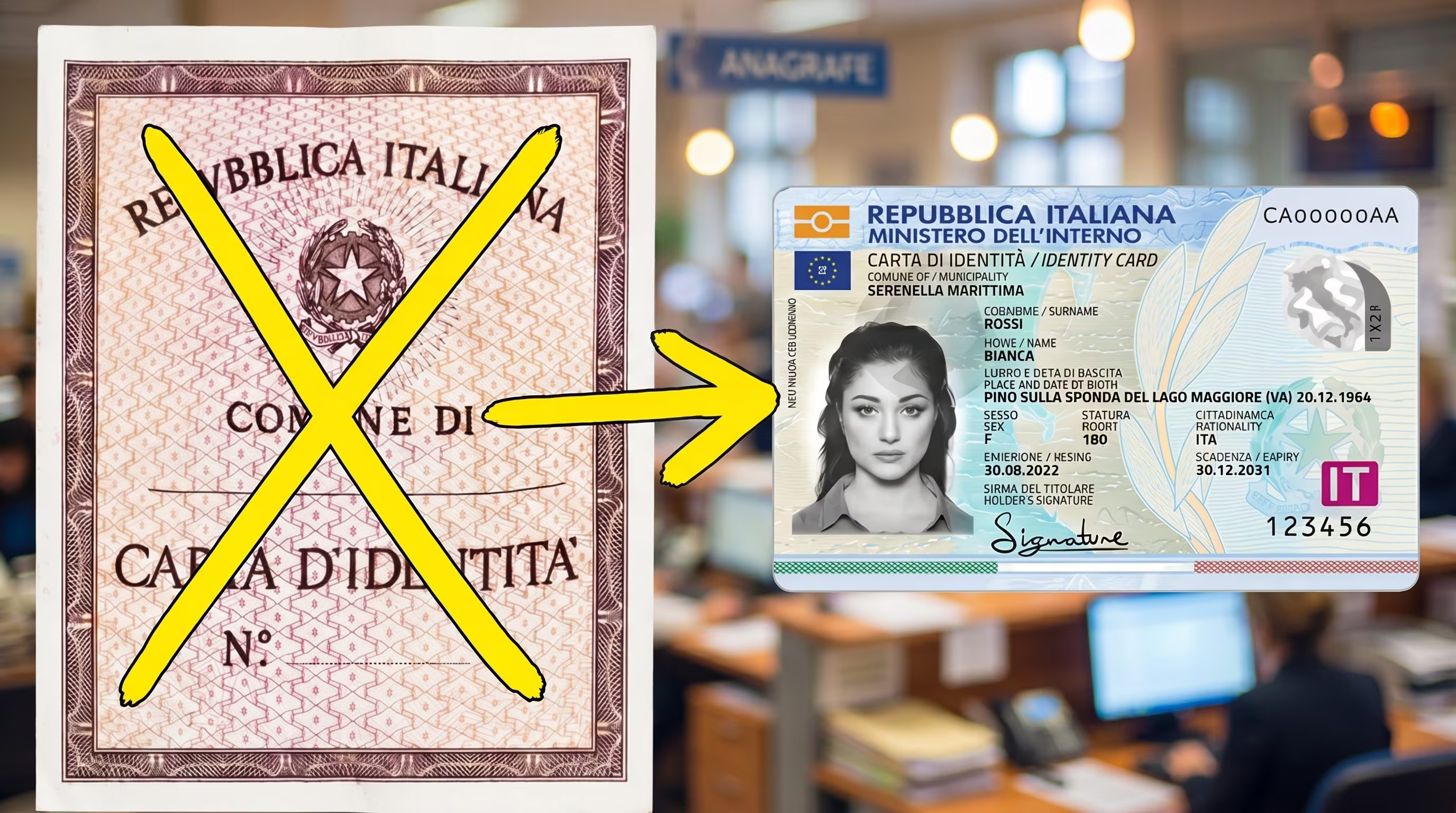
From 3 August 2026 the paper identity card will no longer be valid in Italy or abroad, regardless of its expiry date. This is confirmed by two circulars from the Ministry of the Interior (no. 76/2025 and no. 8/2026), which specify that from next August the paper document will also lose all validity on the national territory, even if it has not yet expired, and will have to be replaced by an electronic identity card (CIE).
This change serves to comply with the provisions of EU Regulation 2019/1157, which requires all Member States to gradually eliminate identity documents that do not comply with European security standards, which are not guaranteed by paper identity cards. Initially, however, it was not clear whether the end of validity concerned only use for expatriation or also circulation within Italian territory: the doubt was later resolved by the Department of Public Function, which confirmed the stop to its use everywhere.
At the moment it is not clear how many paper identity documents are still in circulation: according to the website of the State Printing and Mint Institute, over 61 million electronic identity cards have so far been issued, out of a total of 66,158,714 residents – of which 6,707,264 reside abroad – indicated by the National Registry of the Resident Population (updated to 16 April 2026). According to these data, therefore, approximately 5 million paper identity cards still remain to be exchanged in the next 3 months.
The innovation, among other things, will also have repercussions on the SPID digital identity system, which in the coming years may be gradually replaced by digital identities linked to electronic identity cards (CIE).
Because the paper identity card will no longer be valid in Italy or abroad
The innovation was introduced to follow up on EU Regulation 2019/1157, according to which identity cards that do not comply with the minimum security standards “cease to be valid upon their expiry or by 3 August 2026, if the latter date is earlier”.
With Circular no. 76/2025 of October 2025, the Ministry of the Interior had communicated that all paper identity cards would retain their validity exclusively until 3 August 2026: after which they could not be used for expatriation.
At that point, however, a doubt remained, linked to the possibility of continuing to use the paper document within Italian territory. At that point, the Ministry had posed the question to the Department of Public Function, which responded in the negative: maintaining the validity of paper cards even only for internal use would have risked being in conflict with the objective of the Regulation, exposing Italy to the risk of disputes by the European Commission.
The Regulation, in fact, does not distinguish between cards intended for internal use and cards for travel abroad: it applies to all identity cards issued to citizens by member states, with the sole exception of provisional documents with a validity of less than six months.
The subsequent Circular no. 8/2026 of the Ministry of the Interior, published on 2 February 2026, further confirmed what has already been said: from 3 August 2026 the paper identity card will no longer be usable for any purpose, regardless of the expiry date indicated, not even as a simple identification document on Italian soil.
The mandatory transition to electronic identity cards is justified by concrete security reasons and by an international harmonization of recognition systems. The CIE, in fact, integrates advanced protection technologies that not only make counterfeiting more difficult, but also allow border controls to be speeded up thanks to the MRZ system (Machine Readable Zone). This is a section printed on the document with alphanumeric strings automatically readable by electronic systems, which guarantees rapid and accurate control of personal data.
What to do to request an electronic identity card
But, therefore, what is the procedure to follow to request an electronic identity card? The new document can be requested, by appointment, at the registry office of your municipality of residence or domicile (or at the foreign consulate in the case of citizens residing outside Italy). The documents to be presented are a recent passport photo, in paper format, the tax code and the old paper identity card (or another valid document in case of theft or loss).
The cost of the new document is approximately €22.21 (although the price may vary according to the secretarial rights of the individual Municipalities) to be paid on the same day of the appointment, while the validity of the CIE will depend on the age of the person: specifically, we are talking about 3 years of validity for minors up to 3 years old, 5 years for those between 3 and 18 years old, 10 years for all adults, with the exception of those over 70 for whom the document identity card will cease to have an expiry date if issued after 30 July 2026. In the case of minor citizens, the presence of both parents at the appointment is also required, as well as the minor himself.
During the issuance of the new document, the fingerprints of the identity card holder will also be acquired, who will be asked to express a preference on the possible donation of organs and tissues at the time of death. The new document will not be released immediately, but you will have to wait 6 working days for delivery: the CIE, in fact, is printed exclusively by the State Printing and Mint Institute, which is based in Rome.
The issue of digital identity linked to the CIE
With the end of the validity of the paper identity card, a broader process of digital identity transformation in Italy will also begin. The CIE, in fact, is not just a physical document: thanks to the NFC microchip integrated into the card, it also works as a digital authentication tool, with three security levels similar to those of the SPID. The deadline of 3 August will therefore have direct effects on the Public Digital Identity System, which is destined to be gradually replaced by the CIE as the single access system to digital services.
The digital identity linked to the Electronic Identity Card is managed directly by the State and is completely free, unlike the SPID, which from 1 January 2026 also provides for an annual fee for Poste Italiane users, who will have to pay 6 euros per year starting from the second year of use.