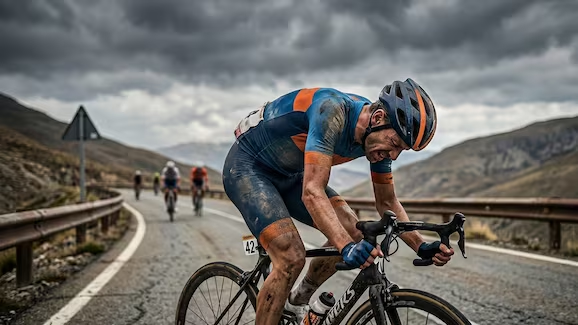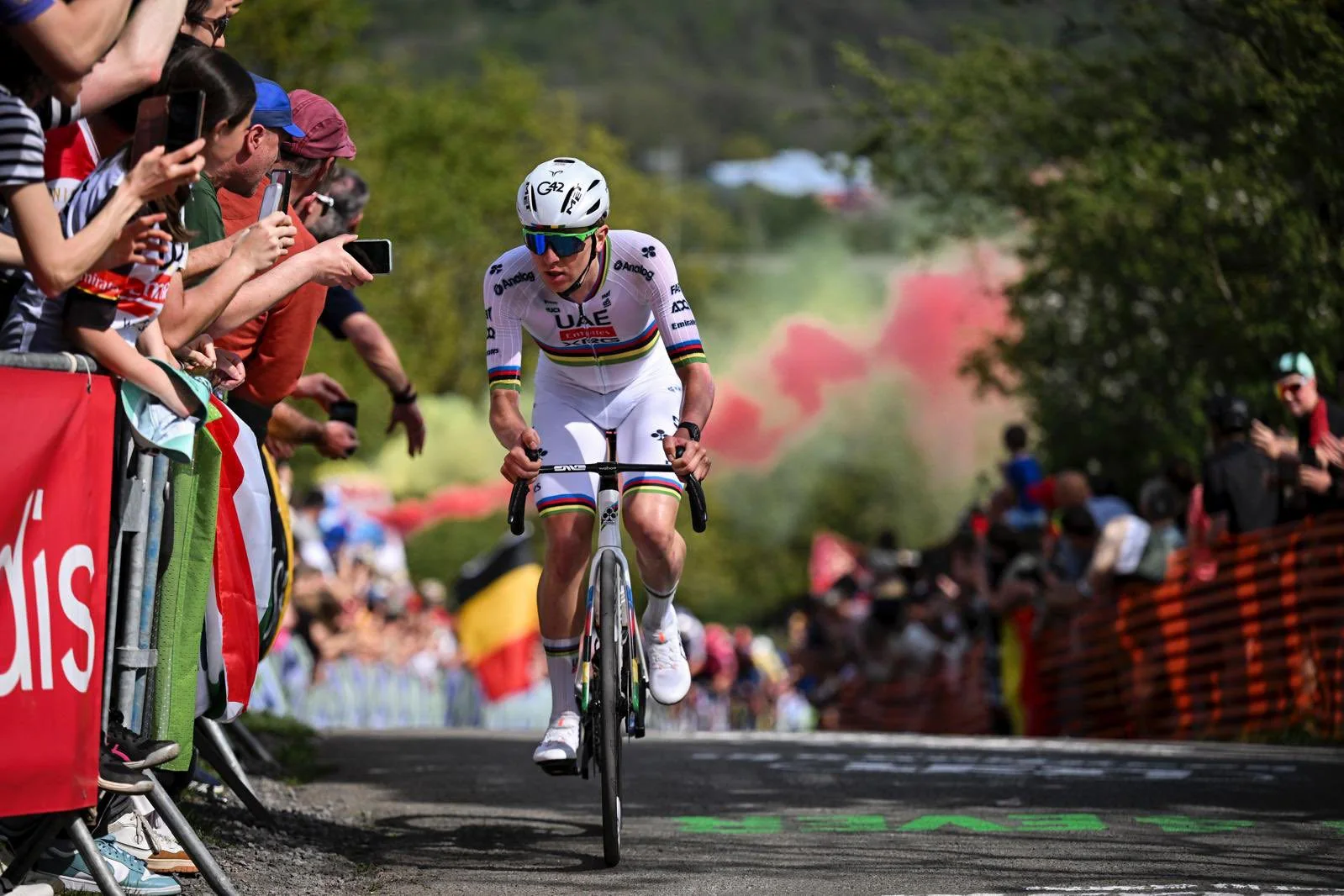
The season of spring road cycling classics will end on Sunday 26 April 2026 with the Liège-Bastogne-Liège, a race of 259 km and 4300 meters of altitude difference in the Ardennes, with short, hard climbs, set in the Belgian woods. This is the Liège-Bastogne-Liège, the oldest road cycling race still active in the world, born in 1892 and therefore nicknamed “La Doyenne des classiques” (the doyen of the classics).
Favorites in 2026: Pogacar for poker
The favorite for 2026 is, as in all spring classics, Tadej Pogačar, who is chasing his 4th success in Liège. After finishing second in Paris-Roubaix, his dream of winning all 5 Monument Classics (Milan-Sanremo, Flanders, Roubaix, Liège and Lombardy) in a single season has vanished, but he can still win 4 out of 5, a feat no cyclist has ever achieved.
The Slovenian’s main opponents are the winners of the other two Ardennes classics that were held in recent days: Remco Evenepoel, a Belgian born in 2000, who has already won La Doyenne in 2022 and 2023 and will be encouraged by the home crowd, after winning the Amstel Gold Race last Sunday.
The other opponent to keep an eye on is the new, very young phenomenon of world cycling: Paul Seixas. With 20 years to go, the French talent is the new hot name when it comes to the future of world cycling, in recent days he has won the Tour of the Basque Country and the Flèche Walloon and could be the ideal challenger on the short and steep côtes of the Ardennes.
How the oldest race in the world was born
The story begins in the most banal way possible: trying to sell more copies of a newspaper. In 1892 the Liège Cyclist Union, an amateur club linked to cycling, organized the first edition of the race to promote sales of the newspaper L’Express. Thirty-three riders showed up at the start, all Belgian, all amateurs, riding very heavy bikes on dirt roads. Only 17 of them managed to reach the finish line, after more than ten hours of racing. The race immediately became a fixed event, the start moved to Liège and the route settled on what we know today: around 260 km descending towards Bastogne, almost on the border with Luxembourg, and then climbing northwards through the Ardennes valleys.
Because the Ardennes make this race epic
The Ardennes are not mountains in the Alpine sense of the term. They are an ancient plateau, carved out by rivers, which with their incidence have created very steep walls. The result, for cyclists, are the côtes: climbs that rarely exceed 2 kilometers in length, but with gradients often above 10%. The difficulty of the Liège therefore does not lie in a single long climb, but in their rapid repetition. In the last 90 km of the route the runners face nine in sequence, without ever being able to really recover. Anyone who reaches the finish line in Liège after six hours of this treatment is truly among the best runners in the world. In the 2026 edition the route will be slightly harder than in recent editions thanks to two new climbs, the Col du Maquisard and the Côte de Desnié, just before the final sequence, potentially bringing forward the moment when the favorites will attack.
Italy and Liège: a history of champions
Liège-Bastogne-Liège is often called “the race of the Italians”. It’s not just a question of palmarès (where Italy boasts 12 victories, more than any other nation except Belgium), because the nickname has its roots in the social history of post-war Belgium: thousands of Italian families, fleeing the poverty of post-war Italy, emigrated to Wallonia to work in the coal mines. They brought with them their passion for cycling, and for decades they crowded the streets of Liège to cheer on the Italian cyclists.
The most exciting victory in this sense was that of Carmine Preziosi in 1965. His family had left Sant’Angelo all’Esca, in Campania, to seek their fortune in the Belgian Ardennes, where his father worked in the mine. Carmine grew up in those same valleys, became a professional cyclist and won right there, on those roads that had become his home. Among the Italian victories, the domination of Moreno Argentin stands out, with 4 victories between 1985 and 1991, the two victories each for Michele Bartoli and Paolo Bettini between the end of the 90s and the beginning of 2000, with the historic Italian five in 2002: Bettini-Garzelli-Basso-Celestino-Codol. Italy has not climbed to the top step of the podium since 2007, with Danilo di Luca.