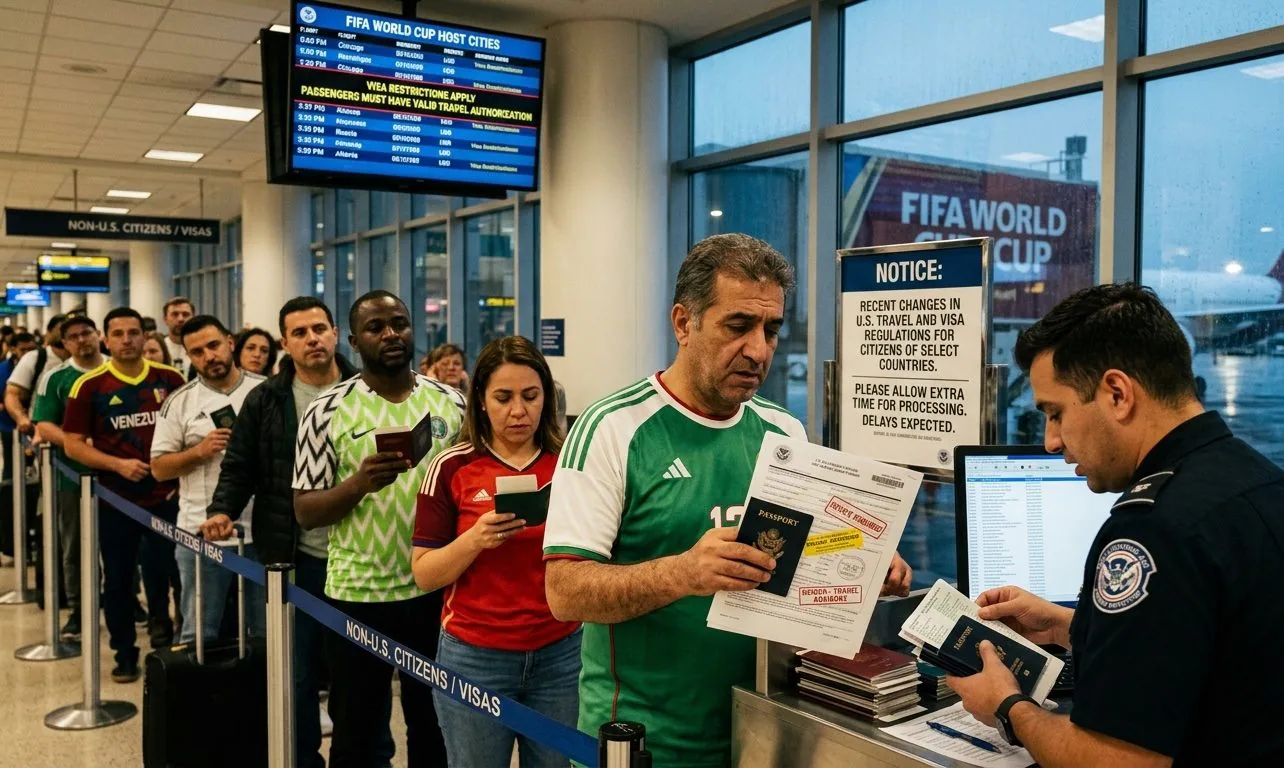
Today, Thursday 11 June 2026, the first football World Cup in history kicks off with 48 teams, hosted by three different countries: the United States, Mexico and Canada. On paper it is the “biggest, most beautiful and inclusive” World Cup ever, to use the words of FIFA president Gianni Infantino. In practice, however, a new variable risks leaving its mark: for the first time the entry rules of the host country become a central theme of the tournament. The migration policies of Donald Trump’s US administration, in fact, complicate (or completely prevent) travel for fans, staff and even referees coming from different countries.
Between visas and ESTA: how to enter the United States
The first thing to understand is on a geographical level: the 104 matches of the tournament are distributed across 16 cities, but 78 matches, including all the matches from the quarter-finals onwards, will be played in the United States (distributed across 11 cities), while Mexico and Canada are entitled to just 13 each (distributed across 3 and 2 cities respectively). This imbalance risks being decisive: a fan who wants to follow his team beyond the groups must, almost inevitably, set foot in the United States. And this is exactly where the entry rules come into play.
To understand the “visa chaos” you need to understand how to enter the United States. There are two main routes: the first is reserved for citizens of 42 countries that participate in the US Visa Waiver Program, the visa exemption program. Italy is among these: an Italian tourist or fan does not need a real visa, but a simple paid authorization called ESTA, which can be requested online in a few minutes, without an interview, and allows stays of up to 90 days.
The second path concerns all the other countries in the world, whose citizens must request a real visa. For tourism, this is the B1/B2 visa, which requires an in-person interview at a US embassy or consulate. It is a longer and more selective procedure, and it is precisely around these visas that the problems are concentrated.
The entry ban: what it says and who it concerns
At the root of the problem is an entry ban (in English “travel ban”) introduced by two presidential decrees signed in June and December 2025, which draw up a list of 39 countries, i.e. approximately 20% of the recognized states in the world, with total or partial restrictions on entry into the USA. The provision provides for two levels of severity: the total ban, foreseen for 19 countries, involves the suspension of all visas, for immigrants and non-immigrants: among others, they include Afghanistan, Iran, Haiti, Somalia, Libya, Sudan, Yemen and Syria.
The partial restriction concerns 20 countries and suspends immigrant visas and those for tourism, study and cultural exchanges. These include, among others, Senegal, Ivory Coast, Nigeria, Angola, Cuba and Venezuela. However, there is an explicit and important exception: the decree exempts from the ban “any athlete or member of a sports team, including coaches, necessary support personnel and immediate family members” traveling for the 2026 World Cup or the 2028 Olympics, scheduled to be held in Los Angeles.
Among the 48 teams in the tournament, four come from countries affected by the ban: Haiti and Iran with a total ban, Senegal and Ivory Coast with a partial ban. Thanks to the exemption, players and technical staff can reach the United States, but their supporters who do not already have a valid visa cannot obtain one: the real risk is that these national teams play US matches in stadiums without their own fans, except for the presence of the communities of origin already resident in the USA.
The case of Iran and the Somali referee rejected in Miami
The most intricate story concerns Iran, qualified for its seventh World Cup. Tensions between Tehran and Washington have made participation uncertain for a long time, to the point that the Iranian federation boycotted the December draw after the refusal of visas to some executives. To reduce logistical risks, the National Team moved its pre-tournament training camp from Tucson, Arizona, to Tijuana, Mexico, on the California border. The US visas for the players arrived in early June but several staff members remained without. Iran will therefore be based in Mexico while playing the entire group stage on the US west coast: against New Zealand and Belgium in Los Angeles (15 and 21 June) and against Egypt in Seattle on 26 June.
However, the case that made the extent of the problem clear does not concern the fans, but rather a referee. Omar Abdulkadir Artan, elected best African referee of 2025 and destined to become the first Somali match director in the history of the World Cup, was blocked at Miami airport and rejected for “control reasons”. Somalia, in fact, is among the countries subject to the total ban. FIFA confirmed that Artan will not be able to referee the tournament, specifying that he has no say in decisions regarding entry into the country that will host the matches. The case shows that not even official accreditation automatically protects you from the recent travel ban rules.
Even without a ban, entering is not a given
The entry ban is not the only obstacle. Even for citizens of non-prohibited countries, obtaining a B1/B2 visa on time can be complicated for several reasons. First of all, the interview for the tourist visa must be booked, and in some locations the wait is very long: in Bogotá, Colombia, estimates of around 13 months were reached, while in Peru and Nigeria the appointments were scheduled over 7 months apart. The State Department has specified that in approximately 80% of countries the wait remains under two months, but for South American and African fans the useful window before the tournament has in many cases already closed.
Furthermore, a program has been in force since April 2026 that requires citizens of 50 countries to pay a deposit of up to $15,000 to obtain a temporary visa. Qualified countries under this program include Algeria, Cape Verde, Ivory Coast, Senegal and Tunisia. To alleviate the inconvenience, FIFA and the US government have introduced a priority booking system for interviews, reserved for those who have purchased an official ticket, without however obviously guaranteeing the issuance of a visa.
The consequences of the problems relating to entry into the United States are already starting to be seen: according to a survey by the American hoteliers’ association, bookings in various host cities were well below forecasts, also due to the perception of delays and uncertainties related to visas. The risk, for a tournament presented as the most open ever, is that of less colorful stadiums and an atmosphere different from that seen in previous editions of the football World Cup.