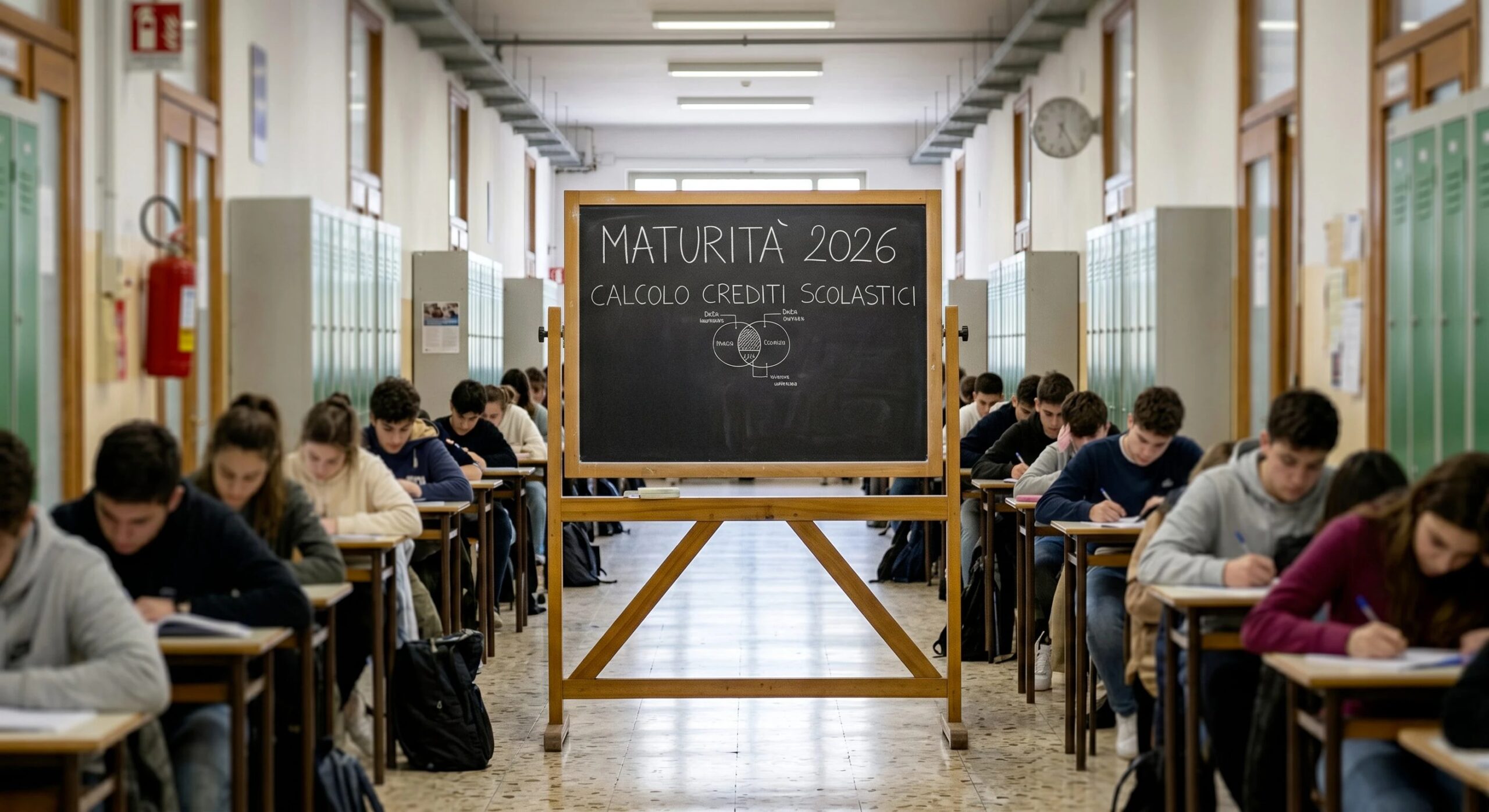
The written tests of the 2026 Maturity are about to end: high school seniors and seniors have faced the first test, the Italian theme, while the second test (which will officially end at 2.30 pm), the one dedicated to the specific subjects, ranged from Quintilian for the classification version, up to the water levels of Lake Bracciano to the scientific one.
At this point, students only need the oral interview: but how is the possible final grade calculated, based on the results of the tests? The final score is obtained from the sum of two large “blocks”: up to 40 points come from the school credit (a score gained by each student during the last three years of high school, be they high schools, technical or professional institutes), while the remaining 60 points depend on the exam tests (respectively 20 for the first test, 20 for the second test and 20 for the oral interview).
As also reported in the table below, which is based on the model attached to Legislative Decree 62/2017, high school graduates access the exam with a minimum number of credits equal to 22 and a maximum number of 40. For almost 30 years now, the final mark of the high school leaving exam is expressed in hundredths (until 1998 it was expressed in sixtieths) and, as high school graduates well know, to pass the exam it is necessary to obtain a minimum overall score of 60 cents.
How the 2026 Maturity school credits work
But, so, what are these school credits and how are they obtained? This is a score assigned by the class council during the final assessment at the end of the third, fourth and fifth year of high school.
The maximum distribution of points is progressive, as visible in this table: up to 12 points for the third year, up to 13 for the fourth year and up to 15 for the fifth year. The sum of the three annual scores therefore constitutes the overall scholastic credit with which the student appears for the exam.
On what basis are these points assigned? The mechanism depends on the average of the votes obtained in the final exam of each year. A particularly relevant element for the 2026 maturity is the role of the behavior grade. In fact, the new legislation provides that the highest score within the credit range due can only be assigned if the conduct rating is equal to or higher than 9/10.
This rule, among other things, does not only apply to the fifth year, but also to the calculation of the credit for the third and fourth years. In other words, school behavior has a direct and concrete impact on the final grade of the high school diploma.
In short, to give a concrete example: a student with an average of 7.5 in third grade, 8 in fourth grade and 8.5 in fifth grade, with a good behavior grade, could accumulate an overall credit of around 35-37 points. On the contrary, a student with lower averages (around 6-6.5) could find himself with a credit of 22-24 points.
How credits are calculated: the conversion table
As mentioned, school credits are accumulated over the last 3 years based on the average grades of all subjects at the end of the year: the table below shows the official conversion, released by the Ministry of Education and Merit, between average grades and credit ranges. The minimum is 22, the maximum is 40.
| Grade point average | Credit ranges III YEAR |
Credit ranges IV YEAR |
Credit ranges THEY GO |
|---|---|---|---|
| M < 6 | – | – | 7-8 |
| M=6 | 7-8 | 8-9 | 9-10 |
| 6 < M ≤ 7 | 8-9 | 9-10 | 10-11 |
| 7 < M ≤ 8 | 9-10 | 10-11 | 11-12 |
| 8 < M ≤ 9 | 10-11 | 11-12 | 13-14 |
| 9 < M ≤ 10 | 11-12 | 12-13 | 2-3pm |
Table created on the basis of table A attached to Legislative Decree 62 of 2017.
How much are the exams and oral exams worth: the scores for the final grade
As mentioned, the 2026 high school exam tests are three in total: two written tests and an oral interview. The commission has a maximum of 20 points for each written test and a maximum of 20 points for the oral interview, for a total of 60 points.
The first written test consists of writing a paper in Italian, with different textual typologies to choose from in the artistic, literary, philosophical, scientific, historical, social, economic and technological fields. The second written test, however, focuses on the disciplines characterizing the course of study.
The third step, the oral interview, represents one of the most important innovations of the 2026 Maturity. It takes place on four disciplines identified by the Ministry of Education and Merit and has the aim of ascertaining the achievement of the student’s educational, cultural and professional profile.
The interview begins with a brief reflection by the candidate on their scholastic and personal career, continues with questions and in-depth analysis on the four disciplines, and also includes the discussion of school-work training experiences (through a short report or a multimedia work), the verification of civic education skills and the discussion of the papers relating to the written tests.
For the evaluation of the interview, the MIM has published a ministerial evaluation grid based on four indicators, each with a maximum score of 5 points (for a total of 20 points). The four indicators are:
- The acquisition of the contents and methods of the four disciplines covered by the interview.
- The ability to use and combine the knowledge acquired, with attention to lexical mastery and technical language (even in a foreign language).
- The ability to argue critically and personally.
- The degree of personal maturation, autonomy and responsibility achieved at the end of the course of study.
For each indicator, the commission chooses which score to assign based on five different performance levels, from the lowest (0.50-1 point) to the highest (5 points).
At this point, therefore, the calculation of the grade will be purely mathematical: it will be sufficient to add the grade of the first test, the grade of the second test, that of the oral interview and the number of credits obtained during the three-year period, i.e. the last 3 years.
Be careful, however: for male and female students there is also the possibility of obtaining a bonus. The commission can in fact integrate up to a maximum of 3 additional points (until last year there were 5) provided that the candidate has obtained an overall score of at least 90 points by adding school credit and exam tests. Honors, however, can be awarded unanimously by the commission to those who reach 100 points without having benefited from the supplementary bonus, and on the condition of having obtained the maximum scholastic credit (with a unanimous vote of the class council) and the maximum score in all the tests.