For the first time in its almost 150-year history, the 2026 edition of Wimbledon, scheduled until July 12, introduces the so-called “video review”. A system that is not used to establish whether a ball is in or out, a task already entrusted to the so-called “Hawk-Eye” and not contestable, but which concerns the chair umpire’s decisions, such as double bounces or irregular shots. This is a significant change for the oldest Slam in the world which with this move aligns itself with two other major tournaments: US Open and Australian Open.
What concretely changes in the 2026 edition of Wimbledon
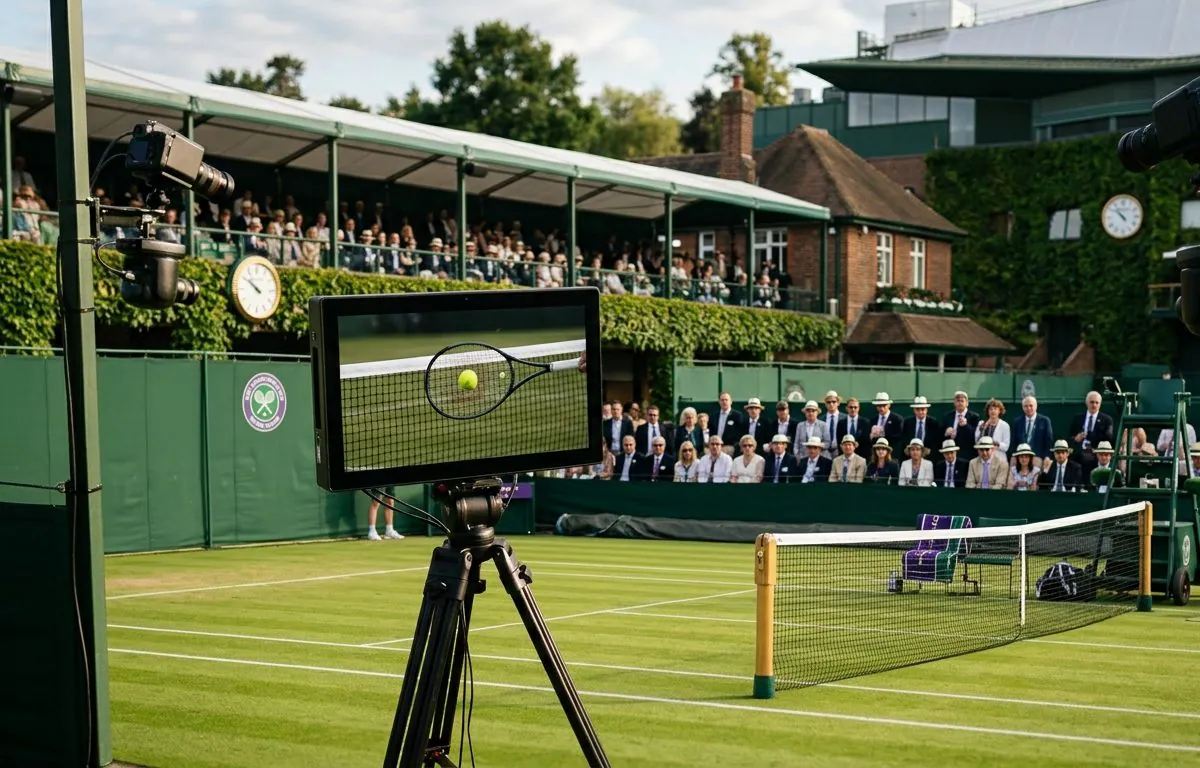
According to the official announcement from the All England Lawn Tennis and Croquet Club (AELTC), the body that organizes the Wimbledon tournament, from the 2026 edition players will be able to request video review of some decisions taken by the chair umpire. The technology will be available on six main courts: on Center Court and Court 1 for the entire duration of the tournament, while on another 4 courts only in singles matches.
An important detail distinguishes this tool from older dispute systems: the number of reviews a player can request is not limited. In the traditional “challenge”, when line calls could still be contested, each tennis player had a fixed number of incorrect attempts per set. Here, however, the constraint changes nature: you can request a review whenever you deem it appropriate, and the arbitrator will manage the procedure. Along with the video review, the AELTC also announced a public-facing enhancement: scoreboards at all courts will display a visual indicator for “out” and “fault” calls produced by the electronic system. It is a response to a concrete criticism that emerged after 2025, when the automatic announcement of calls, entrusted to recorded voices, was difficult to hear from the stands.
Because the video review is not about lines
From this year, two technologies will therefore be present at Wimbledon that answer questions of a completely different nature.
The first is the electronic line calling system, Electronic Line Calling (ELC), based on “Hawk-Eye” technology. His task is to solve an essentially geometric problem: did the point where the ball touches the field fall inside or outside the line? To respond, a series of cameras placed around the court record the ball from multiple angles and recreate the “footprint” of the bounce. Since the ball deforms on impact, the system not only records the contact, but models the crushing to estimate the effective impact area.
The video review, however, addresses the other half of the problem: not where the ball landed, but what happened in a given game interaction. Did the ball bounce twice before being hit? Did he touch a player’s body or racket? Was the shot legal? Did a movement disturb the opponent? These are questions that are not reduced to a single coordinate on the ground: they concern sequences of events, contact between objects and, in some cases, the effect of an action on another player. For this reason they are not delegated to an algorithm but remain in the hands of the referee, who now has the possibility of reviewing the action on replay from multiple angles.
What can be reviewed with video review: the technology behind it
The situations that the chair umpire will be able to review belong to four main families: double bounces, unauthorized touches (such as those in which the ball touches the player’s body or the player touches the net), irregular shots, and finally disruptive actions, those of a player who hinders or distracts the opponent during the rally. This last category is also the most delicate, because it involves a very subjective evaluation that can easily give rise to complaints and controversies both among players and the public. In any case, the video review, unlike the electronic call of the lines, does not produce an automatic verdict: the technology provides the images, but the final decision remains with the chair judge. In this sense the video review is more similar to the VAR of football than the system that calls the lines, where instead it is the machine that decides.
Why only now? Wimbledon: from the “moviola” of 2007 to the farewell to the line judges
The arrival of the video review is the last step in an almost twenty year long journey. Wimbledon had introduced Hawk-Eye technology already in 2007, but in a limited form: it was used by players to contest a limited number of calls, while still leaving the line judges on the field. The turning point came in 2025, when the tournament adopted electronic line calling on all courts, retiring a figure who had been with the tournament for almost 150 years. Once the human eye was removed from the lines, what remained uncovered was the whole other set of “judgmental” decisions that the machine is not capable of making, which the new video review aims to fill thanks to the feedback collected after the introduction of the ELC last year. It’s also a way for Wimbledon to catch up with other major tournaments, where video review has been a reality for a few seasons.