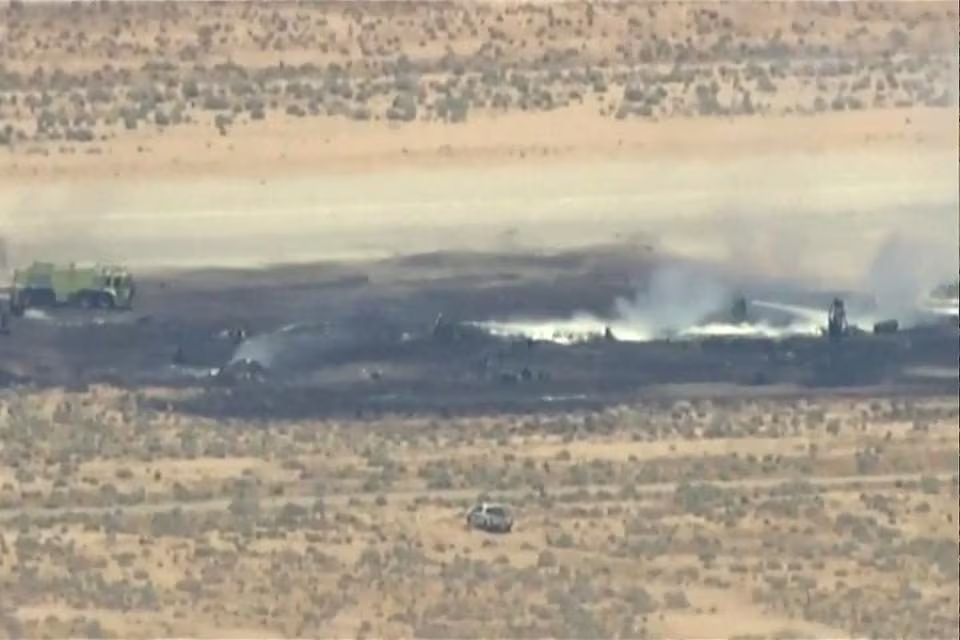
A US Air Force B-52 Stratofortress bomber crashed shortly after takeoff from Edwards base, north-east of Los Angeles (in southern California): the accident, which occurred yesterday 15 June, occurred while the aircraft was probably engaged in a test mission linked to the modernization of the on-board radar.
There were eight people on board, a mixed crew made up of active duty soldiers and government employees: unfortunately all occupants lost their lives. This is the most serious crash involving a B-52 bomber since 1982.
What do we know about the possible dynamics of the accident
As reported by Reuters, the crash occurred around 11.20am (local time, 8.20pm in Italy) at Edwards Air Force Base, located in the Mojave Desert, north-east of Los Angeles. The B-52 would have been engaged in a routine test mission linked to the on-board radar modernization program, when something went wrong immediately after takeoff. There were eight people on board: a mixed crew of active duty military and government employees.
Colonel James Hayes, deputy commander of the 412th Test Wing (the unit responsible for the test flights at the base), confirmed at a press conference that the accident was deemed “non-survivable” based on available images. Aerial footage of the site shows a huge column of black smoke rising over the runway, with very few discernible remains of the aircraft. Boeing confirmed that two of its employees were among those on board.
The causes of the crash remain unknown at the moment. The investigation, according to military authorities, could take up to six months. Immediately after the accident the base closed the runway, diverting all incoming flights and suspending operations for the following day. This is the deadliest accident involving a B-52 since 1982, when a bomber of the same type crashed at Mather Air Force Base, near Sacramento (also in California), causing the death of all nine crew members.
The B-52 Stratofortress: the technical characteristics of the aircraft in service after 60 years
But what are the technical characteristics of the Boeing B-52H Stratofortress? It is a long-range strategic bomber, 49 meters long with a wingspan of over 56 meters and a maximum take-off weight of 220 tonnes. To give you an idea, it is approximately as long as a 16-story building placed horizontally.
Powering it are eight Pratt & Whitney TF33 turbofan engines, which allow it to reach a maximum speed of approximately 1,000 km/h at high altitude and to fly above 15,000 meters altitude. Its operational range exceeds 5,000 km with on-board armament and can reach approximately 15,000 km in transfer missions (without war load).
The overall load capacity exceeds 30 tons, including conventional bombs, cruise missiles and nuclear weapons. The standard crew is generally made up of five people (pilot, co-pilot, electronic warfare officer, navigator and radar operator), but in test flights it is frequent to have additional engineers and technicians on board to monitor the functioning of the new systems.
The B-52 has been in service with the US Air Force since the 1950s and the H version, the only one still operational, has been flying since 1961. There are currently 76 examples left in the Air Force inventory. Despite its age, the US Air Force does not appear to have any intention of withdrawing it from service: on the contrary, it plans to keep it operational until at least 2050 thanks to an extensive modernization program, which includes the replacement of the current engines with new Rolls-Royce F130s and the installation of a new generation radar. From the first information available, it would seem that the crashed aircraft was carrying out one of these modernization tests.
Not surprisingly, in January 2026 the Air Force awarded Boeing a contract worth approximately 2 billion dollars to modify and test the first two B-52s equipped with the new engines.