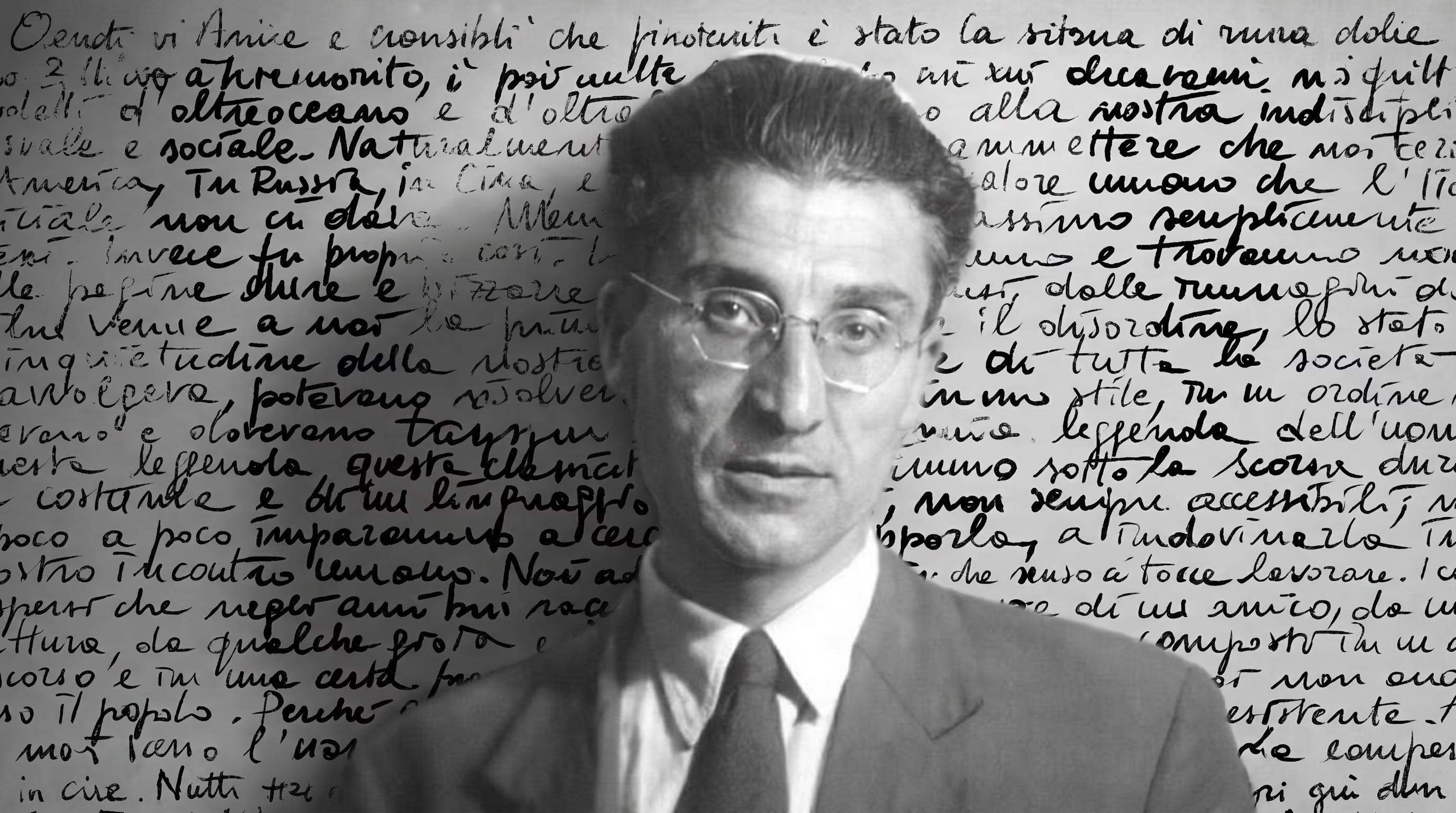
Among the great protagonists of the first 2026 Maturità test is Cesare Pavese, one of the most beloved and tormented Italian writers of the twentieth century. He is the author of the track dedicated to the analysis of the text, with his poetry I will pass through Piazza di Spagnacontained in the collection Death will come and will have your eyes, published posthumously in 1951 by Einaudi.
Writer, poet, translator and literary critic, born on 9 September 1908 in Santo Stefano Belbo in the province of Cuneo and died in Turin on 27 August 1950, Pavese was animated by a fervent civil and anti-fascist commitment, marked by tragic loves and an indomitable inner restlessness, he left us masterpieces such as The moon and the bonfires and one of the most intense and dramatic human parables of our literature, which ended with the extreme choice to take his own life in 1950, at just 42 years old.
Who was Cesare Pavese: childhood in the Langhe and the discovery of literature
Cesare Pavese was born on September 9, 1908 in Santo Stefano Belbo, a small town immersed in the Piedmontese Langhe in the province of Cuneo. Coming from a lower middle class family, his childhood in rural Piedmont, an ecosystem permeated by poverty and sweat, was marked by early mourning: he lost his father at just six years old and was raised with great severity by his mother.
The family soon moved to Turin, where Pavese attended the famous “Massimo D’Azeglio” classical high school. Right among those benches he had an encounter that changed his life: the one with Augusto Montia profoundly anti-fascist professor who guided him in his studies, introducing him to literature and civil commitment.
In 1930, Pavese graduated in Literature with a thesis, “Interpretation of the poetry of Walt Whitman” on the then controversial American poet: it was the first sign of a visceral love for American literature, which culminated a few years later. Starting from the 1930s, he formed a fundamental partnership with Giulio Einaudi and Leone Ginzburg. He thus became a cornerstone of the nascent one Einaudi publishing houseediting dozens of series and becoming a true beacon for the culture of the time.
America in Italy: Pavese translator and the Einaudi workshop
In the years in which Italy was suffocated by the cultural closure and autarchic ideology of the fascist regime, Pavese had a historical merit: he made Italians discover literary America. Through his translations he brought ideals of freedom and a raw, authentic and reality-filled language to the country. He worked on authors such as Sinclair Lewis, Sherwood Anderson, John Dos Passos and John Steinbeck.
His titanic undertaking in translating remains memorable “Moby Dick” by Herman Melvillea work for which he even asked for consultancy overseas in order to render the original nautical jargon to perfection. Pavese was 24 years old at the time and had never seen the ocean, nor the United States, nor had he ever set foot on a ship. Yet he “embarked” on the undertaking, despite the very complex nautical jargon contained within it, the scientific and anatomical terms relating to sperm whales and the slang of American whalers. He sent many letters overseas, asking academics and contacts in the United States to have them explain the exact functioning of fishing gear and the structure of nineteenth-century sailing ships. The translation was published in Italy in 1932 by the publisher Frassinelli, shaking the cultural panorama of the time.
Anti-fascism for love and confinement in Calabria
Pavese did not consider himself an “active fighter”, but in May 1935 he was arrested by the fascist police for his contacts with the clandestine group “Giustizia e Libertà”. In reality, the trigger was a gesture of love: he took responsibility for some compromising letters found in his home, which actually belonged to the woman he was in love with, the communist militant Tina Pizzardo.
Condemned by the regime, he spent seven months I am confined to Brancaleone Calabro. It was a very hard but crucial experience. In fact, it was there that he began to write his diary, intimate and tormented, The craft of living (which will accompany him until the end), and collected the ideas for the novel The prison. The return to Turin in 1936 turned out to be less happy than expected: he discovered that Tina Pizzardo was now close to marrying another man.
“The moon and the bonfires”, the masterpiece of Neorealism and other works
Pavese’s entire literary production is crossed by a constant rift: the contrast between the countrysideseen as a place of myth, childhood and nature, and the city, a place of alienation and pretense, combined with a profound sense of social inadequacy.
In 1936 he published the poetic collection Working is tiringwhich revolutionized Italian poetry by introducing the concept of “narrative verse”. In the 1940s he became one of the most recognizable voices of Neorealism, publishing works such as Your countries, The house on the hillae Among single women. In his last years he took refuge in the study of ethnology and Greek mythology, giving birth to a work very dear to him, the Dialogues with Leucò (1947).
His journey culminated in 1950 with the very famous The moon and the bonfiresthe novel that narrates the painful return of the orphan “Anguilla” from America to the Langhe, only to discover that the civil war has destroyed his world, transforming peasant bonfires into instruments of death and tragedy. Here Pavese talks to us about the illusion of being able to return home, where home no longer exists, because everything is devoured by time.
In June 1950, Pavese reached the pinnacle of success by winning the Witch Award with the novel The beautiful summer. Yet, professional goals failed to fill the emptiness and chronic loneliness that devoured him. During his last months of life he met the American actress Constance Dowling developing an overwhelming unrequited passion for her. He dedicated his last poignant poems to her, later collected in the posthumous volume Death will come and will have your eyeswhich also includes poetry I will pass through Piazza di Spagna, released among the tracks of the first test of the 2026 Maturity.
When the actress returned to America to pursue her career and another man, Pavese sank into a depression of no return. No The craft of living he had lucidly theorized that one does not kill oneself specifically for a woman, but because a failed love reveals «in our nakedness, misery, helplessness… destiny, death». In the night between 26 and 27 August 1950in room 346 of the Hotel Roma in Turin, Cesare Pavese ended his life by ingesting a massive dose of sleeping pills. On the nightstand, right on the first page of a copy of his Dialogues with Leucòleft his last message: «I forgive everyone and I ask everyone for forgiveness. All right? Don’t gossip too much.”
The track of the poem “I will pass through Piazza di Spagna” at the 2026 Maturity
For the analysis of the text of the first exam of the 2026 Maturity, his poem dedicated to the never reciprocated love for the American actress Constance Dowling was chosen. It had been 25 years since Pavese graduated from high school: the last time was in 2001 with a prose text taken from The moon and the bonfires.
The MIM asked the graduates to analyze and interpret the lyric text, in which to present a summary of the poem, analyze the author’s expressive choices, between lexicon and verb tenses, and the atmosphere. Furthermore, students will have to make a comparison with other compositions by the same or different authors, developing a personal reflection on the text.
Below, the text of the poem, contained in the posthumous volume Death will come and will have your eyes.
It will be a clear sky.
The roads will open
on the hill of pines and stone.
The tumult of the streets
that still air will not change.
The sprayed flowers
of colors at the fountains
they will stare like women
have fun. The stairs
the terraces the swallows
they will sing in the sun.
That road will open,
the stones will sing,
the heart will beat and jump
like water in fountains –
this will be the voice
who will climb your stairs.
The windows will know
the smell of stone and air
morning. A door will open.
The tumult of the streets
it will be the tumult of the heart
in the lost light.
It will be you – firm and clear.