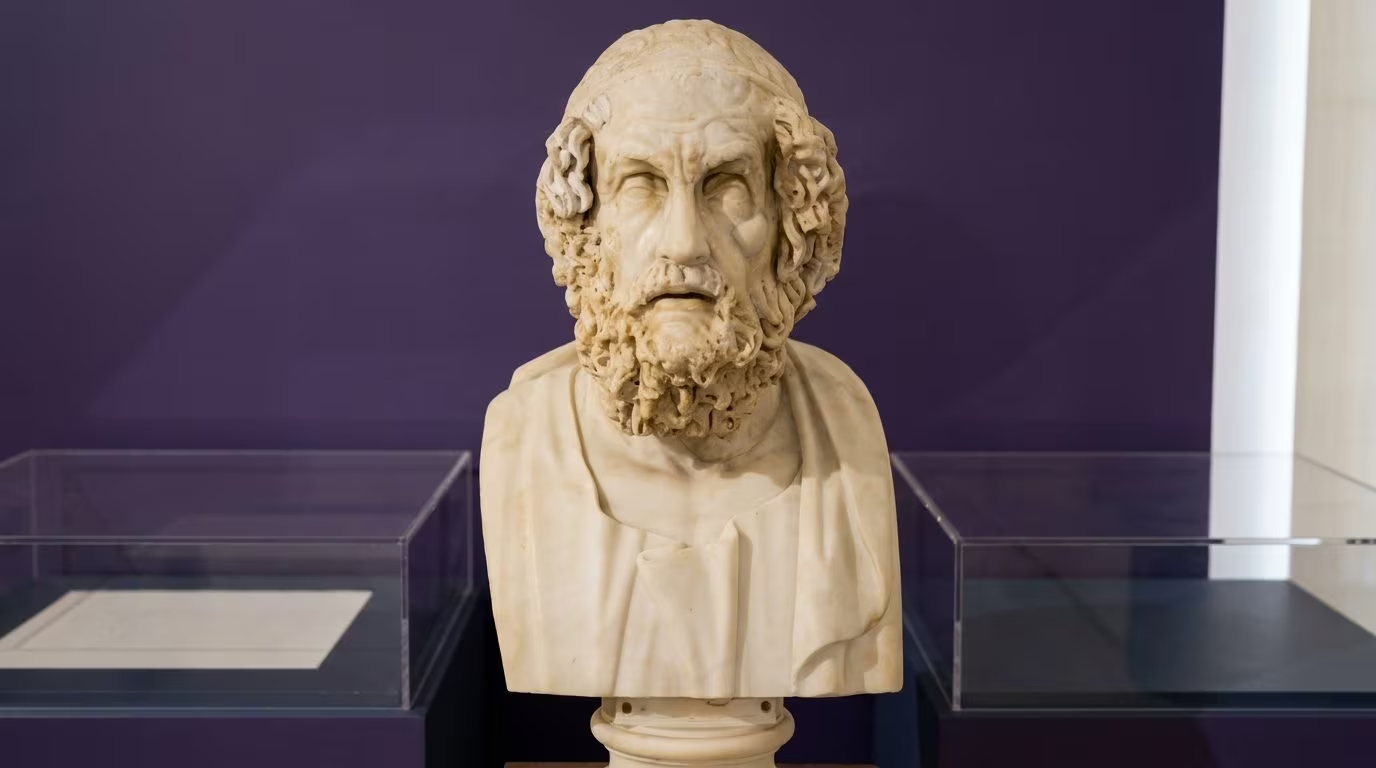
Homer it probably was a Greek singer and poetwho lived approximately between the 11th and 8th centuries BC, to whom the authorship of the poems is historically attributed Iliad And Odyssey. Tradition has it that Homer was blind, an image fueled by the ancients who saw blindness as the symbol of profound wisdom.
In reality, however, about his life and the composition of the two works there are no historical certaintieswhich is why the so-called “Homeric question”, the set of historical and philological studies that seek to shed light both on the existence of Homer and on the authorship of the works attributed to him.
To date, the commonly accepted hypothesis is that the two poems are the result of the stratification and contamination of many songs spread by the bards, professional singers, and that Homer, whose existence cannot be confirmed, is the figure who historically gave them the form we know.
The possible origins of Homer and the hypothesis of blindness
According to tradition, Homer was a Greek singer lived approximately in mid-8th century BC., although some scholars place it in an even earlier period, in the 11th century BC
The name Homer may have come from the terms ὁ μὴ ὁρῶν (I have mè horôn) “he who does not see”: hence the hypothesis that Homer was blind, disputed by several scholars who state that the singer’s spirit of observation was too high.
Not even his hometown is certain, in fact seven Greek cities compete for this title: AthensIzmir, Chios – where the cult of Homer is very strong, in fact a school of official Homeric singers was founded here – Colophon, Ithaca, Pylos and Argos.
Nothing is known about his life either, but it is certain that whoever he was, he traveled to many places in Greece and was a great expert on the specific local traditions of various Greek cities. To explain the great movements, some theories say he was an orphan entrusted to a merchant or traveler himself.
His constant travel, meeting sovereigns and powerful people, associating with soldiers, officials, religious people, but also being among the people and common people, allowed him to connect with the stories he toldwhich at the time were passed down orally.
Homer’s works: Iliad, Odyssey and the Homeric Hymns
Since the two epic masterpieces were originally born from a long tradition of oral transmission, scholars and philologists have been questioning the actual existence of a single author for centuries. It is debated whether behind the name “Homer” lies a single individual who unified and wrote down the traditional songs, or whether the poems are the collective fruit of poets of different generations. In any case, let’s see in detail which works are traditionally attributed to him.
Among the works officially attributed to Homer is theIliad – or, “the story of Ilium”, the name by which Troy was called in Greek – history of the last 51 days of the last year, the tenth, of the Trojan War, which broke out because the Trojan Paris kidnapped Helen, queen of Sparta.
They are on the battlefield the Greeks, the Achaeans – including the heroes Achilles, Agamemnon, Ulysses, Patroclus, Telamonian Ajax – against the Trojans – including Paris, King Priam, Hector and Aeneas. The war is won by the Greeks thanks to the stratagem of Trojan Horsecreated by Ulysses.
The other poem that bears Homer’s signature isOdysseyhistory of ten years of Ulysses’ journey homethe Greek island Ithacaafter the end of the war. Ulysses will have to overcome numerous adversities and vicissitudes: he will face gods, humans and mythological creatures by playing with cunning, before being able to reunite with his wife Penelope and his son Telemachus.
The Homeric hymnsthe33 poems in metric dedicated to the main Greek deities, were not actually written by Homer, but are so called because they were written in the same dialect used inIliad and in theOdyssey.
From the first references by the historian Thucydides, the Homeric hymns they have been attributed to the singer and have traditionally always been reported with his signature.
In the’Homeric hymn dedicated to Apollo, there is a reference to both Homer’s blindnessthan to his hometownin this case considered Chios.
“O maidens, who is the sweetest among the barns for you? who are wont to come here, and who is the most welcome?” And you will all answer: “He is a blind man, and he lives in rocky Chios: all his songs will forever be the most beautiful” (Hymn to Apollo, vv. 169-173).
The “Homeric question”: did Homer really write the Iliad and the Odyssey?
Given the numerous uncertainties about figure of Homer and the total absence of historical sources that allow us to reconstruct his life, the so-called “Homeric question” was raised right from the first transcriptions of the poem.
The question we ask ourselves is: Iliad And Odyssey they are truly works of a single poet or are the result of different contaminations and stratifications of songs passed down orally, as was usual in that historical period?
One of the main points of debate is the stylistic difference between the two works: the first scholars of Homer put forward the hypothesis that the singer had composed theIliad when younger and theOdyssey as older, therefore attributing both works to him. Other scholars put forward the hypothesis that there had been two different poets, one of whom, Homer, was behind the composition.
In the 1795the German philologist Friedrich August Wolf further ignited the debate on the issue, putting forward the hypothesis that the Homeric poems were nothing other than collections of songs handed down by singers which, at a certain point, were transcribed in unitary form.
Today the prevailing idea is that the composition of poems is the final culmination of a long oral tradition of the highest qualityto which it is possible that various figures contributed, including Homer (whether or not he actually existed) he is the historically accredited figure for the composition of the two poems in the form in which they have been handed down to us.