If you usually use a smartphone charging boost using a power bank, you will probably have asked yourself at least once: do power banks damage your phone’s battery? The answer depends on multiple factors. In general, power banks do not damage the smartphone battery if we use them correctly, if they are of good quality and are not defective. The central point, however, is not the powerbank itself, but how it is designed, combined and used: there are many factors that can lead to the battery heating up or its performance deteriorating. Phone batteries are now all lithium ion, an efficient technology but sensitive to three key factors: number of charging cycles, heat and quality of the input energy. Each complete charge contributes, in a minimal part, to the chemical aging of the battery; high temperatures accelerate this process; an unstable voltage or current adds additional stress.
So, when we hear that “the powerbank ruined the battery”, by investigating the usage habits of those who make a similar statement we are likely to come across critical issues related to cheap external batteries, poor cables or incorrect usage habits (or a combination of all these factors). Fast charging also falls into this picture: it works and is safe, but it produces more heat and should be used sparingly. And then there is the issue of charging pass-throughthat is, the possibility of charging a power bank and phone at the same time from the same socket: a useful function, of course, but not always supported and not entirely without compromises. Understanding how these mechanisms work allows us to use power banks for what they really are: a practical and generally safe energy reserve, to be used especially when you don’t have access to a power outlet.
How a powerbank works and the risks of low quality
Let’s start from the basics. Power banks are essentially external lithium ion batteries. Lithium ion cells do not suffer from the so-called “memory effect”, but they age with use, as a certain amount of charge cycles accumulate. By charging cycle we mean the process of total discharge (from 100% to 0%) and subsequent recharging (from 0% to 100%), even if this process is distributed over multiple discharges and partial recharges. Just to be clear, discharging 50% of the battery on two different days and recharging it counts as a single complete cycle.
The number one enemy of lithium ion batteries is heat, which acts as a real accelerator of their degradation: the hotter a battery, the faster it loses its ability to retain energy. This is why the quality of nutrition is crucial. A well-designed power bank provides regulated voltage and integrates protections against overcharging, overheating and short circuits. In these cases, the phone “sees” the powerbank as a stable energy source, no different from a good wall charger.
The real problems emerge when we drop in quality. Counterfeit power banks can use cheap cells and sloppy regulation circuitry, with unstable voltages that increase heat. The quality of the cables also matters: a low-quality cable introduces electrical resistance, which results in energy loss in the form of heat.
The possible problems of pass-through
Pass-through charging deserves a separate chapter. This term indicates the possibility of charging the powerbank while, at the same time, using it to power the phone. It is not an always present function: a dedicated control chip is needed that manages the energy flows, allowing the current coming from the socket to “bypass” the internal battery and reach the smartphone directly, avoiding reverse currents and overheating. If the powerbank doesn’t explicitly support this mode, plugging everything together means forcing the internal battery to charge and discharge at the same time, a condition that generates heat and stress. And we said that heat is the number one enemy for lithium-ion batteries. For this reason, many models automatically deactivate the output when they are charging, or vice versa.
Even when pass-through is present, there are tradeoffs. The incoming energy is “portioned”, a part is given to the powerbank, another part to the battery integrated in the smartphone. The result? Both the phone and the power bank charge more slowly. Furthermore, simultaneous absorption increases the internal temperature, and the heat, once again, reduces the life of the cells. Frequent use of this function can lead to faster aging of the powerbank itself.
How to properly charge your smartphone with a powerbank
Given that a quality powerbank (associated with the use of quality cables) is not at all an enemy for the battery integrated into the smartphone, let’s look at some good usage practices to correctly charge the smartphone with a powerbank. In this way, both the life cycle of the powerbank and that of the smartphone will benefit.
- Use pass-through sparingly: in general, it is much better not to use your smartphone when it is charging, regardless of whether it is charging via the wall adapter or via a power bank.
- Use only suitable, quality power banks: poor-quality and non-certified products are unreliable, if not potentially dangerous.
- Avoid questionable charging practices: it is better not to charge devices piled together or place them on surfaces that retain heat.
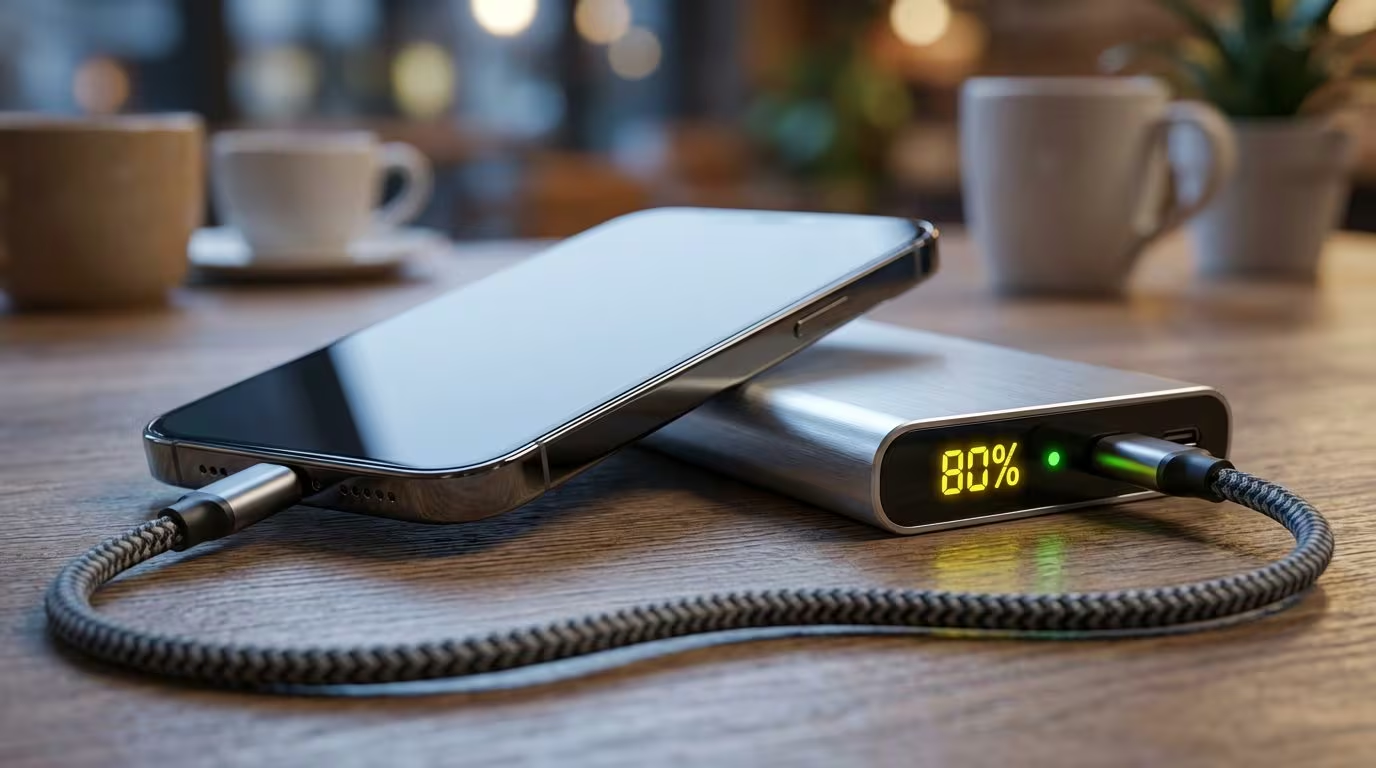
- Adopt the 20-80 rule: to prolong the useful life of the powerbank, it would be better to keep its charge in the 20-80% range.
- Store the powerbank partially charged: if you expect a long period of non-use, it is better to store the powerbank half charged (and not fully charged or totally empty), placing it in a cool, dry place.