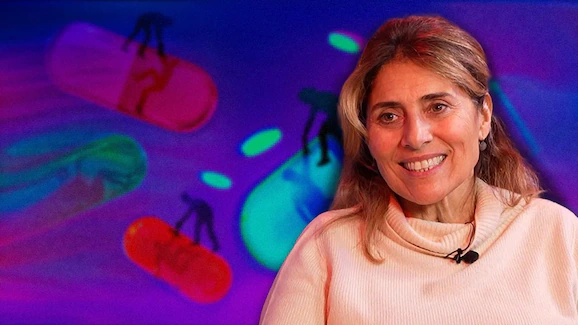
In the second season of Toxic, the Geopop series that this year gives voice to those who have lived alongside someone with an addiction, we meet Giorgia, 22 years old, from Veneto, now living in Sweden. His story shows us with rare clarity how a parent’s alcohol addiction can shape a child’s entire childhood and adolescence: behaviors, dreams, relationships, even the relationship with one’s own body.
Giorgia was born in Montebelluna, in the province of Treviso. His mother, very young at the time of his birth, has always struggled with a serious addiction to alcohol. For Giorgia, that wasn’t an emergency: it was normality. As a child she prepared her own food, learned to recognize by people’s looks if they had been drinking, called her relatives when she couldn’t wake her mother. At six years old he already had a cell phone, a Nokia, to be able to call for help. At seven years old, after a particularly serious episode, her mother entered the community and Giorgia went to live with her grandparents. From that period onwards she carried with her a chronic sense of loneliness and, with today’s eyes, she recognized in those years the first signs of a depression that no one around her knew how to read.
The mother leaves the community before completing the journey, bringing with her a new companion she met there. For Giorgia it is a contradictory moment: she is happy to have her mother back, and sees her lucid for the first time. But something creaks immediately. At London airport, during their first family trip, the two order a beer. Giorgia is nine years old and already instinctively associates that gesture with something dangerous. Over time he understands that the situation is repeating itself: the bottles hidden under the frozen food at the grocery store, the unmistakable noise of a glass bottle opening at night, the arguments, the disorder, the fear that his telescope (symbol of his dream of studying astronomy) would be broken during a crisis.
It was in middle school that Giorgia began to feel more visibly ill. He asks for help at the school’s psychological desk, writing an anonymous letter in the red box. For a while he missed an hour of class every two weeks to talk to the psychologist. Talk about alcohol problems at home. But the social workers will never arrive. «I asked for help many, many times», says Giorgia, «and no one came». It is one of the wounds he still carries with him: not the absence of good will of the people he met, but the lack of tools and clear protocols to translate that good will into concrete action.
In the meantime, he develops self-harming behavior, which he continues for a few years in silence, and goes through periods in which he feels that his life is meaningless. No one around her can really intercept what she is experiencing. He changes school, gives up his dream of studying chemistry to get closer to astronomy, and brings with him concentration difficulties which he interprets as his limitations. Only later will she understand that they were the symptoms of the chronic stress in which she was immersed.
The turning point comes when his mother becomes pregnant: that’s when he stops drinking. «He had a greater motivation than her», says Giorgia. At 19, Giorgia leaves home as soon as she can. She moves into a shared apartment, then to her husband, and undertakes a course of psychotherapy chosen by her, for herself. It is there that he begins to give a name to what he has experienced: the panic attacks, the need for control, the difficulty in staying in certain social environments where there is alcohol. “I still don’t go into a bar alone today,” she says.
Today she lives in Malmö, Sweden, with her husband. She studied 2D animation and stop motion, works as a pizza chef, watches documentaries on astronomy and thinks about building something together with her husband, also an illustrator. Sweden gives her what she was looking for: a place that sees her for who she is, not what she looks like.
The message he would like to say to middle school Giorgia is only one:
«It’s not your fault. And there is no need to give up your dreams to live a peaceful and dignified life.”