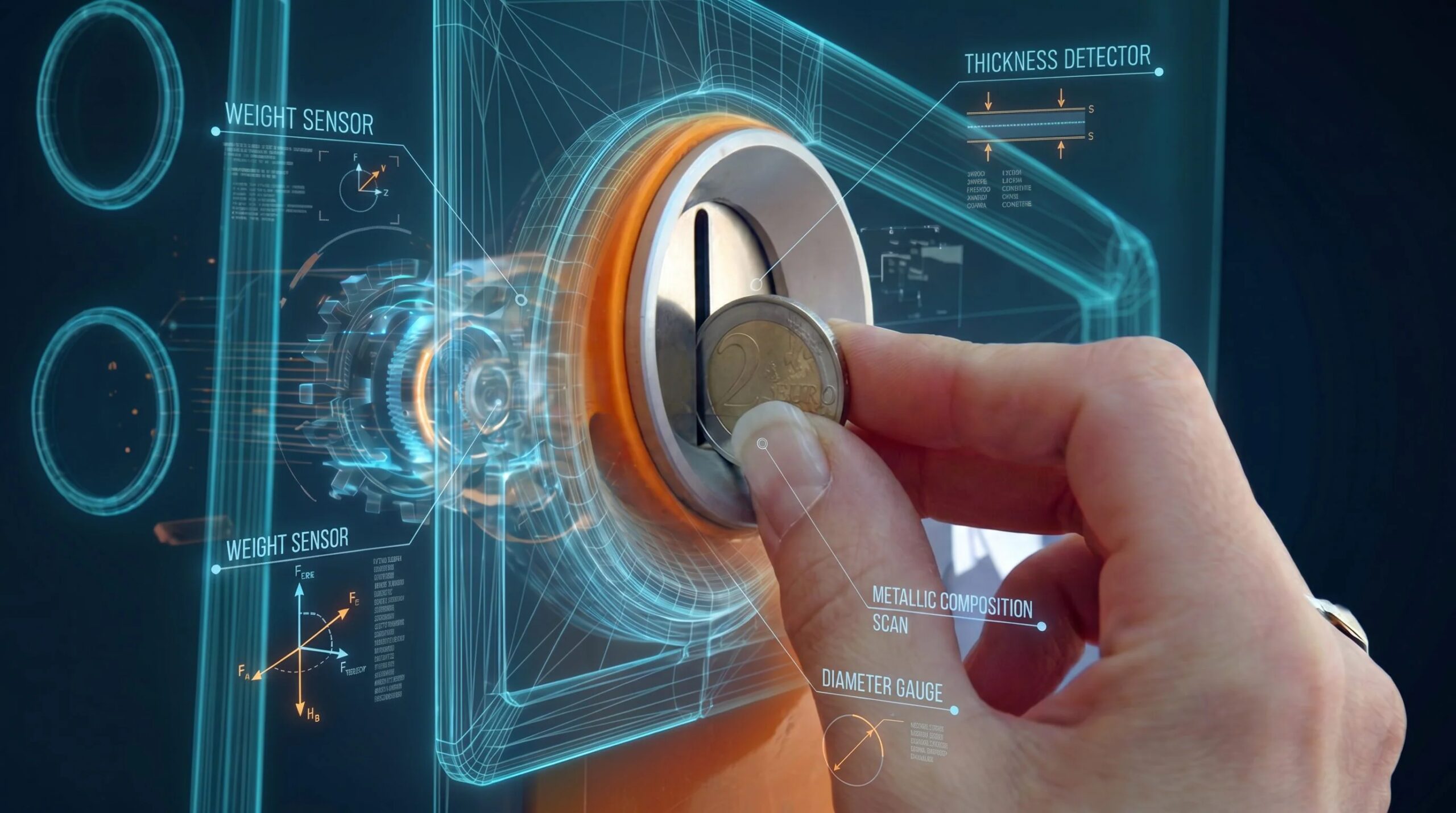
Insert the coin into the slot, hear the metallic sound which confirms that it has fallen into the machine and the accumulated credit appears on the display, ready to be spent to purchase a tasty snack. But how did the vending machine “understand” that the one inserted was not a fake coin? Thanks to a combination of physical, electronic and magnetic controls which, in a few moments, measure the diameter, thickness, weight and metallic composition of the coin, comparing these parameters with those stored in the internal software. Let’s delve into the mechanism that allows distributors to recognize counterfeit coins in detail.
Vending machines use infrared optical sensors, inductive coils, electromagnetic systems and, in the most advanced models, optical scanners and acoustic analysis. Every authentic coin has some sort of physical and electromagnetic “imprint”: the way it reflects light, reacts to a magnetic field or produces a sound against a metal surface is distinctive and difficult to replicate. If even just one parameter deviates from the expected tolerances, i.e. from the error limits considered acceptable by the system, the coin is diverted towards the rejection channel and returned to the user.
In more sophisticated dispensers, the data collected by all sensors is jointly processed by algorithms that fuse the information and produce the final decision. This process must be rapid but reliable: too strict checks would produce a high number of “false positives”, thus risking rejecting worn or dirty authentic coins. This is why validators are designed to work with great precision and must be cleaned regularly, as dust, grease and humidity can alter sensor readings.
Behind the simple slot into which we insert the coins lies a validation system that is much more sophisticated than it might seem. The first check occurs almost immediately: an optical sensor or a microswitch – a small mechanical switch – detects the coin’s entry and starts the analysis cycle. From that moment, the money travels an internal trajectory along which it encounters various verification points.
The first involves measuring size and mass. The coins are produced to extremely precise specifications and minimal differences in diameter or thickness can indicate a fake. Infrared sensors measure the diameter, while other devices monitor the thickness. In some cases the weight is not detected directly, but estimated through the behavior of the coin during the fall or transit in the internal channels. If the values do not fall within the set tolerances, the validator stops the process and returns the coin.
Once this first filter has been overcome, electromagnetic reading comes into play, one of the most effective systems against counterfeiting. The coin passes through a magnetic field generated by inductive coils: electrical components capable of creating a magnetic field when current passes through them. Each metal alloy reacts differently to this field, modifying its intensity and phase. The machine thus analyzes the so-called “electromagnetic signature”, i.e. the characteristic behavior produced by the metal of the coin. An authentic 2 euro coin, for example, generates a very different response than a token or a copy made from low-quality materials.
In more advanced systems, capacitive sensors are also used. Electrical capacity is the property of a material to accumulate electric charge: when the coin passes near the sensor, it alters its value differently depending on the surface and its metallic composition. Capacitive control is often combined with other systems to increase the overall reliability of recognition.
Some validators also use high-resolution optical scanners. Miniaturized cameras capture images of the coin and compare them with the details, engravings and surface patterns stored in the internal database. This allows us to identify very accurate fakes, capable of passing dimensional and electromagnetic tests. In the most advanced models, even multispectral imaging is possible, a technique that analyzes the coin using different wavelengths of light, from ultraviolet to infrared, to highlight anomalies invisible to the human eye.
There is also still experimental technology based on sound analysis. When the coin hits an internal metal ramp it produces a specific vibration: a microphone records the signal and the software studies the acoustic spectrum, i.e. the distribution of sound frequencies. Density and metallic composition influence the noise produced by the impact, generating a further identifying signature.
All this data, collected in a very short time, is processed jointly by the distributor’s central unit. The algorithm constructs a feature vector – a numerical set representing parameters such as size, magnetic response, optical patterns and acoustic signals – and compares it to the profile of the expected coin. If the values match, a small engine diverts the money to the internal collector; otherwise it directs it to the rejection channel.
Despite their technological sophistication, these systems are not infallible. Genuine but very worn, dirty or deformed coins can be rejected by mistake, just as variations in temperature, humidity or dust accumulations can alter sensor readings. For this reason, validators must be cleaned periodically and updated against new forgery techniques. Some recent models can even be “trained” to recognize new coins or tokens via software updates.