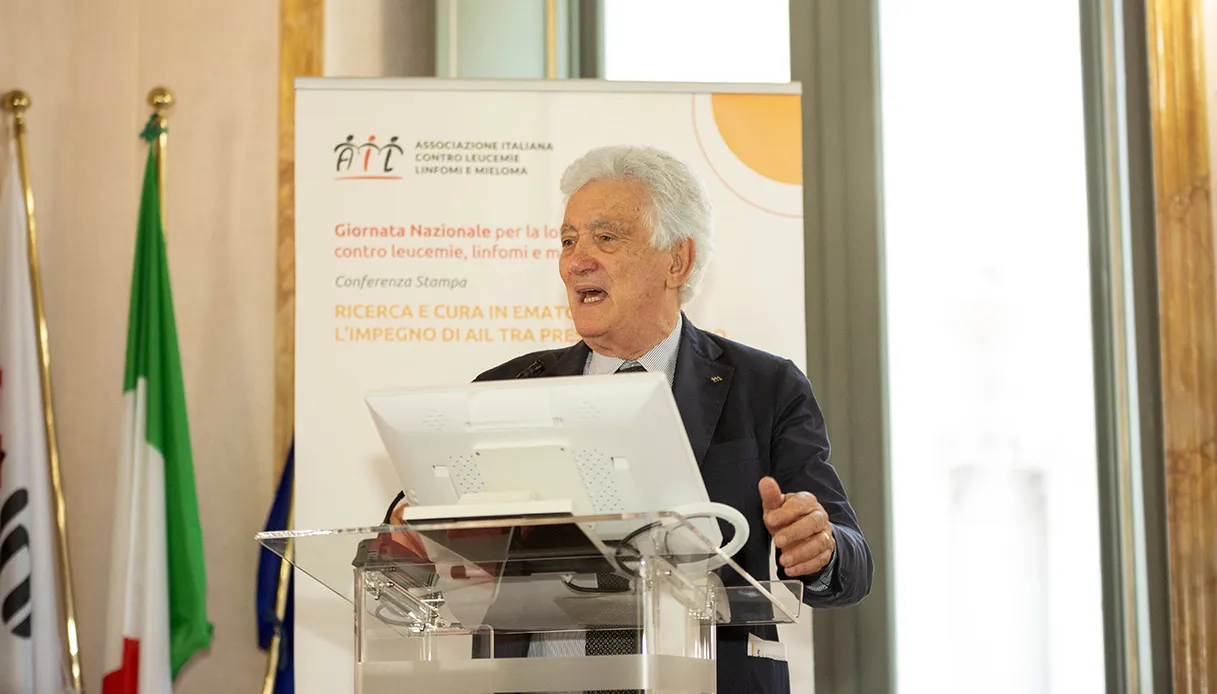
AIL, the Italian Association against Leukemia – Lymphoma and Myeloma, on the occasion of the National Day dedicated to these pathologies, renews a long-awaited and consolidated appointment for patients and families.
The AIL Haematological Problems Toll-Free Number 800 22 65 24 will be active on Sunday 21 June from 8am to 8pm. The free service allows patients to speak directly with expert haematologists, receive clarifications on their pathologies and ongoing therapies, in total confidentiality and without the time limitations that they often have with the haematologists who usually follow them. There will be more than 40 hematologists available, a large number of specialists to guarantee even broader, timely and personalized support.
AIL’s commitment
Every year in Italy approximately 30 thousand new hematological neoplasms are diagnosed, of which over 2,100 concern children and adolescents. Today there are around 500 thousand people living with blood cancer, but thanks to the progress of scientific research the scenario has changed profoundly: innovative therapies such as immunotherapy and hematopoietic stem cell transplants have increased the chances of recovery and allow a growing number of patients to live with the disease for a long time while maintaining a good quality of life. In several cases, the life expectancy of people suffering from a haematological disease is increasingly approaching that of the general population.
A result that demonstrates the value of Scientific Research and collaboration between patient associations, scientific societies, institutions and the medical-scientific community, committed daily to the development of increasingly effective and accessible treatments. AIL – Italian Association against Leukemia, Lymphoma and Myeloma – has been alongside patients and their families for almost 60 years, supporting Scientific Research and concretely contributing to the improvement of hematological care in our country.
Over the years, AIL has invested more and more funds to finance independent scientific research: in 2025, AIL financed 206 research projects on leukemia, lymphoma, myeloma and other blood diseases, supporting innovative studies aimed at understanding the mechanisms underlying the pathologies, promoting increasingly earlier diagnoses and developing new therapeutic strategies.
The Association has also expanded its commitment by identifying and supporting important research projects led by the most authoritative Italian hematologists, many of whom were present at the press conference dedicated to the National Day, and by GIMEMA, an essential point of reference for independent research and a place in which hematologists elaborate and develop research protocols in various pathologies. The Association’s commitment also translates well into the support of 111 Hematology and Stem Cell Transplant Centers distributed throughout the country, through the financing of healthcare personnel, equipment, drugs, clinics and dedicated departments.
Present and future of transplants and CAR-T
In Italy, in 2025, 5,259 transplants and 750 CAR-T were performed in hematology.
“As regards autologous transplants in our country, there is a trend towards reduction, especially in the treatment of lymphomas, of over 30% compared to five years ago. This decline is due to an ever-increasing use of CAR-T therapy”
informs Massimo Martino, President of GITMO, Director of the single regional center for HSC transplants and cellular therapies, Grande Metropolitano Hospital of Reggio Calabria.
The positive aspect to underline is that the use of this approach in patients over 60 and 70 years of age is increasing. Multiple myeloma is the pathology most treated with autologous transplantation and represents 63% of procedures. In contrast to autologous, the number of allogeneic transplants is constantly growing. In 2025, 2,152 transplants were carried out in Italy, with an increase of over 7% compared to two years before.
The main pathologies are acute myeloid leukemia, followed by lymphoblastic leukemia, but its use is also growing for myelodysplasia and myelofibrosis.
CAR-T therapies are redefining the treatment paradigm for numerous hematological tumors, not only for the results obtained in patients with refractory or resistant disease, but also for the new prospects for use in the earliest stages.
“CAR-T cells represent one of the most advanced frontiers of immunotherapy”
explains Franco Locatelli, Director of the Clinical Area of Pediatric Onco-Hematology, Cellular Therapy, Gene Therapies and Hematopoietic Transplant, Bambino Gesù Pediatric Hospital of Rome, Catholic University of the Sacred Heart, Rome
“there are already numerous CAR-T products approved for clinical use in the treatment of refractory and resistant forms of B-cell acute lymphoblastic leukemia, B-cell non-Hodgkin lymphomas and multiple myeloma. Today, however, the objective is progressively shifting towards an earlier use. In fact, clinical trials are underway, or in the activation phase, which envisage the use of CAR-Ts already at the first relapse, in patients with high risk, and potentially also in newly diagnosed patients in whom there is evidence of a high probability of failure of traditional therapies”.
Finally, CAR-Ts are also improving the situation for lymphomas. Every year in Italy there are approximately 15,500 new cases of lymphoma, including non-Hodgkin and Hodgkin forms, therapeutic innovations are changing the therapeutic approach.
“Immunotherapies, in particular CAR-T and bispecific antibodies, represent a real revolution in the treatment of lymphomas, especially non-Hodgkin lymphomas. The results obtained so far are extremely encouraging. In patients suffering from particularly aggressive forms of lymphoma, these therapies allow long survivals and potential cures to be achieved in approximately 40% of cases. Before the advent of these therapeutic strategies, the same category of patients had a median survival of just over six months and only 8-10% were alive at two years”
informs Luigi Rigacci, Head of the FIL Hodgkin’s Lymphoma Commission, FIL Steering Committee, Director of the Hematology UOC and Stem Cell Transplant Center at the Campus Bio-Medico Polyclinic Foundation and Associate Professor of Hematology at the Campus Bio-Medico University of Rome.