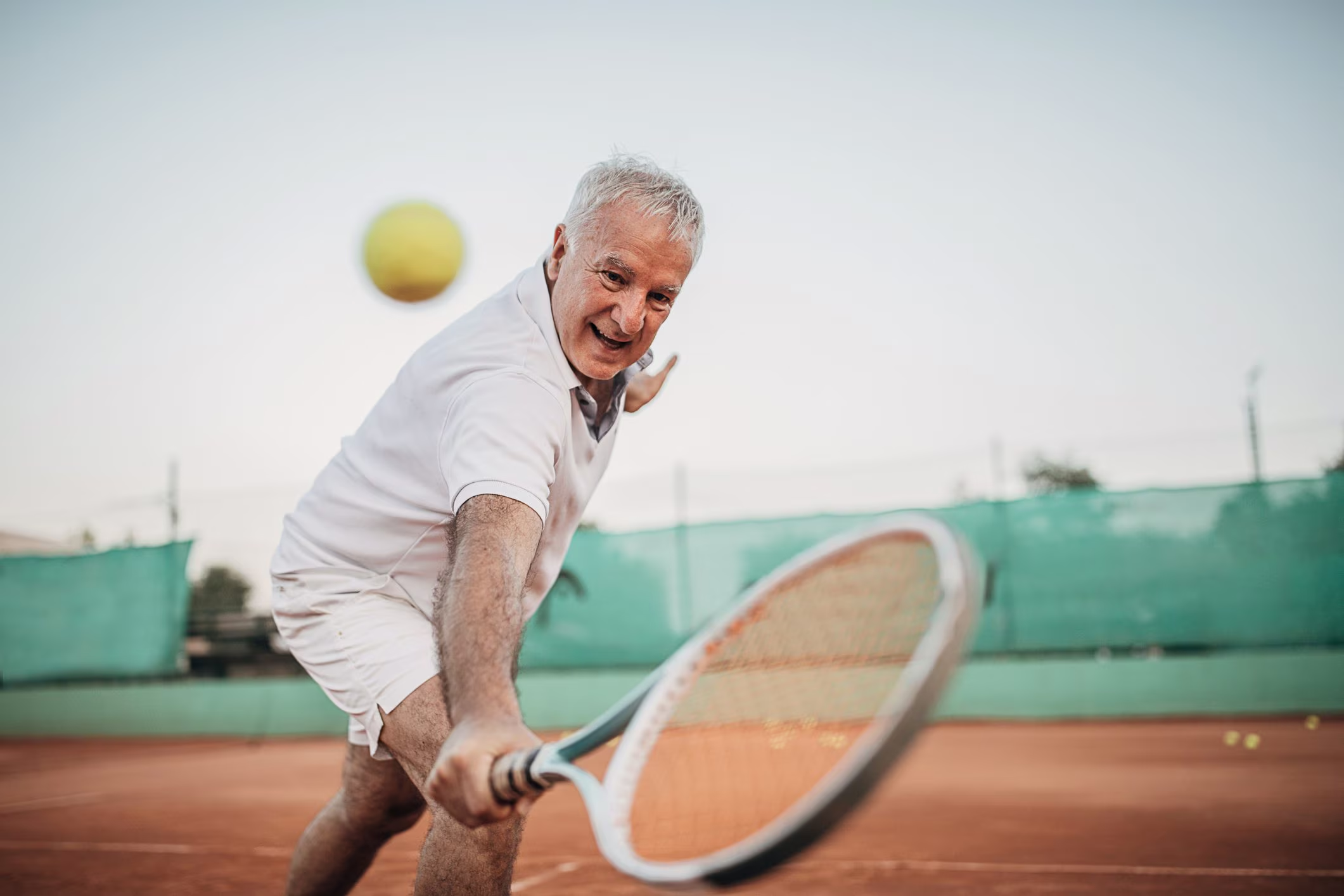
Tennis can extend your life by up to 9.7 years, football by almost 5 and cycling by around 3.7, according to a study published in the British Journal of Sports Medicine. Longevity, in fact, is a multifactorial phenomenon and racket sports are those that best combine three key elements: high intensity alternating with phases of active recovery, motor coordination, social interaction. But if tennis seems to have a statistical advantage, the first real protective factor remains practicing an active and varied lifestyle over time. Let’s see in this article which sports prolong life the most and why.
Which sports increase longevity: the ranking according to research
It is now well established that physical activity is good for both physical and mental health: it reduces the risk of cardiovascular disease, diabetes, tumors and cognitive decline. It is no coincidence that international guidelines recommend at least 150 minutes of moderate physical activity per week.
But is there a sport that extends life more than others?
One of the most cited research on the topic is an English study published in 2017 in the British Journal of Sports Medicine. The data showed that those who regularly practice racket sports (such as tennis and badminton) have a reduction in the risk of early mortality of up to 47% compared to sedentary people. Significant, but less marked, reductions were also observed for swimming, aerobic activities and cycling. The authors then evaluated mortality from cardiovascular causes: also in this case, racket sports were associated with the most marked reduction in risk, followed by swimming and aerobic activities. However, another important factor that emerged in this study is that the variety of activities practiced appears to have a greater protective effect than the total amount of exercise alone.
In 2018 another very large Danish study, the Copenhagen City Heart Studyalso went so far as to evaluate how many more years of life are associated on average with different sports compared to a sedentary lifestyle. Here are the results:
- Tennis: +9.7 years
- Badminton: +6.2 years
- Calcium: +4.7 years
- Cycling: +3.7 years
- Swimming: +3.4 years
- Jogging: +3.2 years
- Calisthenics: +3.1 years
- Aerobic activities: +1.5 years
The striking fact is the advantage of tennis, clearly superior to other sports. Be careful though: these are statistical associations, not direct cause-effect relationships. In fact, those who play tennis could also have other factors favorable to longevity (such as a higher socioeconomic level or a more balanced diet).
And what about older people? A 2022 US study of more than 200,000 older adults showed that, in old age, running can offer a similar advantage to racket sports. However, they remain statistically significantly associated with greater longevity:
- fast walk
- aerobic activities
- golf
- I swim
- cycling
The associations are also similar for cardiovascular and oncological mortality. Italian research from 2024 also highlighted that good physical performance is correlated with greater longevity even beyond the age of 80, confirming that it is never “too late” to benefit from physical activity.
Finally, even for professional athletes, a positive association with longevity is confirmed between tennis and badminton (+5.7 years in men and +2.8 in women). A Dutch research from 2024, conducted on over 95 thousand athletes from 183 countries, has in fact highlighted interesting differences even between professional athletes. Surprisingly, among men the greatest advantages are observed for:
- pole vault (+8.4 years)
- gymnastics (+8.2 years)
While volleyball and sumo are associated with a lower life expectancy than the average of other athletes (-5.4 and -9.8 years respectively). Even in this case, however, many variables come into play: extreme training loads, traumas, physical differences required by the disciplines.
Because tennis actually prolongs life according to scientific studies
As the study in the British Journal of Sport Medicine states, racket sports combine three key elements:
- High intensity intervals, with active recovery phases
- Complex motor coordination, which stimulates the nervous system and cognition
- Social interaction, a factor known to reduce mortality risk
Longevity, in fact, is a multifactorial phenomenon that does not depend only on calories burned or aerobic capacity. The social component, the variety of motor stimuli and the alternation of intensity could explain why tennis and badminton emerge so often in studies.
However, if there is one solid conclusion that emerges from all this research, it is this: moving matters more than the sport you choose. And even more important: doing it regularly, combining different activities and adapting the intensity to your age and health conditions. In other words, the sport that prolongs life the most is also the one we manage to practice consistently for years.