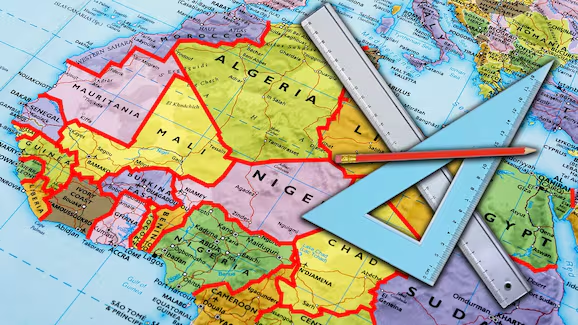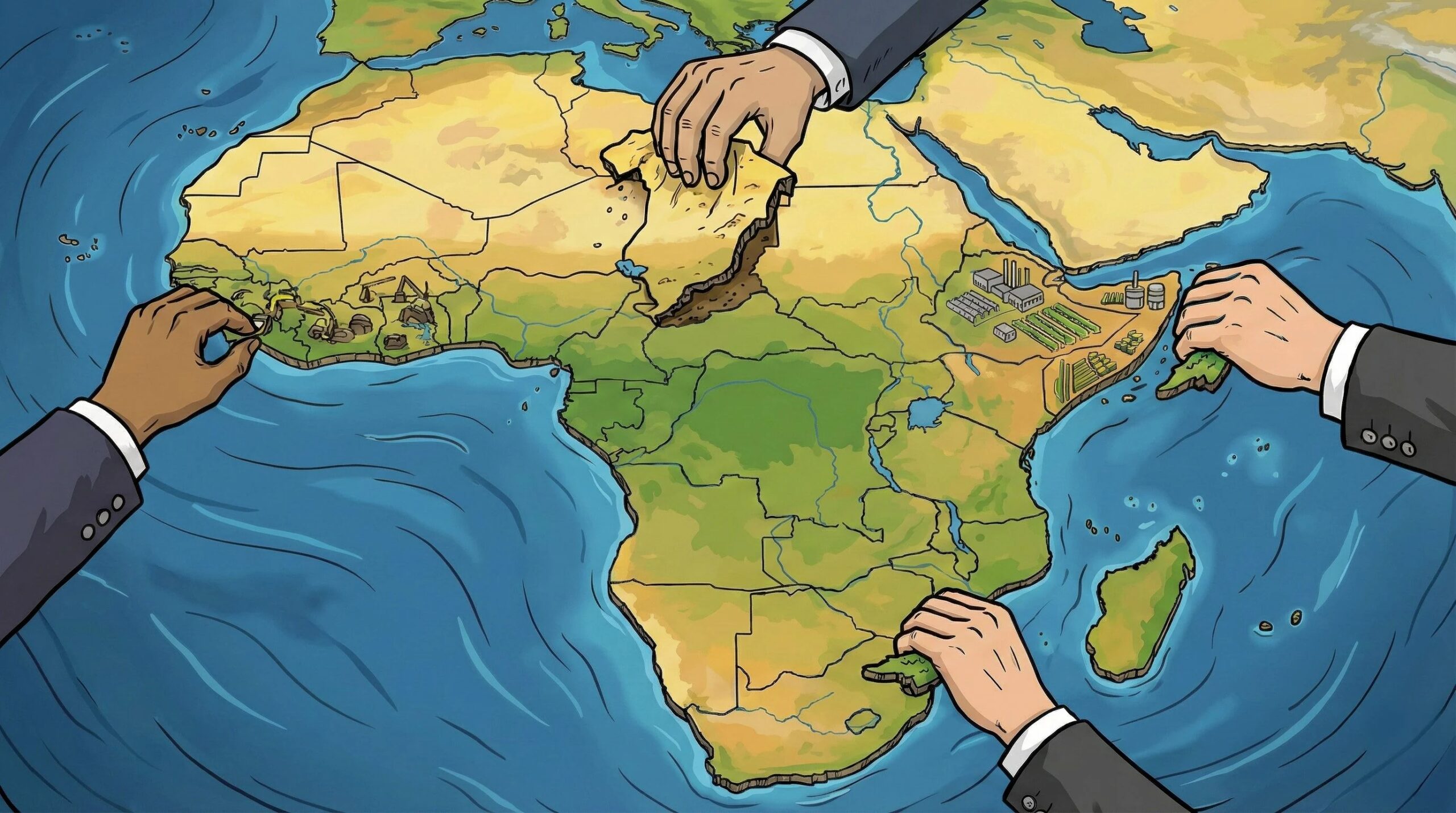
The land grabbing, in Italian “land grabbing”, is the phenomenon whereby governments, multinationals or private investors purchase or appropriate large portions of land in the poorest countries, often to the detriment of local populations. The tendency of the most powerful to grab other people’s lands is nothing new, it is as old as the Human Being himself, what differentiates our era from those of the past are the disproportionate dimensions of the phenomenon and the involvement of a plurality of actors. The systematic nature of land grabbing it puts local populations at risk, who are also defrauded of the last valuable asset they have left: the land, stolen with often non-transparent or forced practices, transformed into land for industrial crops, mineral exploitation or financial speculation.
What does it mean land grabbing and how it happens today
From both a “quantitative” and “qualitative” point of view, the phenomenon of land grabbing today is different from what happened in the past. During Colonialism (15th-18th century) and Imperialism (19th century), only the European powers conquered vast territories across the globe, suffocating the independence of local populations, especially in Africa and Asia. Today, however, the race to land grabbing it has become generalized and involves new powers such as China, Brazil, Saudi Arabia and the United Arab Emirates, but also “unsuspected” countries, whose name is not usually (and erroneously) associated with phenomena of exploitation, such as the Netherlands and Switzerland.
Not only that: while in the Colonial era the European powers occupied African and Asian territories to exploit their natural resources, in particular those underground, and conquer new markets for their own manufacturing; today the old and new players aim to grab fertile areas, to convert them to food production or the development of industrial crops, such as those linked to the so-called “green fuels” (biofuel).
The new “race to Africa”
Although the land grabbing has now become a problem in every corner of the world, once again it is the African countries that bear the brunt of it. According to data published by the “Land Matrix Initiative”, from the year 2000 to today there have been over 1,000 agreements signed by states or foreign companies with African countries concerning the exploitation of local lands. The country most affected by this phenomenon was Mozambique, with 110 agreements on large-scale agricultural land, but Ethiopia, Cameroon and the Democratic Republic of Congo have also stimulated foreign attention. It is important to remember that among the protagonists of this new “race to Africa” there is also Italy, which has entered into agreements for the exploitation of the land with eleven countries: Ethiopia, Kenya, Tanzania, Mozambique, Madagascar, Gabon, Nigeria, Benin, Ghana, Liberia and Senegal.
The sad fate of local populations: the consequences of land grabbing
The big losers of this modern variant of the “gold rush” (in this case “agricultural gold”) are once again the defenseless local populations. Tightened in a vice created by the effects of climate change, authoritarian governments, interests of great foreign powers and unscrupulous multinationals, African farmers are seeing their margin for maneuver increasingly restricted and, often, they are forced to abandon their ancestral lands and join the already large group of the dispossessed, who end up concentrating in large urban areas in search of paid work.
If we consider that approximately half of Africa’s arable land (1.2 billion hectares of land) has already been affected by the phenomenon of appropriation described and that the trend shows no sign of decreasing, it is not difficult to predict that in the future local communities will see a further compression of their living spaces (a phenomenon that has already acquired the name of land squeezing) with the result of accentuating the already marked social tensions and general geopolitical instability of the continent.