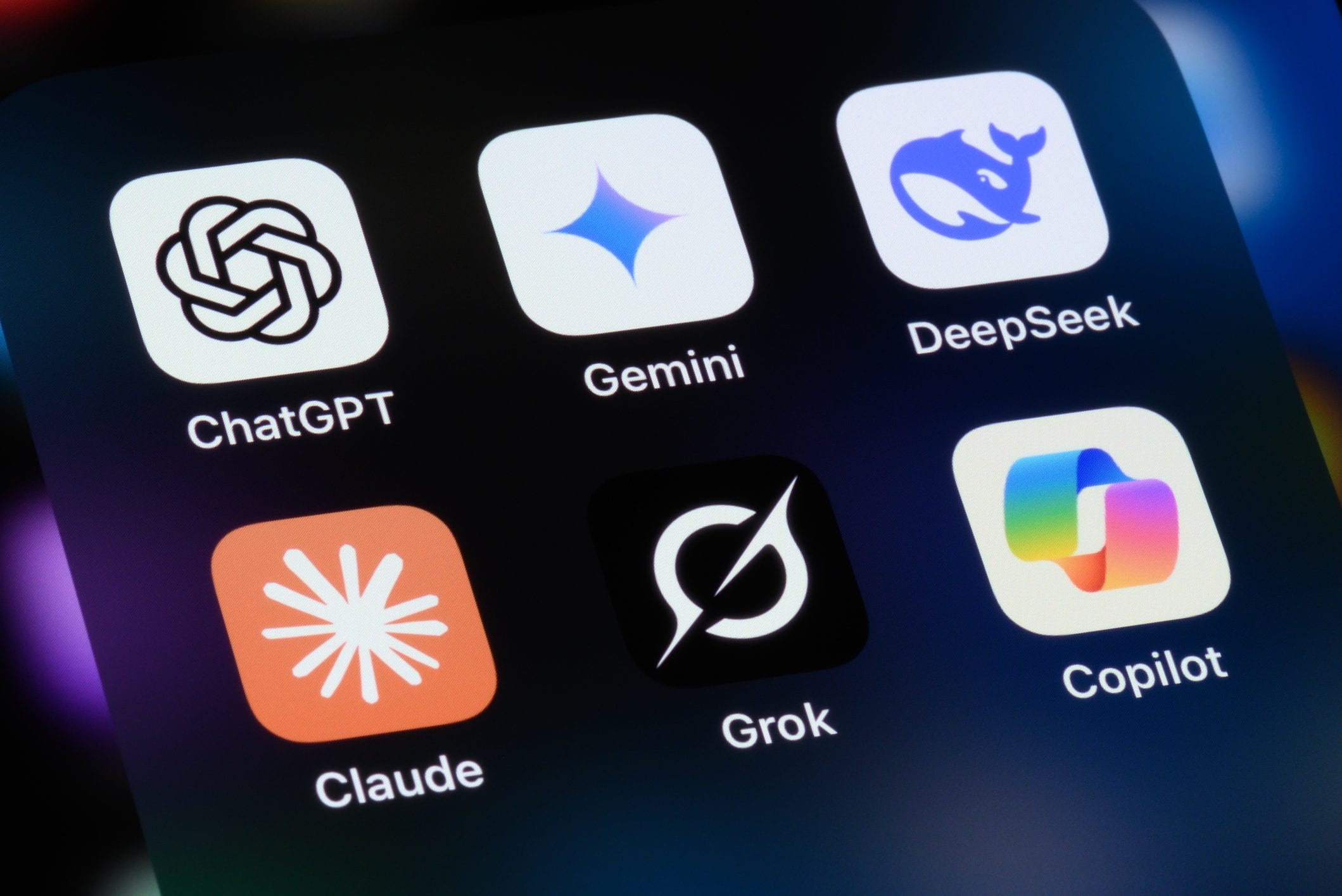
Today we hear more and more often about LLM (Large Language Models), or large language models. These are the artificial intelligence systems that are the basis of the functioning of the chatbots that we use every day for the most varied reasons: from ChatGPT to Gemini, passing through Claude, DeepSeek, Grok, etc. Each LLM has its own peculiarities and characteristics: it depends on how it was trained and the purpose for which it was designed. For this reason, before turning to an LLM, we should ask ourselves if it is the most suitable for the purpose we want to achieve. In this in-depth analysis we have made a selection of the best LLMs of the moment and, based on the available benchmarks, we have organized them based on the type of activity best suited to the characteristics of each one.
More advanced models tend to behave similarly in general tasks, but significant differences emerge only when we analyze targeted benchmarks, i.e. standardized tests designed to measure specific skills such as reasoning, programming or scientific knowledge. A benchmark is, essentially, a comparative test that allows you to objectively evaluate the capabilities of a system. Today these tests have become much more sophisticated than in the past, because the simpler ones have been “saturated”: the models have achieved scores so high that they are of little use in distinguishing real performance. For this reason, the current panorama is based on diversified and more difficult test batteries, designed to avoid phenomena such as data contamination, i.e. the risk that a model has already “seen” the answers during training. These are not reliable tests in an absolute sense, but they certainly represent an excellent yardstick for measuring the capabilities of the various LLMs. In this context, to understand which LLM to use, we must think in use cases. In this study we will analyze three of them: academic/scientific research, software development and complex reasoning. Activities that require different skills and, therefore, different models.
Academic/scientific research
When we work in an academic or scientific field, the priority is the reliability of the answers and the ability to handle advanced level questions without incurring plausible but false errors, the so-called “hallucinations”. This is where benchmarks like GPQA Diamond (Graduate-Level Google-Proof Q&A), a test designed with advanced college-level physics, chemistry, and biology questions. The questions are asked in such a way as to be “Google-proof”, therefore with answers that require more than a simple Google search to find.
The data shows that models such as Google DeepMind’s Gemini 3.1 Pro achieve very high performance, reaching an average precision of 94% accuracy, while OpenAI’s GPT-5.4 and Anthropic’s Claude Opus 4.6 follow closely behind with accuracy scores that are 93% and 91% at short range, respectively. This type of result indicates a strong capacity for synthesis and deep understanding, making these systems particularly suitable for reviewing literature or building structured scientific analyses.
Programming and software development
In the field of software programming the situation changes radically. This is because models must not “simply” generate code: they must understand entire software projects, navigate between different files and propose working changes. Among the most relevant benchmarks in this field we find the one called SWE-bench Verified, which simulates real problems taken from GitHub repositories. To go into more detail, the benchmark includes 2,294 cases based on real problems encountered by developers on GitHub, collected from 12 of the most popular projects written in Python. In practice, models are asked to analyze an entire software project, understand the description of an error or feature that needs fixing, and propose a change to the code to resolve it. It’s a much more complex test than simply writing functions: models must navigate complex projects, understand how different files are connected to each other, and produce changes that integrate correctly with existing code. The solutions are then automatically tested to verify that they actually work and do not introduce new errors.
In this test Claude Opus 4.5 (high reasoning) emerges as the undisputed leader with a score of 76.8%, thanks to its ability to intervene on complex codebases. In second position we find Gemini 3 Flash (high reasoning) and MiniMax M2.5 by MiniMaxAI tied with a score of 75.8%. In third position, however, appears Claude Opus 4.6.
Complex reasoning
If, however, we are interested in complex reasoning, we enter the domain of the so-called “System 2”, a mode of thinking described by Daniel Kahneman, characterized by slow, analytical, logical and energy-intensive processes. A reference benchmark in this field is Chatbot Arena, managed by LMSYS. It stands out for its completely innovative methodology. Instead of measuring the capabilities of artificial intelligence on standard and pre-established tests, it directly exploits people’s opinions through “blind” tests. Users, in fact, chat simultaneously with two models without knowing their identity and choose which one provided the best response. Having accumulated more than 5 million votes, this method allows you to calculate Elo scores, which offer a very reliable estimate of the effectiveness of AI in everyday use. The Elo system, originally designed for chess, generates constant and easy-to-read rankings: a high rating simply means that that model regularly wins direct duels according to the public’s opinion. In this way, a complete 360-degree evaluation is obtained, which takes into account usefulness, accuracy, clarity and pleasantness of use, all fundamental elements that traditional sector tests struggle to detect.
At the time of writing, the models that achieved the best scores in complex reasoning are Gemini 3.1-Pro (with 1505 Elo points), Claude Opus 4.6 Thinking (with 1503 Elo points) and Grok-4.20 (with 1496 Elo points).
Recap of the best LLMs
| Type of activity | Reference benchmark | Best LLM |
|---|---|---|
| Academic/scientific research | GPQA Diamond | Gemini 3.1 Pro |
| Software development | SWE-bench Verified | Claude Opus 4.5 (high reasoning) |
| Complex reasoning | Chatbot Arena | Gemini 3.1-Pro |