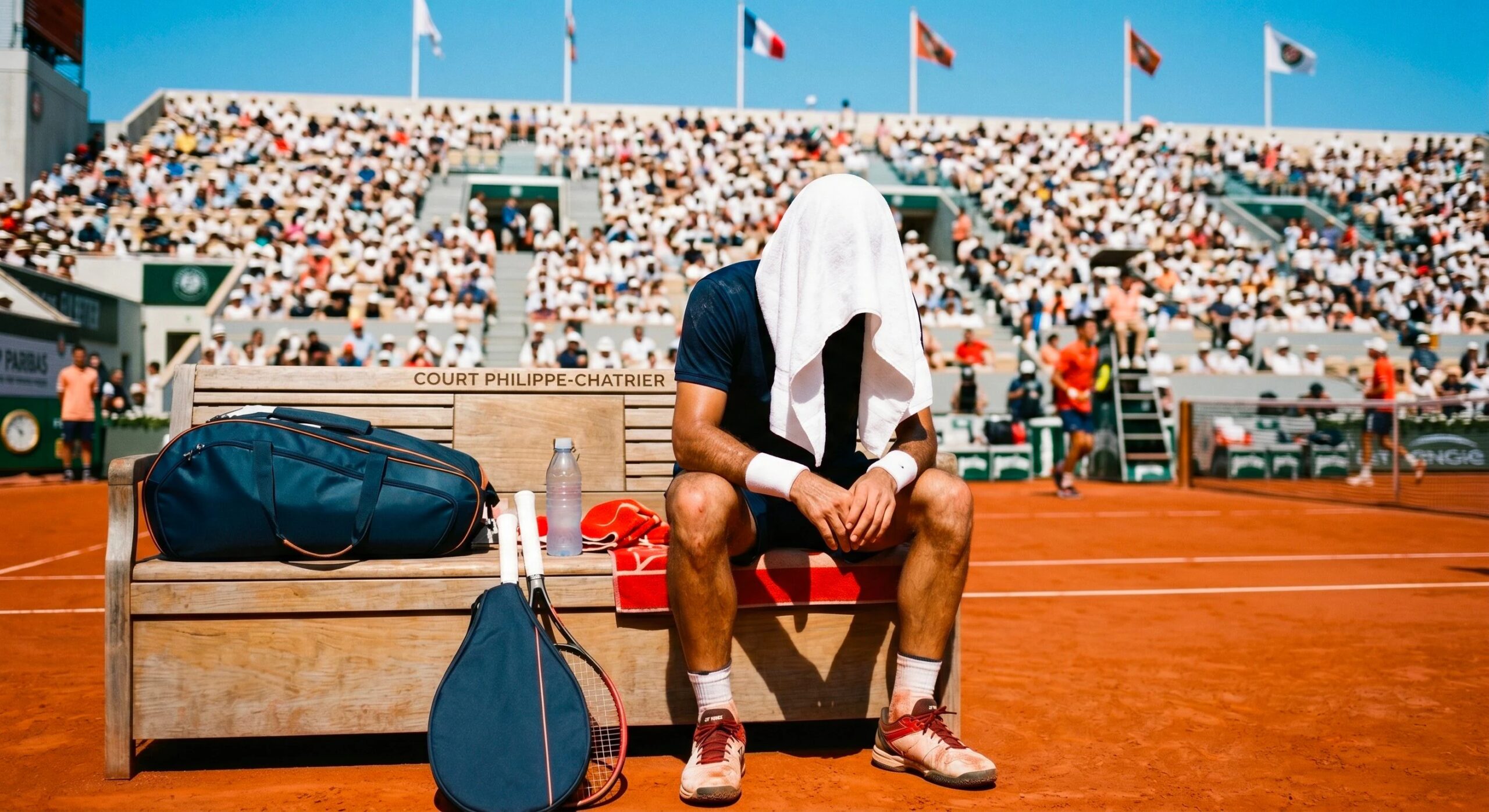
Jannik Sinner’s surprise elimination in the second round of Roland Garros 2026 left everyone in suspense. After dominating the first part of the match against Cerundolo, the world number 1 suffered a serious illness on the court, complaining of severe dehydration and nausea until he sensationally gave in in the fifth set. In Paris the temperatures were around 33°C, decidedly anomalous heat for the French spring. As Sinner himself later explained at the end of the race, the temperatures were not unbearable, but they dealt the final blow to a body already drained of energy by a very busy season and a sleepless night.
The episode, combined with the illnesses also suffered by other tennis players in these sultry days in France, immediately put the spotlight back on a fundamental safety mechanism but little known to the general public: the so-called heat rule of the Slams and the scientific parameter that decides their activation, the WBGT (Wet-Bulb Globe Temperature). But if it was 33 degrees, why wasn’t the game stopped? Let’s see what this rule is, how it works and why it is causing so much discussion at Roland Garros.
What is the heat rule and when does it kick in at Roland Garros 2026
There heat rule it is part of the Extreme Weather Policy, the regulation that all four Slams (Australian Open, Roland Garros, Wimbledon and US Open) have adopted to protect players when weather conditions exceed the safety threshold. The logic is simple: high-level tennis is one of the most grueling sports there is (matches that can last over 5 hours, rallies over 30 shots, and best-of-five sets for men), and doing it under a blazing sun with high humidity can lead to heat stroke, a condition that can be lethal.
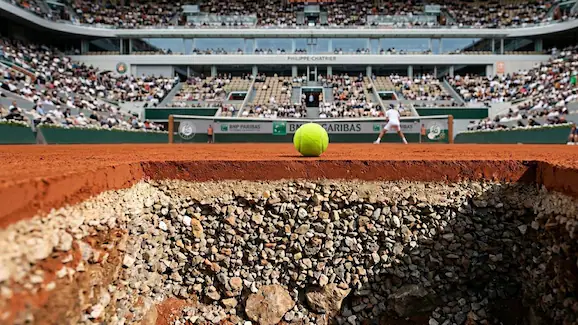
At Roland Garros the rule works like this, and has two thresholds. Threshold 1 applies when the WBGT index exceeds 30.1 °C, a 10 minute break is granted before the deciding set. In men’s matches (best of 5 sets) the break occurs between the third and fourth set; in the women’s ones (best of 3) between second and third. Ten minutes to go to the changing rooms, cool down, hydrate, restart the thermoregulation system. Threshold 2, however, comes into effect when the WBGT reaches 32.2 °C, matches stop. He waits for conditions to improve, then he recovers. The French Federation has made it known that this threshold has never been reached at Roland Garros, but in recent days it has come close. There are two sensors monitoring in real time, one placed on Philippe-Chatrier (the central court) and one on court 14.
In Paris, reaching those thresholds is more difficult than it seems. Not because it is not very hot, but because, as reported by the Italian Weather Center, the French air is relatively dry, and humidity weighs heavily in the calculation of the WBGT. For this reason, even with the 33 °C of traditional thermometers, the index often remains below the threshold. And this is also why, despite illnesses, match officials rarely intervene automatically. Finally, the roofs of the main courts of Roland Garros protect from the rain, but do not cool the environment and closing them in case of extreme heat could only worsen the situation, making the air even more muggy.
What is WBGT (Wet-Bulb Globe Temperature)
Four environmental factors act simultaneously on our body when we are outdoors and move:
- The air temperature warms us (or cools us) by direct contact.
- The sun warms us with its radiation. Just think about how hot it is to be in the sun compared to being in the shade at the same temperature.
- Humidity determines how quickly our sweat can evaporate. And since evaporating sweat is the main way our body cools itself, the more humid the air is, the less we are able to shed heat.
- The wind takes heat away from the skin and accelerates the evaporation of sweat, cooling us.
The problem is that the classic thermometer only measures the first of these four factors. The “felt temperature” we see in weather apps (theheat index) adds a second one, humidity, but it is designed for the shade not considering when the sun “beats down” on you, and not considering the wind. For those who play tennis on an open court at midday, theheat index It’s useful information, but it’s incomplete.
The WBGT combines all four factors into one number. It was developed in the 1950s by the United States Marines, at the Parris Island training camp in South Carolina: too many recruits trained in the height of summer, under the sun and humidity typical of the American southeast, and many suffered from heat stroke. It worked so well that today WBGT is used by the military, OSHA, ISO 7243, high school football leagues, several sports federations, and the four tennis grand slams.
How to calculate the heat stress index: three thermometers at work
WBGT is obtained by combining three different measurements, taken from three different thermometers working in parallel. Each captures one of the factors that interest us:
- Normal thermometer: measures the air temperature, it is the classic thermometer
- Wet gauze thermometer (this is the “wet bulb”): measures humidity. It is a regular thermometer, but the bulb is wrapped in gauze soaked in distilled water. The water evaporates from the gauze and cools the bulb, just as sweat evaporates from our skin and cools us. The drier the air, the more water evaporates, the lower the measured temperature is compared to the air. If, however, the air is saturated with humidity, the water is unable to evaporate and the measured temperature remains high. This thermometer, in practice, simulates our sweating skin.
- Thermometer inside a black sphere (it is the “globe bulb”): measures the impact of the sun. It is a thermometer inserted inside a copper sphere painted matt black, about 15 cm in diameter. The black sphere absorbs solar radiation and heats up, exactly as the sun warms our skin when we play tennis in broad daylight.
The wind enters all three, because it is an air condition that affects them all at the same time: air moving over the wet bulb evaporates more water and cools more or the air moving over the black sphere takes heat away. At this point the three temperatures are combined with a formula in which they do not all weigh the same. The thermometer with the wet gauze alone is worth 70% of the total. The black sphere is worth 20%. The air thermometer is only worth 10%, the air temperature counts for a tenth in the final calculation.
This decidedly unbalanced proportion tells us that the human body does not overheat so much due to the degrees of the air, but due to how efficient its cooling system is, i.e. sweating. If you sweat and the sweat evaporates immediately, you are fine even at 35 degrees. If you sweat and the sweat doesn’t evaporate because the air is already saturated with moisture, you are in trouble even at lower temperatures.
The situation at Roland Garros 2026 and the collapse of Sinner
At the end of May, Paris is experiencing an anomalous heat wave, with thermometers fluctuating between 33 and 34 °C (up to 14 °C higher than the seasonal average). However, the Parisian air is currently quite dry. This lack of humidity “saves” the WBGT calculation, preventing it from reaching critical thresholds. This is why, despite the high summer numbers, Roland Garros’ emergency protocol rarely comes into play automatically and play continues even during peak hours under the blazing sun.
As a rule, a well-trained and hydrated professional athlete can manage these margins. But Sinner has a notoriously complicated relationship with the scorching heat: already last January, at the Australian Open against the American Spizzirri, he had suffered from violent cramps all over his body which risked causing him to lose the match. On that occasion he was “saved” by the activation of the heat policy, which led to the closure of the arena roof to reduce thermal stress.
If for Sinner the Parisian temperatures were “only” the trigger on an already tested physique, in this Roland Garros 2026 there are cases in which the heat was the real and only culprit. In recent days, Casper Ruud suffered illness on the court, a ball girl came close to fainting and the Czech Jakub Mensik, after a five-set marathon, declared that his body “literally shut down”.