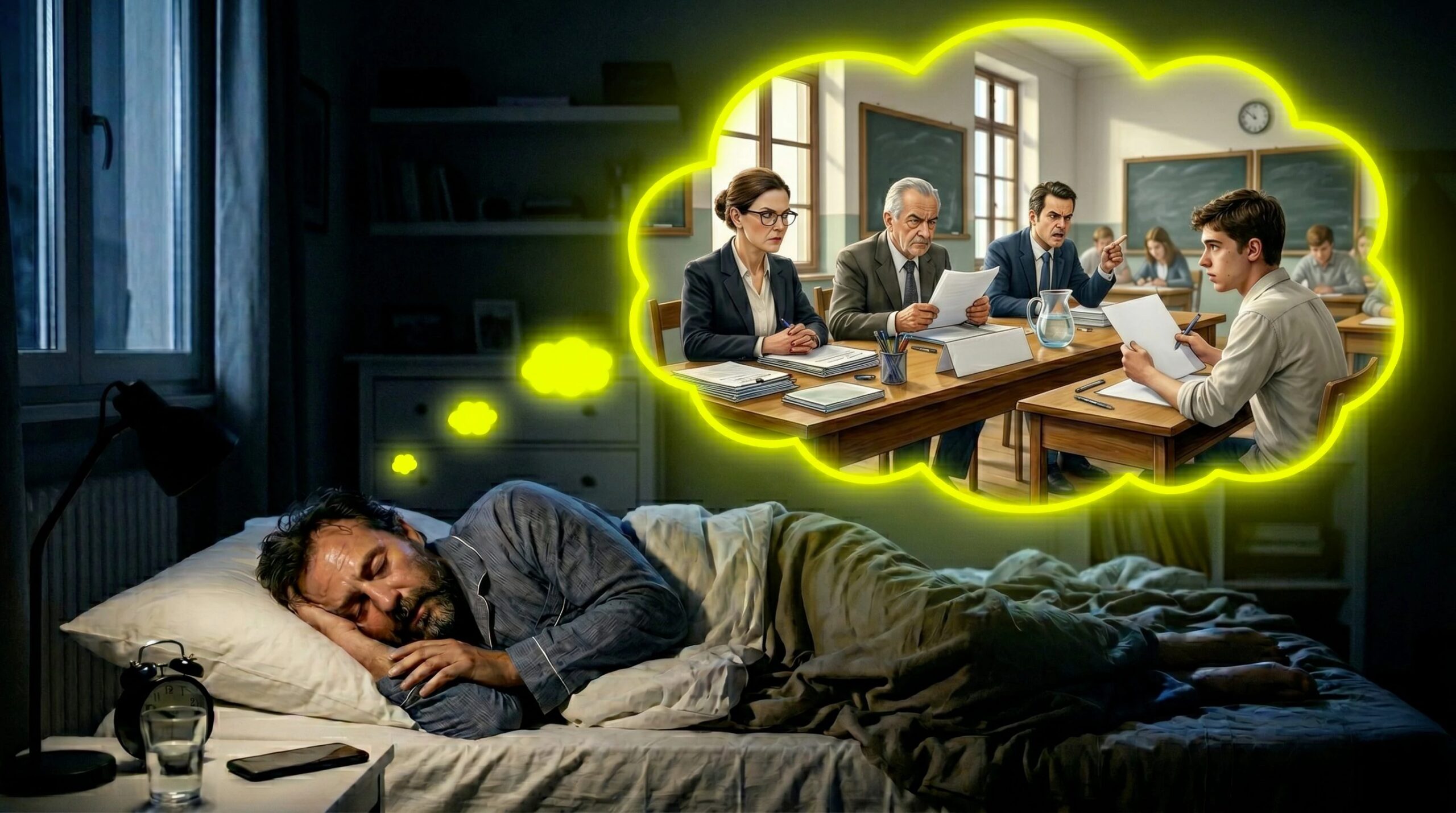
Dreaming about your high school exam even many years after you’ve taken it is a surprisingly common experience. According to sleep researchers, it does not depend so much on the memory of the exam itself, but on the emotional meaning we attribute to this moment of passage. For the brain, in fact, maturity can transform into a universal symbol of judgment, pressure and evaluation so significant that it continues to resurface during sleep, especially in periods of high stress. If this has happened to you, don’t worry, you are in good company – after all, even Albert Einstein claimed to often dream about mathematics exams even after becoming famous.
It is one of the most widespread dream contents in the world and, according to sleep researchers, it does not only concern students and recent graduates. Many people continue to dream of exams, quizzes and school tests even decades after finishing school. The question then is: why maturity? The most intuitive response would be to think that it is a particularly traumatic memory. But science suggests different and more detailed interpretations on the matter.
The problem is not maturity, but what it represents
Sleep psychologist Michael Schredl, one of the leading researchers on the content of dreams, has analyzed the phenomenon of so-called “examination dreams”. In his search “Pass or Fail? Examination dreams in a long dream series” showed that these dream contents tend to appear especially in moments of life in which we feel evaluated, under pressure or called upon to face performance challenges. According to the expert, therefore, they are not simply school memories that resurface, but reflect our daily worries.
In other words, the brain isn’t necessarily thinking back to maturity, but it’s using it as a metaphor. For many of us that exam was one of the great occasions in which we felt publicly observed, judged and evaluated. It is an experience that concentrates an enormous amount of emotions in a few hours: expectations, fear of making mistakes, desire to succeed, fear of the judgment of others. For this reason, when years later we face a job interview, a promotion, an important choice or go through a particularly stressful period, the brain can reactivate precisely that scenario, since the final exam can represent a mental model of performance anxiety.
“Performance anxiety dreams” and why the final exam
In sleep psychology there is a very specific category called “performance anxiety dreams”, i.e. dreams linked to performance anxiety. They are dreams that revolve around an evaluation: an exam, a competition, an interview, a public presentation. The interesting detail is that the dream content may change, but the underlying emotion remains the same.
It can happen to anyone: today maybe we are doctors, teachers, journalists or workers. Yet the brain continues to select the final exam as a backdrop; it’s a bit as if he were using an old, ready-made emotional file. Not because it is the most recent, but because it is the most significant.
One of the most accepted explanations concerns the way in which sleep reprocesses memories. Neuroscience has shown that while we sleep, the brain does more than just store information. On the contrary, it selects and reorganizes lived experiences, especially strengthening those associated with a strong emotional impact. In fact, several studies suggest that sleep plays a crucial role in the consolidation of emotional memory: events that have aroused anxiety, fear, enthusiasm or strong participation tend to leave more stable and long-lasting traces over time. Dreams could represent a window into this re-elaboration process, bringing back to the scene fragments, emotions and meanings that the brain still considers relevant.
This means that a detailed memory of the exam, the commission or the questions received is not necessarily retained. Rather, it tends to preserve what that event represented for us from an emotional point of view; and it is precisely this emotionally charged trace that can resurface in dreams even many years later.
A virtual gym to face threats
Then there is another particularly fascinating theory. In his famous research, the Finnish neuroscientist Antti Revonsuo described what became known as the “Threat Simulation Theory”, according to which dreams had an evolutionary function: to simulate problematic situations to train the brain to deal with them. According to this hypothesis, dream contents could function as a sort of virtual gym in which the brain simulates threats to train our cognitive and emotional responses. That is, the brain refines the neuronal circuits necessary to deal with situations in the real world.
If we think about our ancestors, threats were represented by predators, enemies or physical dangers (who knows if Neanderthals actually dreamed of the unsuccessful hunt of a mammoth, or if Julius Caesar dreamed of conspiracies on the part of his enemies!); today, however, dream contents can take the form of social challenges: being judged badly, making a bad impression, failing in front of others represent ideal scenarios for this type of simulation.
From this perspective, the exam dream would not be a brain bug, but a simulator that allows us to practice, in a safe way, managing pressure situations.
But are these dreams always negative?
Curiously, no. One of the lesser-known aspects that emerged from Schredl’s research is that not all exam dreams end badly. In the collective imagination, the typical dream is one in which we do not know how to answer the questions or we arrive unprepared. However, there are also dreams in which the exam is passed brilliantly, or faced with serenity. This suggests that dreaming of that moment is not necessarily a sign of unresolved trauma, but a way in which the mind continues to work on the experiences it considers important. The brain is not simply re-presenting a fear, rather it is possible that it is re-elaborating the very concept of evaluation and/or competence.
So, why do we keep dreaming about it? The simplest answer is that graduation, for many people, has become something more than an exam. It’s a symbol. Symbol of a test to be faced alone, of the judgment of others, of the fear of failure or even of the ability to succeed.
This is why the brain continues to keep it available in its repertoire of images and scenarios, even after years. Deep down, perhaps, we still don’t dream of maturity because we haven’t really overcome it. We do it because our mind has chosen it as a universal symbol of all the trials we continue to face in daily life.