The Tour de France, which starts today July 4th with the one hundred and thirteenth edition, has built its legend also thanks to extreme stages that put the riders faced with distances that are unthinkable today, interminable climbs and prohibitive conditions. From the Bayonne–Luchon of 1910, which introduced the Pyrenees to the race for the first time, to the 482 km of the Les Sables-d’Olonne–Bayonne of 1919, still today the longest stage in the history of the Tour, up to the great exploits of Marco Pantani and Claudio Chiappucci in the Alps: some days have entered the memory of cycling for their exceptional hardness. This year the Grand Boucle it will take place in twenty-one stages until 26 July 2026, covering a total of 3,320.7 km with a departure from Barcelona in Catalonia and the traditional arrival on the Champs Élysées in Paris. As always, the high mountain climbs will capture the attention of the public at the Tour de France 2026, ready to put modern cyclists like Vingegaard and Pogačar to the test with significant gradients and altitudes.
- 1Luchon – Bayonne (1910)
- 2Les Sables-d’Olonne – Bayonne (1919)
- 3Bourg-d’Oisans–Morzine (1983)
- 4Grenoble–Les Deux Alpes (1998)
- 5Saint-Gervais – Sestriere (1992)
Luchon – Bayonne (1910): the first hell of the Pyrenees
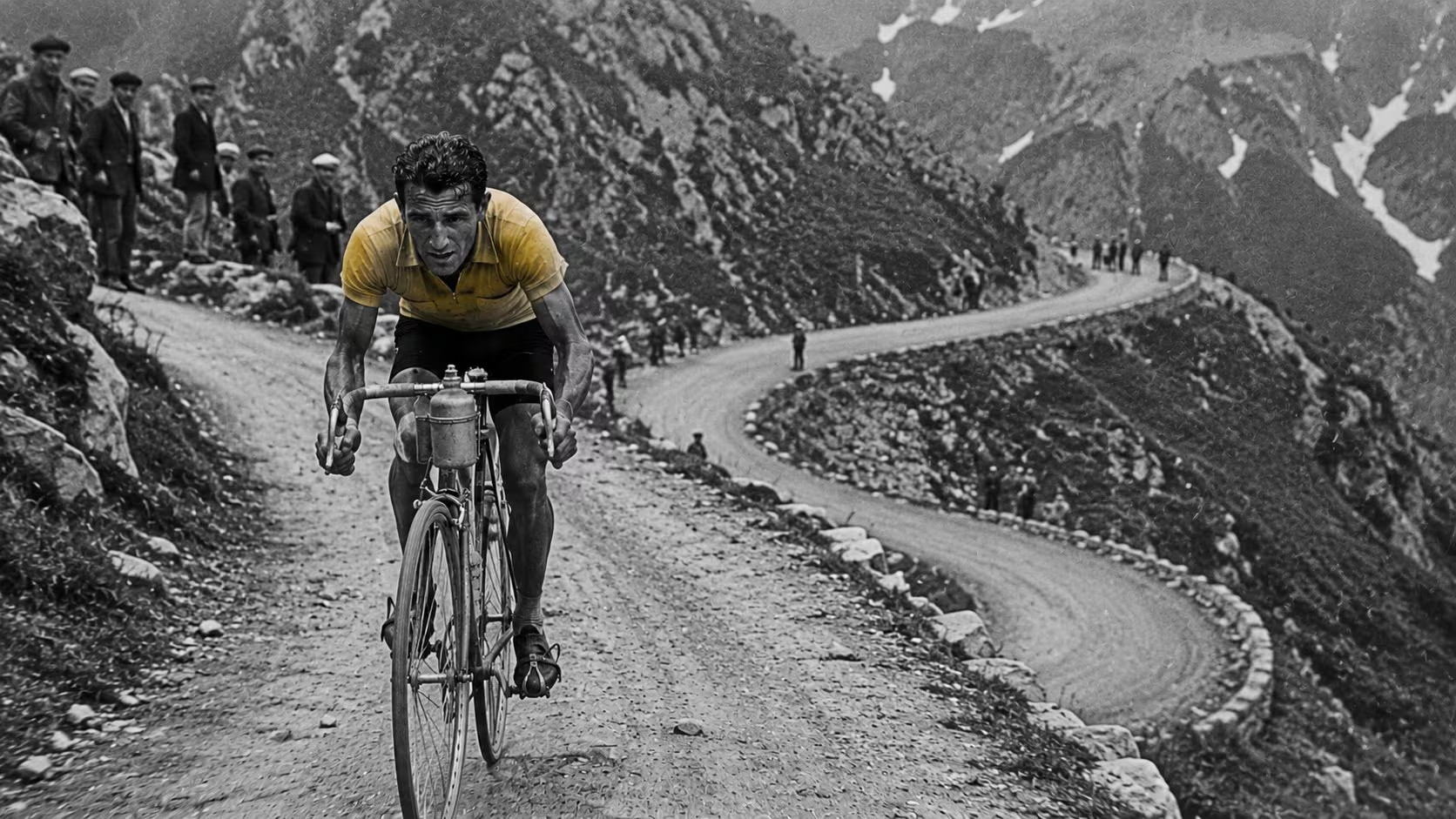
In the 1910 the Tour de France decides to include the Pyrenees in the route for the first time, until then considered impassable for a cycling race. The tenth stage, from Luchon to Bayonne, measures 326 km and crosses four large mountain passes: Peyresourde, Aspin, Tourmalet and Aubisque.
To give an idea of the madness, the riders set off in the middle of the night riding steel bicycles that weighed more than 15 kilos, completely without gears and on dirt roads. Once they reached altitude, the athletes found themselves pedaling between walls of snow accumulated on the side of the road, and in the steepest sections pushing the bike by hand; all this for a total of approximately 5,500 meters of altitude difference. Octave Lapize, who will win that stage, arrives at the top of the Tourmalet exhausted and addresses the organizers with words destined to go down in cycling legend: “You are murderers!”, accusing them of having created an inhuman route.
That day marks an epochal turning point: from that moment the Tour de France is no longer just an endurance race over long distances, but also becomes a challenge to the great mountains.
Les Sables-d’Olonne – Bayonne (1919): the longest stage in the history of the Tour
If today a 220km stage is considered long, at the 1919 Tour de France the organizers proposed one of 482 km: an enormity that still represents the absolute record in the history of the Grande Boucle. The fifth stage, from Les Sables-d’Olonne to Bayonne, was held on 7 July 1919 and required the winner, the Frenchman Jean Alavoine, almost 19 hours of racing (18h54’07”).
The context makes this feat even more impressive. It was the first Tour after the First World War: France still bore the scars of the conflict, many roads were bad, food was rationed and that of 1919 went down in history as the so-called “Hunger Tour”. Riders were asked to tackle endless stages on heavy bicycles, without mechanical assistance and with very few refueling points.
Furthermore, the 482km stage came after two already grueling days of over 400km and just before the Pyrenees. Of the 67 runners who started from Paris, only 17 out of the 33 remaining in the race they managed to conclude this grueling stage. And the haemorrhaging of retreatants continued until the final finish line: just 10 cyclists they arrived in Paris, the lowest number in the history of the Tour de France.
Bourg-d’Oisans–Morzine (1983): the Alpine marathon
247 kilometers in total, five legendary Alpine hills and a record positive difference in altitude for the time of over 6,400 metres: the eighteenth stage of the Tour de France on 20 July 1983, from Bourg-d’Oisans to Morzine, is undoubtedly one of the hardest days ever drawn in the history of the Big Boucle. The route, as shown in the diagram in X’s post below, forced the platoon to cross five of the most feared climbs in the French Alps: the Col du Glandon, the Col de la Madeleine, the Col des Aravis, the Col de la Colombière and, finally, the Col de Joux Plane, faced before the dive towards the finish line.
The stage turned into an elimination race, putting many of the protagonists in the general classification in crisis. A memorable solo victory was won by the Frenchman Jacques Michaud, who after an old-fashioned breakaway resisted the return of his pursuers and rushed to the finish line after a long time. 7h 45′ 25″. Behind him, the young debutant Laurent Fignon defended tooth and nail the yellow jersey that he would later wear all the way to Paris.
Grenoble–Les Deux Alpes (1998): Pantani’s feat on the Galibier
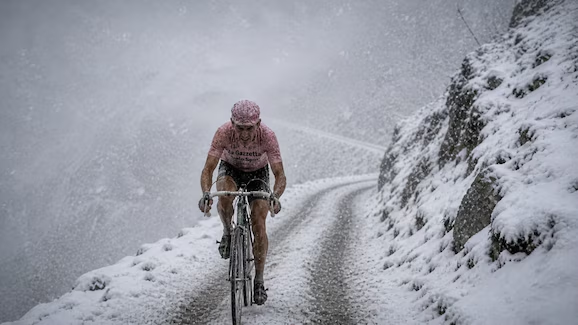
On 27 July 1998 the fifteenth stage of the Tour de France, from Grenoble to Les Deux Alpes, took place under a incessant downpour, with thick fog and freezing temperatures close to zero. At the start Marco Pantani was 3’01” behind Jan Ullrich in the general classification and knew he had to attempt an action from afar if he wanted to reopen the race.
In these climatic conditions, Pantani launches a devastating attack (shown in the video below) less than six kilometers from the summit of Galibier. The Pirate takes off the yellow jersey, which will collapse under the frost and fatigue arriving at the finish line almost nine minutes late. This 50km escape allowed Pantani to get his hands on a historic Giro and Tour double in the same year, and remains engraved in the collective memory as one of the most spectacular feats in the history of cycling.
Saint-Gervais – Sestriere (1992): Chiappucci’s impossible escape
The Saint-Gervais – Sestriere on 18 July 1992 it is considered one of the toughest stages in the history of the Tour. With his 254.5 km And 6,500 meters of altitude differencethe runners had to face in succession Col des Saisies, Cormet de Roselend, Col de l’Iseran – the highest point of that Tour with his team 2,764 meters –, Mont Cenis Hill and the uphill finish at Sestriere.
However, it was Claudio Chiappucci who made it legendary. The Italian attacked together with a small group of pacesetters just 28 km from the start, only to then make a gap behind him and remain completely alone 125 km from the finish line. It seemed like a madness destined to fail; instead, kilometer after kilometre, “El Diablo” continued to gain ground, climbing first over the Alpine giants and resisting the ferocious pursuit of the group of favorites led by Miguel Induráin. After 7 hours, 44 minutes and 51 seconds of the race, Chiappucci crossed the finish line in Sestriere with a 1’34” advantage over the second place, achieving one of the most iconic victories in the history of the Tour.
The feat was not enough for him to win the Tour – Induráin limited the damage and retained control of the general classification –, but that day he definitively delivered “El Diablo” to the legend.