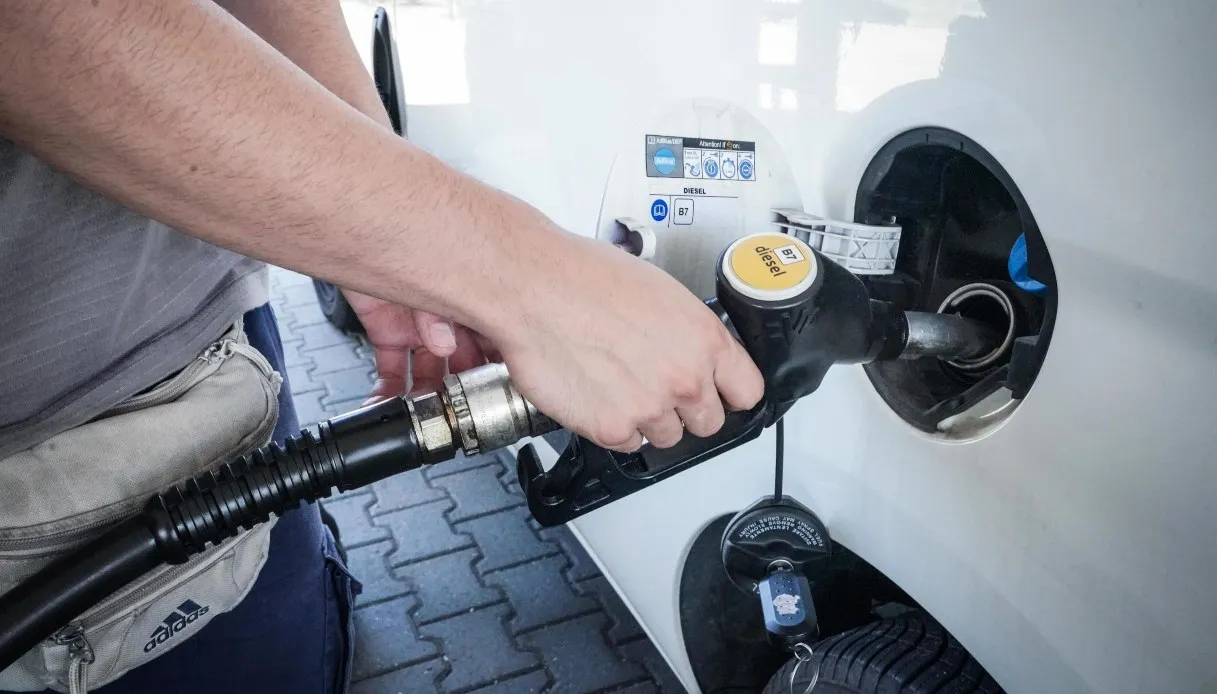
A small breath of fresh air for Italian motorists: fuel prices are today recording a general decline across the entire national network. The relief, however, is only partial: prices remain far from pre-conflict levels and every week Italian families spend almost 150 million euros more than a few months ago.
This is what emerges from the Codacons analysis, developed on regional data from the Ministry of Business and Made in Italy (Mimit).
Today’s prices at the pump
On the ordinary network, diesel drops to 2.166 euros per litre, with a reduction of 1.4 cents compared to yesterday’s price lists. Petrol drops to 1,790 euros per litre, with a drop of 0.3 cents. On the motorway the situation is similar: diesel stands at 2.193 euros per liter (-0.8 cents), while green fuel reaches 1.817 euros per liter (-0.6 cents).
The most significant reductions concern diesel in some regions of the South and the islands: in Sicily the drop is 2.3 cents per litre, in Valle d’Aosta 2.1 cents and in Calabria 2 cents. The only exception is Molise, where the price of diesel remains unchanged.
Comparison with the pre-conflict period
Despite the cut in excise duties ordered by the government, the comparison with prices at the end of February (before the outbreak of the conflict in Iran) still gives a worrying picture. Diesel has increased by more than a quarter compared to those levels, with an increase of +26% at the pump. Petrol has undergone a more limited, but still significant, increase of around +7%.
In practical terms, filling up with diesel costs around 23 euros more today than in February. For a full tank of petrol, the surcharge is around 5.8 euros. Codacons explains:
Considering the average daily consumption of fuel only on the ordinary network, i.e. on roads and motorways, Italians find themselves paying over 148 million euros more per week for their supplies: 128.7 million euros more for diesel, 19.5 million more for petrol.
Who really benefits?
But who does this extra revenue go to? The Codacons analysis tries to answer by breaking down the price per liter into its main components:
The industrial price today represents a share of 59.4% of each liter of diesel purchased at the distributor, (55.1% on petrol), while taxes, thanks to the excise duty cut, account for the remaining 40.6% (44.9% on petrol).
On each liter sold, in addition to the cost of Platts quotations, a gross margin is applied which remunerates brokers, transporters, wholesalers and other intermediaries. The margin of the plant managers, however, is fixed and varies between 3 and 5 cents per liter and does not increase as prices increase.
Based on these calculations, oil companies and the entire fuel supply chain are earning around 88 million euros more per week than two months ago, thanks to the price increases.
The state’s share
Public coffers also benefit indirectly from high prices. The Italian State, through VAT and excise duties applied to fuel, collects around 61 million euros more every week than last February.
A figure which, according to Codacons, should push the government to evaluate further interventions to support motorists, given the still high pressure on family budgets.









