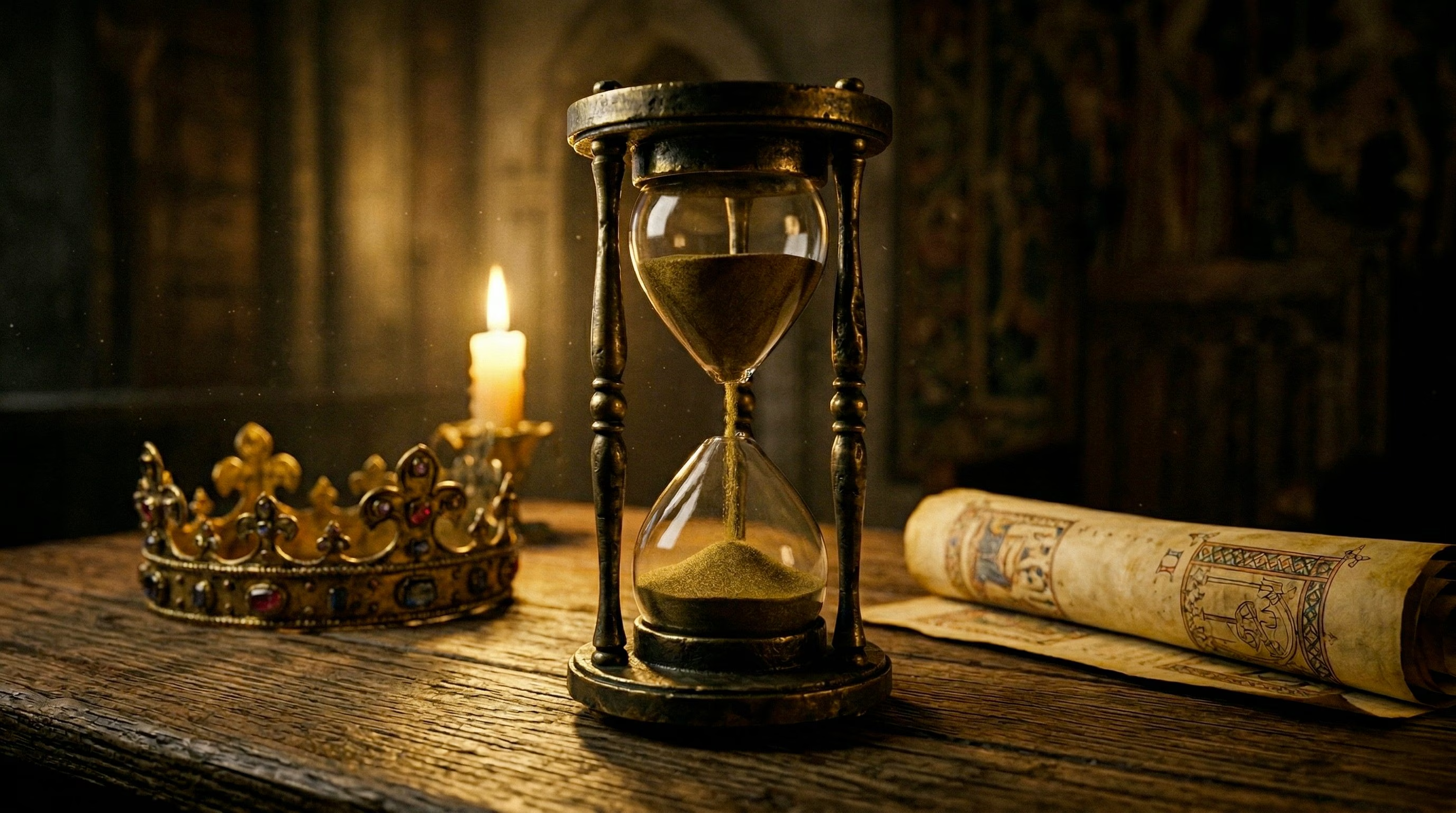
The so-called “phantom time hypothesis” is a controversial theory that aims to correct a part of historical chronology, pointing out why some centuries never existed of the High Middle Ages. It is considered without historiographical foundation and has been circulating on the web for years but, in reality, dates back to the end of the twentieth centuryin particular to the works of the German publisher and publicist Heribert Illig and of the engineer and scholar Hans-Ulrich Niemitz. One of the books in this vein was published in 1996 with the title: The invented Middle Ages (in German: Das erfundene Mittelalter).
According to the theory of phantom time, the historical interval between 614 and 911 AD – of 297 years – would never have existed. This counterfeiting would be attributable to Emperor Otto III and Pope Sylvester II, both intending to place their government – secular and spiritual – in correspondence with the fateful year one thousand with the aim of legitimizing authority with which they were invested.
Consequently, much of the chronological sequence covering the period of the High Middle Ages should be framed as a sort of artificial void filled a posteriori from false documents and legendary figures.
Because the phantom time hypothesis is not convincing
According to the very few promoters of the phantom time hypothesis, Emperor Otto III of Saxony (ca. 980 – 1002 AD) and Pope Sylvester II (ca. 940-950 – 1003) would have altered the Christian calendar adding almost three non-existent centuries – 297 years, to be precise – to obtain power and prestige. Reigning at the end of the first millennium after the birth of Christ (1000 AD) would in fact have allowed the emperor and the pontiff to strengthen their authority. Consequently, the history of the Middle Ages should be changed. Figures like Charlemagne (742-814 AD) would have no historical consistency and today we would not be in the 21st century, but in the XVIII.
The reasons why this conclusion is reached are multiple: from the fact that very few archaeological finds exist to the harsh criticism of the veracity of written sources. Furthermore, it is argued that the Gregorian reform of the end of the 16th century – with which Pope Gregory XIII replaced the Julian calendar, promulgated by Julius Caesar – would have revealed the chronological gap with respect to official history. This alleged mismatch (the result of an erroneous assumption about the historical functioning of the Julian calendar) is one of the main levers used to give substance to the hypothesis of counterfeiting.
However, the phantom time hypothesis, debated in newspapers and magazines long before moving to the internet, has missed the target. He didn’t have the strength to become what he wanted to be: a sensational revelation.
Several scholars, dealing with it, have rejected it. The main ones counterarguments they concern calculation errors, the analysis of the original documents, the archaeological findings and then the inconsistency of the thesis itself with respect to the dynamics of global history. To demonstrate that the years included in the period of the High Middle Ages really existed, there are also the observations of solar eclipses and the passages of Halley’s comet (documented in 684, 760, 837 and 912 AD).
On the other hand, the deliberate concealment of approximately three centuries of history it would have required a network of connivance and complicity of multi-century and supranational extension, inside and outside Europe. An unlikely network in terms of ramification and complexity, of which in fact there is no trace.
One of the vulnerabilities of the theory is precisely its boundless and imprudent ambition. To accept it, one should first consider it plausible simultaneous falsification of culturally independent and geographically distant events. It would be necessary to compress the long history of Christianity and the complex history of Islam, but also, for example, the history of China under the Tang dynasty (618-907 AD). There is an effective way to do this: set aside the elements that do not support your point of view.
The origins of the phantom time hypothesis
Go back to origins of this theory it is useful. One of his sources of inspiration was a conference organized in Munich in 1986 on medieval forgeries. On that occasion Horst Fuhrmann — among the top managers of Monumenta Germaniae Historicaan editorial initiative for the collection of medieval sources — underlined that many documents dating back to the Early Middle Ages, especially from the Merovingian and Carolingian periods, they were not reliable. He did it to illustrate the pitfalls of historical work and invite critical reading of documentary sources, taking into account their genesis and their purposes.
Interpreting them arbitrarily, some took Fuhrmann’s words as an incentive to contest the documents of the Early Middle Ages en bloc, and then went further. Thus a progressive sliding was produced which culminated in a fall the thesis of the non-existence of approximately three hundred years of history. An unsolid thesis which, in a few years, was completely undermined.
In the world of incredible chronologies
Yet the phantom time hypothesis it is not isolated. It belongs to one constellation of unconventional chronologies. One of these, the New Chronology born from the ideas of the Russian mathematician Anatoly Fomenko, reaches dissolve many centuries of the ancient worldjuxtaposing distinct political entities, from the Egyptian to the Byzantine, and evoking a big Eurasian empire dating back to the 13th-16th centuriespredating modern Russia.
Visions of this type are based on distrust of philology, archeology and historical sciences. To be defended they often require the activation of a kind of metaphysics of suspicion: the right to doubt prevails over the duty of method and the burden of proof is reversed, as in the most classic conspiracy theories. Furthermore, sometimes they are functional in promoting perspectives which, starting from the past, have an impact on the present.
In-depth analysis and historical research proceed in the opposite direction: all sources must be taken as true unless there is tangible evidence of their falsity. As Marina Gazzini, professor of Medieval History and Historical Communication, wrote:
The sources require to be decoded and interpreted: ignorance of their specific languages, the result of a system of values given over time, can lead to fables. But, above all, they must be used honestly: they must not be selected maliciously to strengthen the thesis you want to demonstrate. And this turns out to be the main distinction between making history and telling stories.
The Middle Ages don’t exist? A poorly posed question
The study of history, as an intellectual discipline, can correct or refine old interpretations that are no longer tenable and is based on a rigorous comparison of different visions with shared practices.
For many historians, the Middle Ages is an evolving concept, a representation full of judgments and prejudices given a posteriori. A multifaceted reality of about a thousand years held together by a theoretical process of periodization.
In this sense, it is not unusual to read that the Middle Ages are an invention: not because a whole series of circumstances, temporal sequences and characters are false or fictitious, but because it contains within itself notable and very different phases, experiences and transformations. This however, it is a completely different story. Much denser and more interesting than the phantom time hypothesis.