This year too, anyone who wants to visit Venice for the day, without staying overnight, on weekends and holidays, must pay an entrance fee, between 5 and 10 euros. The ticket is not an absolute novelty, given that this is the third consecutive year that the Municipality has activated the so-called access contribution, launched in 2024 to combat over tourism and active this year until 26 July, but like every year the discussion resumes: is it a measure that really serves to combat over tourism?
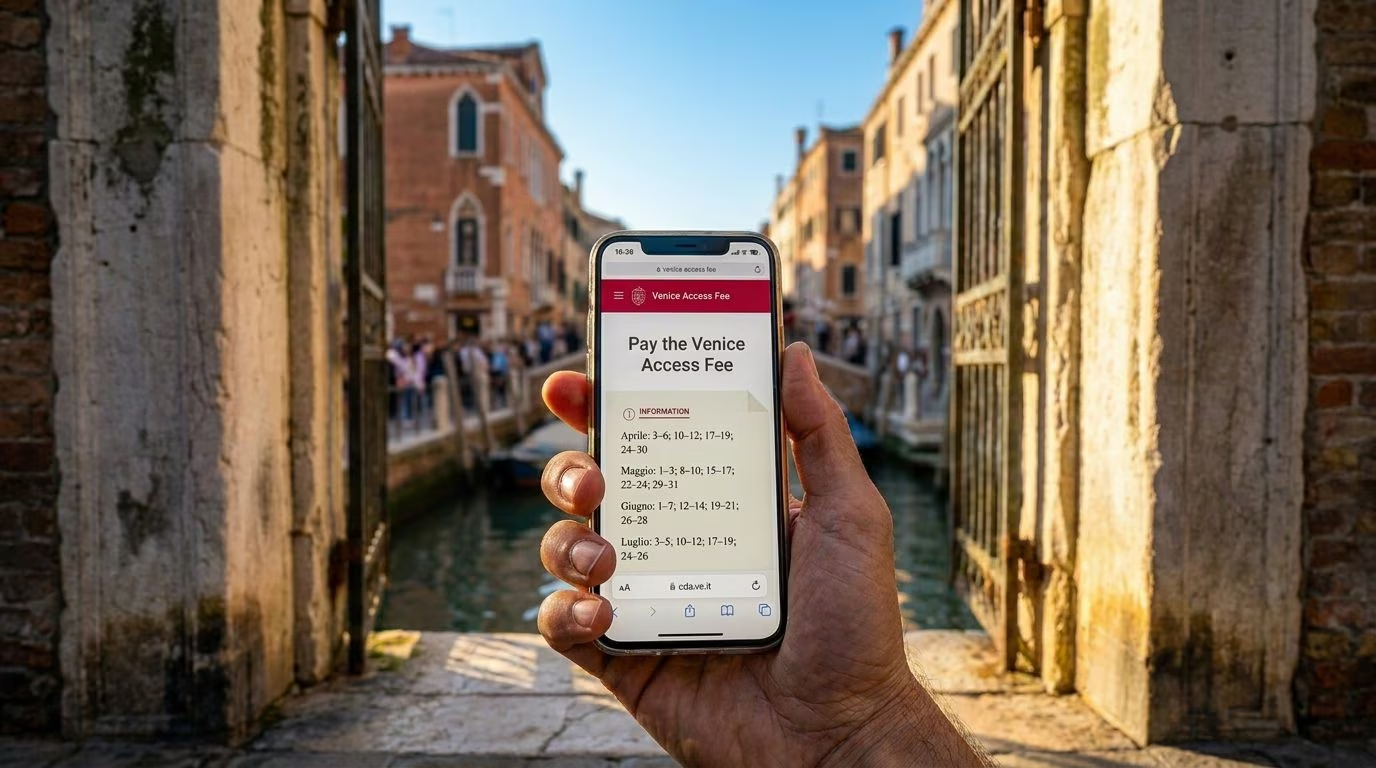
For 2026, access is regulated on specific high-crowd days, between April and July, and requires daily visitors to make a contribution with a cost that varies depending on the advance payment on the reservation, payable on the official website cds.ve.it.
When was the paid “ticket” to Venice born?
The regulation establishing the access fee, created to combat over-tourism in one of the most visited cities in Europe, was approved by the Venice City Council already in 2019, but the pandemic slowed down its application and so the first experimentation started in 2024. It was the first time in the world that a payment was required to visit a city center (from 8.30am to 4.00pm, in 29 days of the year, weekends and holidays) to daily visitors who do not stay in the municipality, are not residents in Veneto and do not have friends or relatives in the city. In 2024, 485,000 paying people were registered and around 2,400,000 euros in revenue (much more than expected, and with a minimal loss compared to the investment in structures, staff and information campaigns).
In 2025 the system was expanded, with an extension of the active days: Fridays were also included in the months of applications, reaching 54 days, and the rates were updated, still in force today (5 euros for those who book by the fourth to last day before the visit, 10 euros for those who do so in the three previous days). In 2025, the system issued over 720,000 paid daily visitor vouchers from 18 April to 27 July, for a total revenue of approximately 5,400,000 euros. For the moment, an access ceiling has not yet been established, which would therefore regulate the number of people authorized to access: also for this reason, the flows (which increased in 2024 compared to the previous year) have not seen significant drops.
How the paid ticket works from April to July 2026
In 2026 there was a further extension of the days, increased to 60 starting from 3 April. The ticket continues to be active from 8.30am to 4.30pm, with mandatory booking through the cda.ve.it website, followed by the receipt of a QR code which must be shown in the event of checks – and from this year these take place in a more widespread and intransigent manner. The cost is:
- €5.00: By booking in advance (within 4 days before);
- €10.00: By booking in the last 3 days before the visit.
The complete calendar of days for 2026 is as follows:
- April: 3–6; 10–12; 17–19; 24–30
- May: 1–3; 8–10; 15–17; 22–24; 29–31
- June: 1–7; 12–14; 19–21; 26–28
- July: 3–5; 10–12; 17–19; 24–26
Anyone visiting the city outside these dates does not have to do anything. Furthermore, for 2026, the contribution is not required for access to the smaller islands: Murano, Burano, Torcello, Lido di Venezia, Pellestrina, Sant’Erasmo, Mazzorbetto, S. Andrea, S. Servolo, Poveglia, Mazzorbo, Vignole, La Certosa, S. Clemente, Sacca Sessola. Furthermore, the contribution is not required for those who access exclusively the areas of the Ponte della Libertà, Stazione Marittima and Isola Nova del Tronchetto, P.le Roma, Ferrovia di Santa Lucia and the area directly connected to P.le Roma and Stazione di San Basilio, without accessing the Ancient City.
Residents or those born in the Municipality of Venice or Veneto, children under the age of 14 are also exempt from any payment – just show an identity document proving it. Workers (including commuters), students attending institutions based in the ancient city or on the islands and people with disabilities are also exempt. Tourists who stay overnight in the Municipality’s accommodation facilities (who therefore already pay the tourist tax), people who participate in sports competitions, relatives and friends of residents, and others will not have to pay, but still register and reserve their access and fill out the substitute declaration.
Not just Venice: other examples in Italy
Venice was the first city in the world to introduce a daily entrance tax to the historic center, but it is no longer the only one to adopt measures aimed at combating over tourism, including entrance fees, taxes and tourist caps.
Since February 2026, in Rome, a 2 euro ticket has been in force for tourists and non-residents (excluding residents of Rome and the Metropolitan City, people with disabilities and children up to 5 years) to access the basin of the Trevi Fountain, on Mondays and Fridays from 11.30am to 10pm, on other days from 9am to 10pm. The site records an average of 30,000 accesses per day, with peaks of 70,000, for a total of over 9 million visitors a year. Tickets can be purchased at the entrance, online on the fontanaditrevi.roma.it website, in the ticket offices of the Museum System, in the Tourist Infopoints and in affiliated sales points. Access to the square and the view of the fountain from afar still remain free and together with this “closure” of the fountain area, however, access to some museums that had previously been paid for by all was made free for residents, such as the Capitoline Museums, the Museums of the Imperial Forums, the Ara Pacis Museum and others. From 2023, access to the Pantheon, previously free, also became paid, upon reservation and purchase of a 5 euro ticket (with a reduced price of 2 euro).
In Civita di Bagnoregio, in the province of Viterbo, on the days of maximum attendance (Saturday, Sunday, holidays) the purchase of a 5 euro ticket is required: every year “the dying city”, with its dozen inhabitants, welcomes over 700 thousand people from all over the world. The Archaeological Park of Pompeii, in the province of Naples, which welcomed 4 million tourists in 2024, has introduced, for protection and safety reasons, starting from November 2024, a daily limit of 20 thousand visitors, with the purchase of a nominative ticket until capacity and time slots are exhausted. Among the beaches, that of La Pelosa, in Sardinia, for example, has limited daily access to 1,500 people, through reservation and payment – this also happens in other beaches in the region, but also in Tuscany, Liguria, Campania, Marche, Puglia, Sicily.
In Liguria, in the Cinque Terre, since 2001 to access some of the most popular paths (the Sentiero Verde Azzurro, i.e. the coastal stretch that connects the villages, and the Via dell’Amore) the Trekking Card of the Cinque Terre Park has been necessary, for a fee, personal and non-transferable – with a cost of 10 euros per day for adults, which rises to 15 on busy days, such as weekends and in high season – which however also allows visits guided tours, use of buses, free use of toilets and other benefits. This year it is active from 14 March to 2 November 2026.