The interesting part is not that it is a family winery: there are many in Italy. The interesting part is how this family dimension was transformed into a possible business model for Cantina Amadei.
The story begins in 1961, when the brothers Franco and Renato Amadei started the wine business. It is not the usual tale of the “heroic small producer”: it is a path of consolidation, investments and progressive focus on the corporate identity.
From the small workshop of the Sixties to the farms, from the extensions to the farmhouse, up to the online shop. The entrepreneurial key lies right here: having built over time not an abstract brand, but a supply chain ordered around a precise geography. In a sector where the risk of slipping into the brochure is always around the corner.
The business model starts from the vineyard
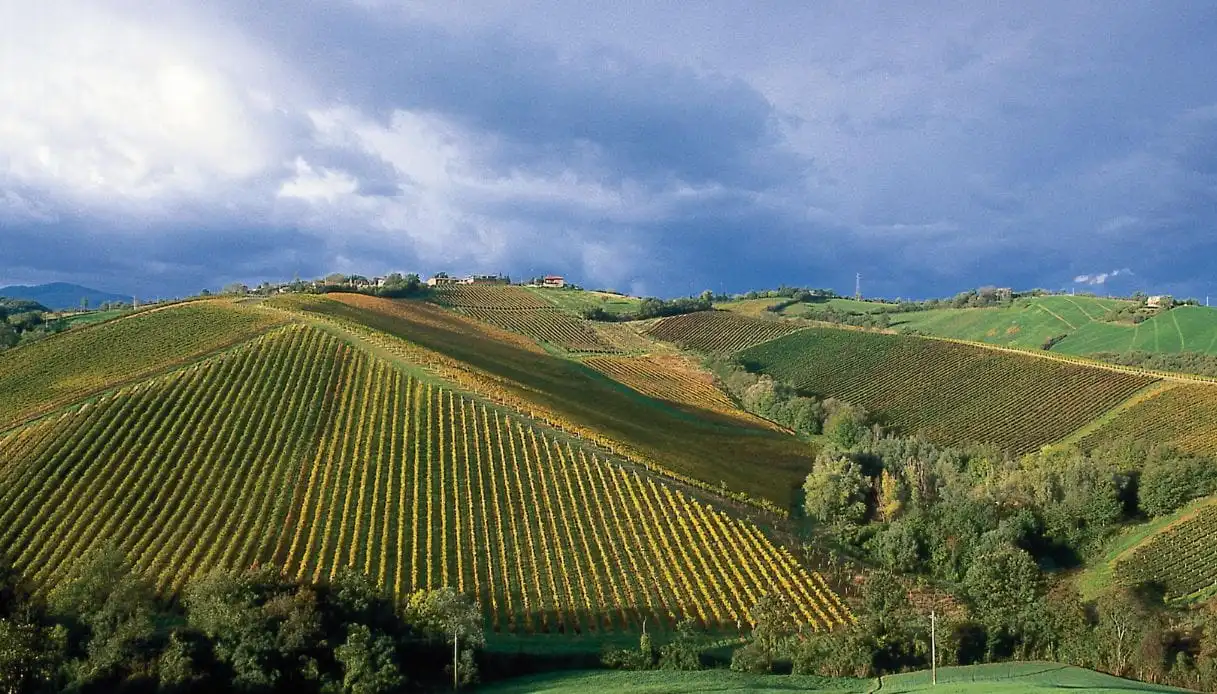
The heart of the model is territorial specialization. The company today declares a wide range of PGI and PDO wines obtained from grapes from its own vineyards and from a network of local producers; on the production front it speaks of approximately 40 hectares in total, of which approximately 29 are under vineyards, located between 270 and 330 meters, with manual harvesting. The scale is not that of large groups, but it is sufficient to transform proximity into a competitive advantage: control of the raw material, stylistic recognisability and coherent narrative of the territory.
The range follows the same logic. Sparkling and still reds, sparkling and still whites, rosés and bubbles: a portfolio that does not chase dispersion, but interprets local vocations in various forms. In other words: the winery moves between denomination and flexibility, between DOC and IGT, without losing the Parma center of gravity.
Sustainability as a method, not as a framework
If you are looking for a distinctive feature, however, it is not enough to stop at the product portfolio. Quality and sustainability are the two guiding objectives of the development model of the Amadei Winery.
In his philosophy he states that since 2020 he has embraced organic farming in his vineyards, to focus on practices capable of limiting soil erosion and run-off, promoting biodiversity and preserving the rural landscape; he also adds that he does not resort to irrigation in the vineyards. It is an interesting fact because it shifts the discussion from “green” marketing to the structure of the production process itself.
Even more interesting is the chapter on circularity. Cantina Amadei focuses on a production model that is as zero kilometer as possible, purchasing grapes, musts and wines only from neighboring territories, encouraging direct sales and direct delivery to shorten the supply chain.
This is accompanied by practices that are very popular in Northern Europe: returnable bottles for bottles purchased in the cellar or delivered to your home, collection of cork stoppers for reuse and exclusive use of electricity from renewable sources, with the help of two solar systems which came into operation in 2024 between the cellar and the farmhouse.
Translated from the corporate lexicon to the economic one: less dispersion, more control, more coherence.
Digital does not replace the winery, but expands its market
In this context, e-commerce is not an ancillary detail. Cantina Amadei sells online with shipments throughout Italy and organizes the catalog by product families, making the offer immediately understandable.
For a wine SME, the financially relevant point is precisely this: transforming the local identity into an offer that can be purchased without superfluous steps.
Reputation and positioning also depend on teamwork
The company is among the associated wineries of the Parma Wine Consortium, which works to strengthen the positioning of the Colli di Parma DOC within the territorial system of the Food Valley, focusing on catering and hospitality as development levers. It is a crucial detail: for a reality like this, staying within a collective naming strategy often matters more than seeking isolated visibility.
To this is added the 5StarWines chapter. The 5StarWines – the Book 2026 selection is organized by Veronafiere with Assoenologi, includes in the guide the wines that reach at least 90/100 and presents the selected labels to buyers, journalists and international operators; in 2026, 636 wines were included out of approximately 2,000 samples.
In this context, “Primo Fiore” obtained 91 points and “Eliodoro” 90, entering the 2026 guide; it is not an ornamental stamp, but a commercial positioning tool. Furthermore, the Lambrusco “Primo Fiore” had already emerged in 2023 as the best sparkling wine of the edition, with 92 points, according to the official Vinitaly magazine.
Because the history of Cantina Amadei also speaks beyond wine
The case of Cantina Amadei is interesting for those who look at Italian SMEs because it shows something simple, but not trivial: valorising a territory does not mean simply naming it on the label.
It means organizing production, supply chain, range, sales channels and reputation in a way that is consistent with that territory.