Yesterday the negotiators of the European Parliament, the European Council and the European Commission shared with the press the outcome of the negotiations of the Conciliation Committee on air passenger rights in the European Union, a journey that lasted 13 years, which began in 2013 with the aim of updating the rules which now date back to 2004. As summarized in a tweet on and predictability, and keep the industry competitive.”
The agreement reached by the conciliation committee, which must be definitively approved in July, and which in that case will intervene on passenger rights starting from the second half of 2027, provides in short: greater transparency on hand baggage fees, which must now be included in the starting price; compensation after 3-hour delays and simpler compensation procedures and stronger rights for families and passengers with disabilities. Consumer associations
All the most transparent hand baggage rules and fares
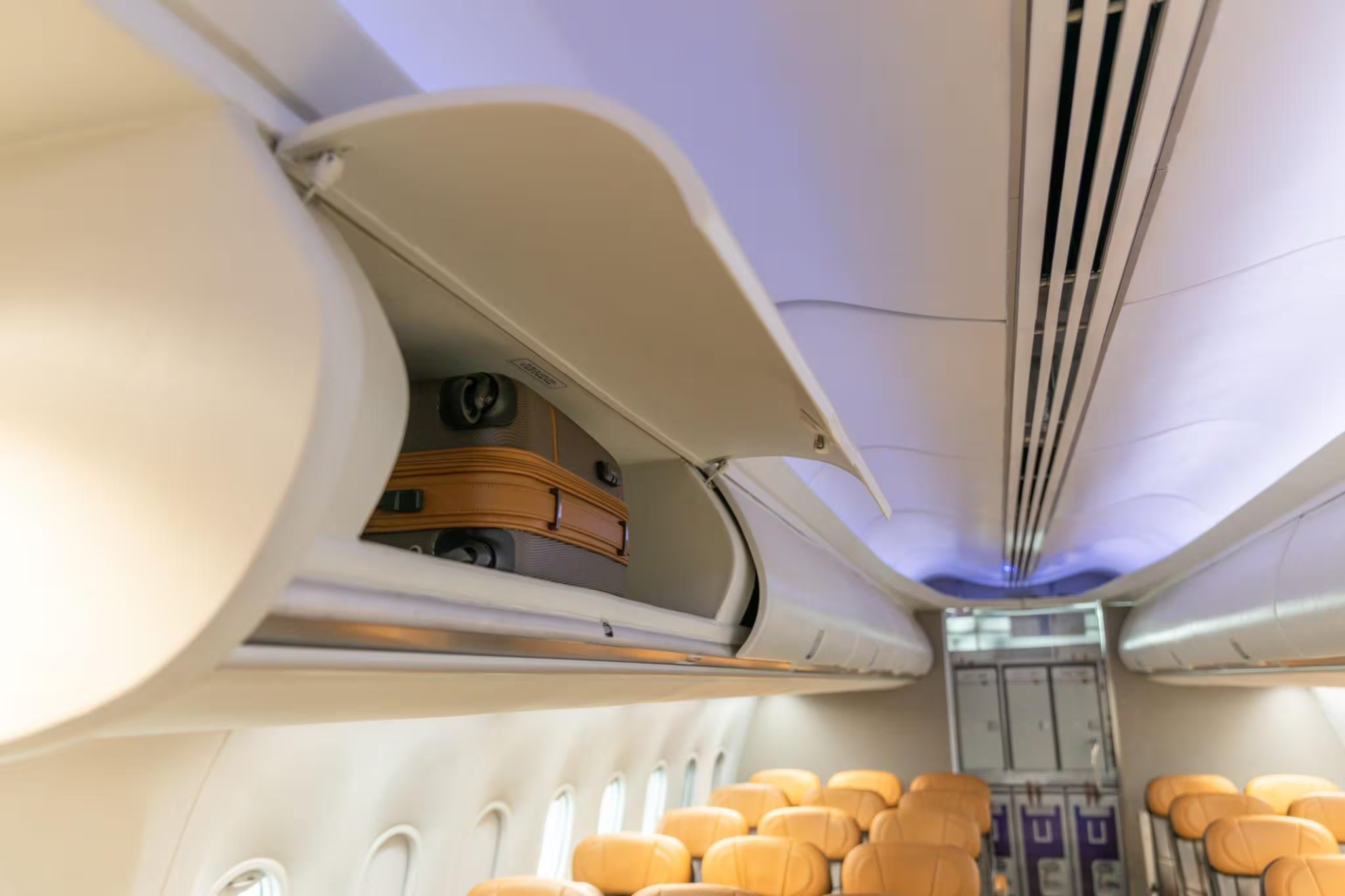
The European Parliament pushed hard to make the classic overhead bin trolley free by law, but in the end airlines retained the right to charge for it as an additional service. However, it changes the way luggage is sold.
There will be no more hidden costs in the end: airlines will in fact be obliged to show the price of the ticket which already includes hand luggage from the first moment of the search. Those who decide to give up their luggage and travel lighter, taking advantage of the basic fare, will receive less promissory note: the companies will then be able to offer a “reduced fare” to those who voluntarily decide to give up the trolley and travel only with a backpack or a bag to store under the seat.
In practice, the basic ticket will be the one “with baggage”, and the one without will be considered a discounted option, exactly the opposite of what happens today. Baggage will continue to cost more, but this should make it easier for travelers to compare fares between different airlines, including on aggregator sites.
It has been confirmed that every passenger always has the right to bring on board, at no additional costa personal object (such as a backpack, a bag or a computer case) that can be stored under the front seat (the dimensions and weight will however be established by the carriers).
Other protections: reimbursements, compensation, assistance
Passengers retain the right to be refunded or re-protected (the airline must organize an alternative journey to take the passenger to the destination anyway), in the event the flight is canceled less than 14 days before departure, in the event of denied boarding or prolonged delays. The right to request compensation remains intact if a flight is affected delay of more than 3 hours and the amount of compensation is confirmed, calculated based on the distance of the flight:
- 250 euros for routes up to 1,500 km
- 400 euros for routes between 1,500 and 3,500 km
- 600 euros for longer flights.
However, companies are not required to pay compensation in the event of “exceptional circumstances” (the perimeter of which, however, will be defined more clearly with precise lists that include natural disasters, severe bad weather, wars, unruly passengers or strikes), but they are still required to provide assistance: drinks every 2 hours of waiting, a meal after 3 hours and, if necessary, an overnight stay in a hotel for up to a maximum of 3 nights. Passengers will no longer be forced to remain on board the plane if their flight is delayed.
Refunds will have to be clearer and faster: the companies will have 4 days (96 hours) of time to provide passengers with clear instructions for requesting a refund, which should not require them to register an account or use specific apps. Airlines will be required to immediately acknowledge receipt of the request and provide a response within 30 days, either by proceeding with the payment of compensation or by providing a clear reason for rejecting the request.
The agreement introduces several new rights, including the prohibition on denying boarding to a passenger for the sole reason of not having taken a previous connected flight (the so-called clause “no show”) or make him pay an additional fee. The practice of “no show” it will be completely prohibited for people with reduced mobility, pregnant travelers and unaccompanied minors.
The right to assistance will be guaranteed for people with disabilities or reduced mobility, children, unaccompanied minors and pregnant women. Persons with reduced mobility (PRM) will have new rights to compensation if airports fail to provide adequate assistance; will enjoy priority rights regarding assistance and re-routing on alternative flights; they will be able to travel with their own mobility aids and assistance dogs without having to incur additional insurance costs and will be entitled to free replacement of their mobility aids if they are lost or damaged.
Airlines will also have to allow parents to bring strollers to the plane door upon boarding and collect them in exactly the same place upon arrival, without necessarily having to check them in at the check-in desk. Finally, families cannot be separated on board: children under 14 must have a seat adjacent to that of a companion at no additional cost.
Who do the rules apply to and what are the next steps
The rules apply to all passengers traveling within the European Union, on flights operated by both EU and third-country airlines, to those arriving in the EU from a third country on board an EU airline and those departing from the EU to a third country with an EU or third-country airline. On the basis of the agreement, the European Commission will evaluate within 3 years whether the scope of application of the regulation should be reviewed and potentially fully extended also to operators from third countries. To make it clearer to passengers which airlines are covered by EU rules on passenger rights, a voluntary label will be introduced which will be displayed during the booking process.
The agreement reached today will still have to be formally approved by both the European Parliament and the Council, after the legal-linguistic revision of the text: according to the so-called “third reading” procedure, both institutions now have six weeks to decide on the agreement – a deadline which can be extended by a maximum of another two weeks. The most probable scenario involves definitive approval, but if someone were to vote against the act it will not be adopted and we will have to start from scratch with a new proposal. The European Parliament plans to vote on the agreement during its plenary session in July. Once approved, it must be published in the Official Journal and allow the companies time to adapt,
However, it remains an agreement defined as “historic”. In fact, it required the intervention of the conciliation committee, which brings together representatives of the 27 member states and as many deputies of the European Parliament, with the Commission present to reconcile the different positions. Between 2014 and 2025, no conciliation procedures had ever been initiated and in 2026, for the first time in 10 years, the committee was convened to discuss the proposal for air transport passenger rights.