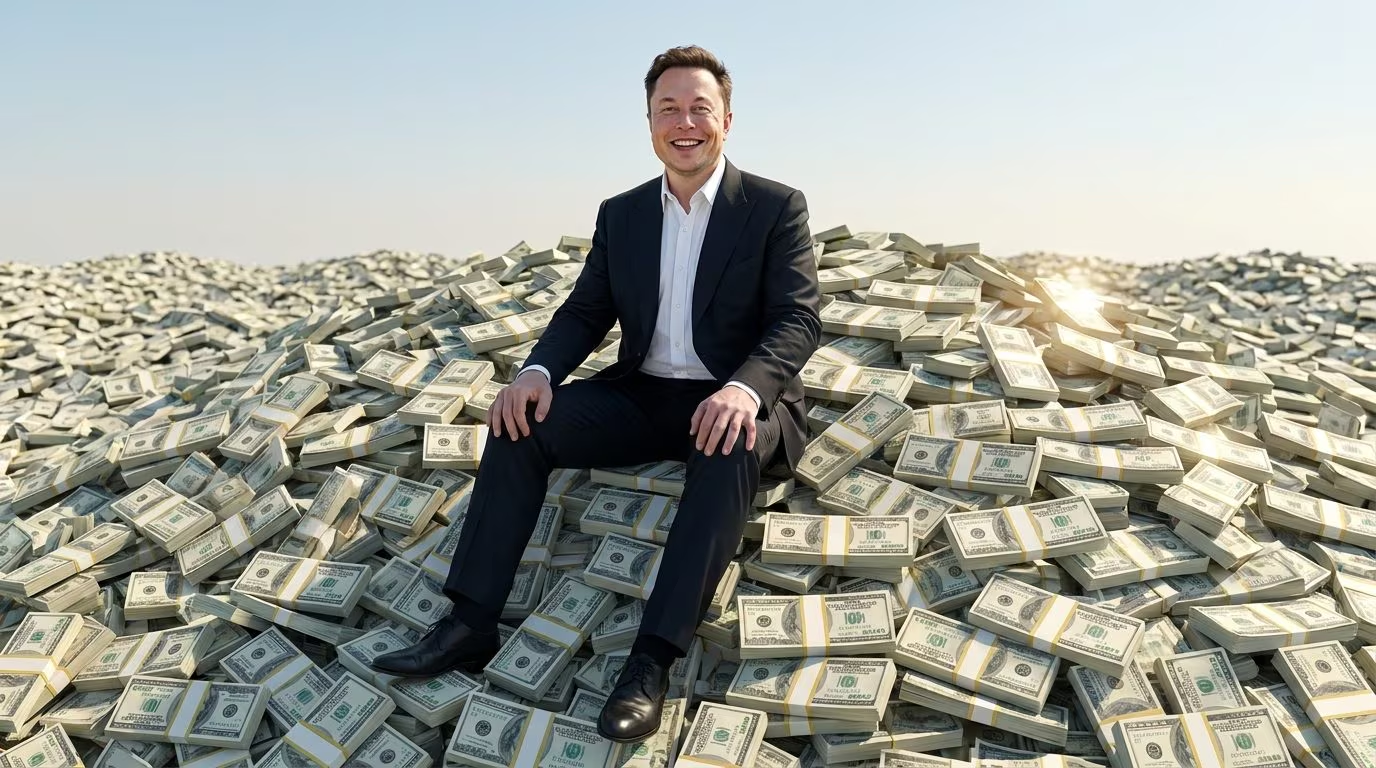
Elon Musk has officially become the world’s first trillionaire. His estimated assets have reached and exceeded one thousand billion dollars, a figure which in English is indicated by the term “trillion”.
The achievement of this goal depended on the debut on the stock exchange (IPO) of the space company SpaceX, which he founded, and its listing. With the value of each share listed at $150, Musk’s stake in the company has exceeded $720 billion. This is in addition to his stakes in carmaker Tesla, valued at around $280 billion, and in neurotechnology company Neuralink and infrastructure firm The Boring Company, which are worth around $10 billion together. In this way, Elon Musk’s estimated wealth has reached almost $1.1 trillion.
Be careful, though: this doesn’t mean that Elon Musk actually has 1.1 trillion in his bank account or stored in a safe. As we said, most of his wealth is made up of shares in his companies. According to what Musk himself declared about X in February 2026, his liquidity would represent less than 0.1% of total assets. In other words, the amount of immediately available money “only” amounts to $1 billion.
When we hear figures so huge and far from our daily experience, we often struggle to understand what they really mean. So let’s try to better understand how much a “trillion” really is and how much it is worth a trillion dollars.
One million, one billion and one trillion: the differences
As we said, a “trillion” corresponds to one thousand billion, that is, to a “1” followed by 12 zeros (1,000,000,000,000). This term is often erroneously reported in Italian as “trillion”, however making an error of 6 zeros. The reason is that English-speaking countries, i.e. those that speak English as their first language, and continental Europe use different systems for measuring and naming large numbers. A bit like what happens with “meters” and “feet” or “kg” and “pounds”, numbers above one million also follow different conventions. Continental Europe uses what is called the “long scale,” while English-speaking countries use the “short scale.”
In both scales the million (or “million”) is equal to a “1” followed by 6 zeros, but from then on the two scales diverge, using terms that are very similar to indicate different quantities. For example, in the American scale the “billion” corresponds to a “1” followed by 9 zeros, i.e. a billion. On the European scale, however, the “billion” corresponds to a “1” followed by 12 zeros, i.e. one thousand billion.
The “trillion” we refer to when we talk about Elon Musk’s assets corresponds to one thousand billion (a “1” with 12 zeros), while the European “trillion” indicates 1 million billion (a “1” with 18 zeros).
It is therefore possible that misunderstandings may arise due to inaccurate translations. Even once this difference is clarified, however, it is not easy to imagine how much a trillion dollars are really worth.
What a trillion dollars are worth in the real world
One trillion dollars is so much that even combining the assets of the other three richest people in the world, namely Larry Page and Sergey Brin of Google and Jeff Bezos of Amazon, we would not be able to reach that figure. The second richest person in the world, Google co-founder Larry Page, has a fortune of around $300 billion, less than a third of Musk’s. His personal wealth is higher than the GDP of entire countries such as Switzerland, Saudi Arabia or the Netherlands: in a purely hypothetical scenario (as mentioned, he doesn’t have all this money in his pockets!) if he spent 1 million dollars in cash every day, it would still take him 2,740 years to exhaust his wealth.
But what does it really mean to be so rich? Let’s try to do a thought experiment and try to understand what we could buy with a trillion dollars.
Let’s imagine we want to offer a 50 dollar dinner (around 43 euros) to all the inhabitants of the city of Rome, around 2.7 million people. Each dinner we would spend around 135 million dollars… a huge amount! For how many consecutive days could we continue to offer dinner to all Romans? Maybe we imagined being able to pay for dinner for everyone for a couple of weeks and already felt incredibly rich… well, with 1000 billion dollars we could continue to offer dinner to the whole of Rome for around 7400 days, which corresponds more or less to 20 years.
Again with this figure, one thousand billion, we could have bought all the tickets for all the dates of Taylor Swift’s Eras Tour, the highest grossing tour in history, 500 times. Or we could have bought all 20 Serie A teams, valued overall at around $5.4 billion, 200 times. Musk could buy all the NBA franchises and still have hundreds of billions left over.
Beyond the most curious purchases, however, with one trillion we could solve problems on a global scale. In fact, we would be able to provide clean, drinkable water in low- and middle-income countries or eradicate world hunger.
According to a UNESCO estimate published in 2021, ensuring universal access to safe water and sanitation would require approximately $114 billion per year. To structurally address the problem of world hunger by solving it by 2030, investing in infrastructure, agricultural development and climate resilience, the United Nations, however, has estimated the need for approximately 93 billion dollars per year.
This means that a trillion dollars would theoretically be enough to fund global interventions on some of humanity’s most pressing challenges for years.