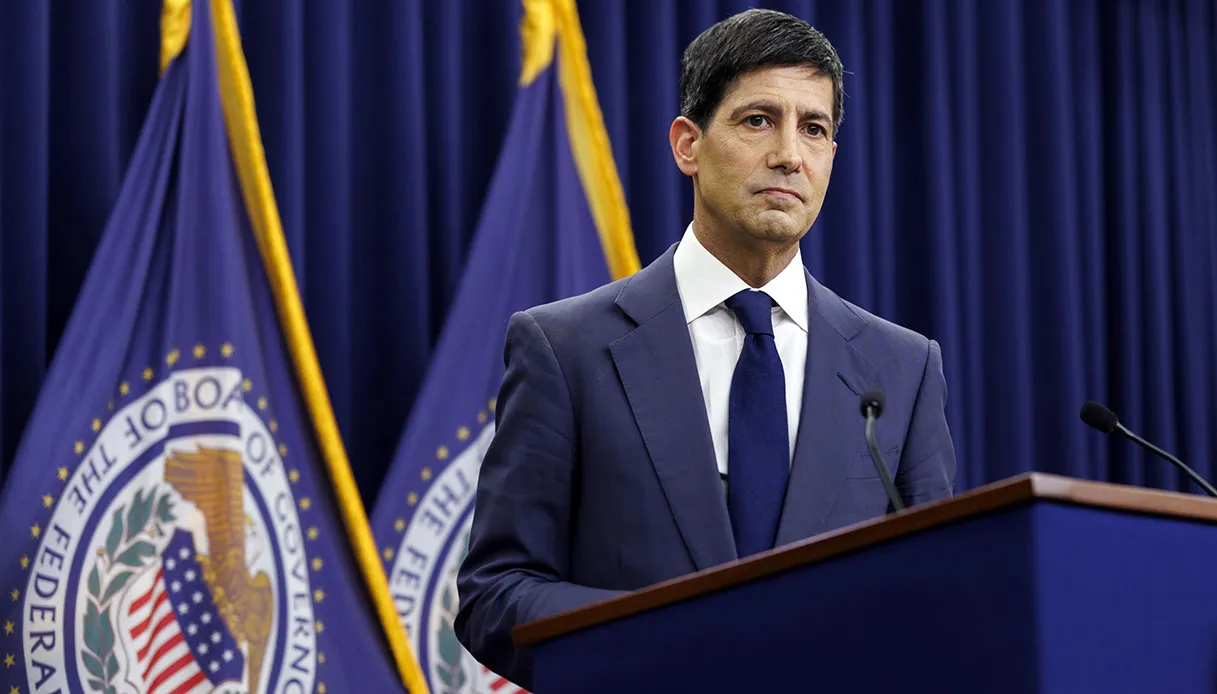
Kevin Warsh, in his debut as president of the Federal Reserve, kept rates steady as expected, but left several signals that took the markets by surprise on the future direction of monetary policy. Stocks reacted negatively, with major indices falling during and after his press conference. Although the FOMC voted without apparent dissent to keep the federal funds rate in the 3.5%-3.75% range, the dot plot showed a clear split.
The division on future moves
The dot plot published by the Fed shows a deep split on the future path of rates: nine of the 19 members of the committee expect at least a quarter-point increase this year, of which six assume at least two, while another eight believe that rates should remain unchanged and only one predicts a cut. Three months ago none of the members foresaw the need for a raise.
The expected median rate thus rises to 3.8%, a sign of a possible increase during the year against initial expectations linked to the appointment of Warsh, chosen by Trump in the hope of rate cuts. The speculation circulating on the eve of the meeting was confirmed: Warsh did not present his own projections on rates. The president, who has long been critical of forward guidance, explained it directly in the press conference:+
“It is the policy of this committee for participants to present these projections, and I have encouraged my colleagues to continue to do so. I, however, have refrained from providing any projections of my own, in keeping with my long-standing positions on the SEP, at least in its current structure.”
The new line
Warsh announced the creation of five task forces, the first concrete step of the promised reform for the Fed: they will deal with communication, the central bank’s balance sheet, data sources on which decisions are based, productivity and work (including the impact of artificial intelligence and other transformative technologies), and the approach to inflation. On the price front, as CNBC pointed out, Warsh used the term “price stability” about a dozen times during the conference. A surprisingly aggressive tone for a president who in the past had often spoken out in favor of rate cuts, speaking of the committee’s “unequivocal and unanimous” determination to bring inflation back under control.
The reactions
On the markets, the reaction was negative: Nasdaq and S&P 500 reached new weekly lows, while the Dow Jones held up with limited losses. On the currency front, USD/JPY rose sharply towards the 160.70 area, approaching the critical threshold of 161, while EUR/USD fell below 1.15 and GBP/USD below 1.33. WTI oil remained unchanged at the lows of the day, while gold and silver fell again. the 2-year Treasury yield rose 14.4 basis points.
Kay Haigh, global head and CIO of Fixed Income and Liquidity Solutions at Goldman Sachs Asset Management, highlighted:
“Today’s meeting confirms that the Fed’s recent tightening turn was not just tied to rising energy prices. Despite the recent drop in oil prices, half of FOMC members expect rate hikes as early as this year, reflecting solid labor market and inflation data. Our baseline scenario remains that the Fed just barely manages to avoid hikes, but the margin is tight and there will be a high premium on upcoming inflation data.”