On June 19, 1846, the first official baseball game in history was played in New Jersey. Alexander Cartwright had written the rules, the result was merciless – 23 to 1 for the New York Nine against the Knickerbockers – and the sport was just born. 180 years have passed since that afternoon, and the game has evolved in every aspect. But there is a question that still excites fans and scientists today: how can a human being throw a ball at the speed of a car on the highway? The world record belongs to Aroldis Chapman, nicknamed the “Cuban Missile,” who on September 24, 2010, hurled a ball at 105.8 miles per hour — about 170.2 km/h. Even today that launch is recognized by Guinness World Records as the fastest ever recorded, although at the time it was initially credited at 105.1 mph (169.1 km/h) and only later updated thanks to a review of the measurement systems. What seems like a superhuman feat actually has a precise and fascinating scientific explanation.
The record: 170 km/h in an instant
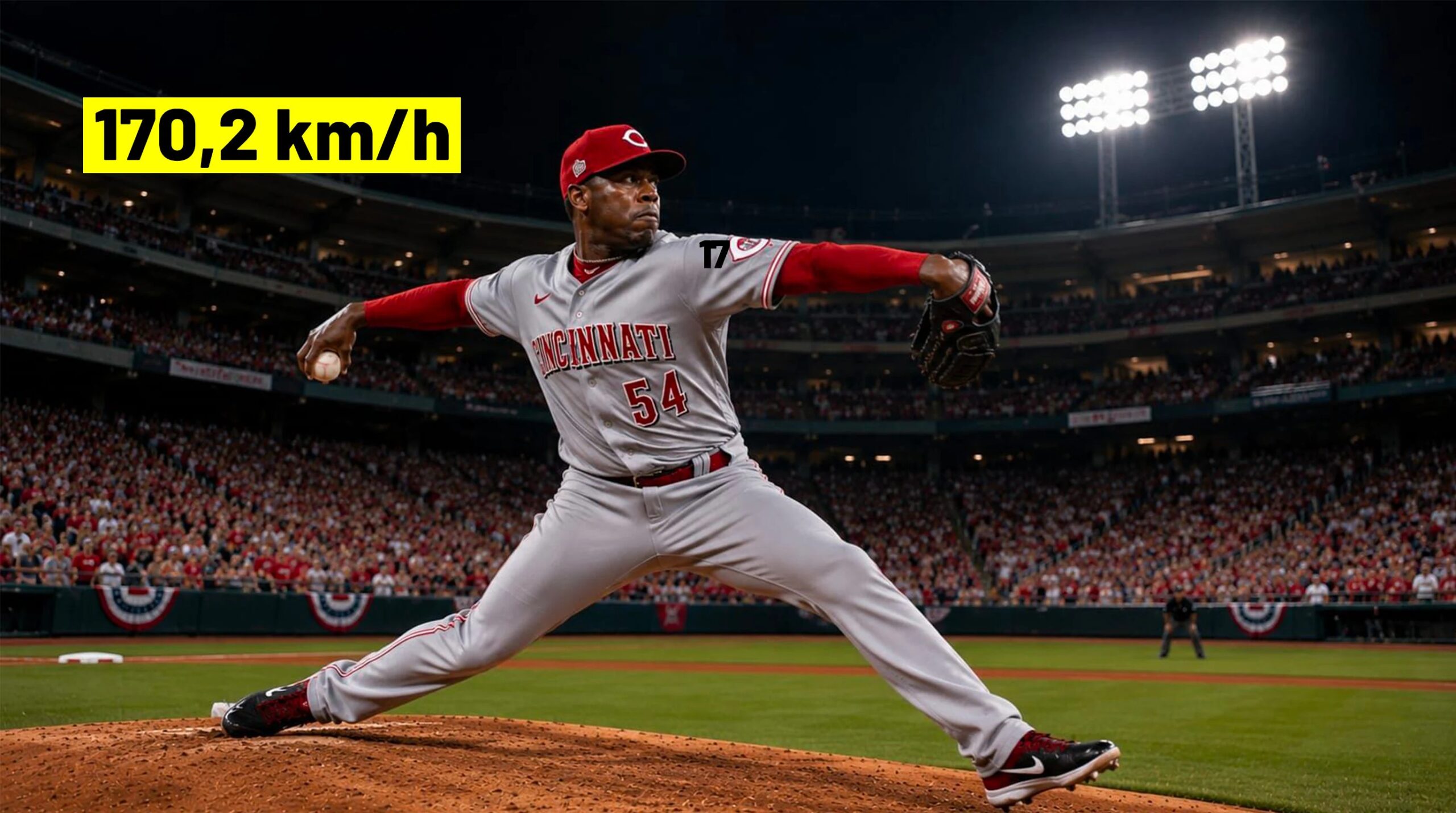
Aroldis Chapman made history on September 24, 2010, when, as a rookie for the Cincinnati Reds, he threw a fastball at 105.8 mph (170.2 km/h) — against the San Diego Padres. Guinness World Records certified that pitch as the fastest ever recorded in baseball.
Nicknamed the “Cuban Missile,” Chapman was not a one-day champion: over the course of his career he made many of the fastest pitches ever measured in MLB, regularly maintaining speeds above 100 miles per hour (160 km/h) well into his thirties. In 2025, at age 37, he was still hitting over 103 mph in a Boston Red Sox jersey, a level of power unprecedented in the history of the sport.
Even today, more than fifteen years after the 2010 record, no pitcher has managed to officially overcome that 105.8 mph barrier.
The physics of throwing: the body like a whip
To understand how a human being can throw a ball at 170 km/h you have to forget the idea of simple arm strength. The devastating speed of the throw arises from the coordination of the whole body, exploiting a principle of biomechanics called kinetic chain: a sequence of movements in which the energy generated by the legs is transferred through the pelvis, trunk, shoulder and arm up to the hand, progressively amplifying as happens in a whip. According to biomechanical studies, over half of the throwing energy is produced by the lower body and trunk, while the arm functions as the last link that transfers this energy to the ball.
One of the most important elements is the so-called hip-shoulder separationthat is, the tiny delay between the rotation of the pelvis and that of the torso. In elite pitchers, the pelvis rotates first while the trunk lags behind for a few milliseconds, accumulating elastic tension in the abdominal and oblique muscles. When this energy is released, the arm violently accelerates the ball.
A study of Vrije Universiteit Amsterdam showed how delicate this mechanism is: by limiting the independent movement between the pelvis and trunk with elastic bands, the speed of the throws immediately decreased. All it took was a few milliseconds of lost coordination to slow the ball down.
In fact, at 170 km/h, a fastball travels the 18.4 meters between the mound and the batter in approximately 0.39 seconds. The hitter has less time than the blink of an eye to understand trajectory and speed and decide whether to hit.
Grip and rotation, it’s not just speed that counts
A record-breaking pitch doesn’t just depend on power, but the way the pitcher grips the ball is also crucial. There four-seam fastballor four-seam fastball, is the pitch of choice for those who want to maximize velocity. In this type of throw, the index and middle fingers press on the seams, giving the ball a rapid backward rotation — the so-called backspin.
This is where aerodynamics comes into play. The rotation modifies the flow of air around the ball generating the Magnus effect: a force that partially counteracts gravity and makes the ball “fall” less than expected. For the hitter, the trajectory therefore appears straighter and faster than he expects.
Then there are variants such as two-seam fastball or the cutterwhich thanks to slightly different grips modify the rotation of the ball, making it deviate laterally in the last few metres. Even though they are often slower, they are much more difficult to intercept.