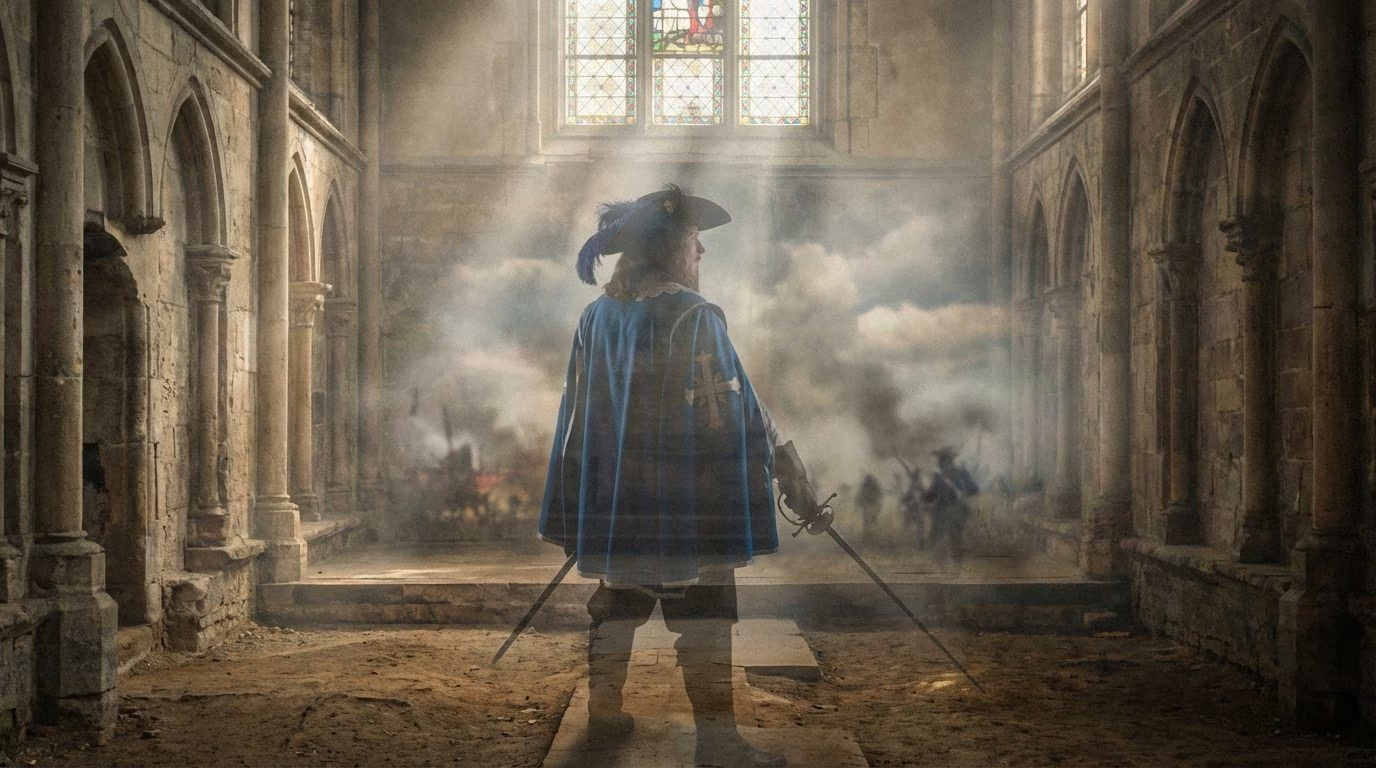
During the restoration of a church in the Dutch city of Maastricht, some workers discovered a skeleton that could be that of the French nobleman and soldier Charles de Batz-Castelmore, known to most as d’Artagnan, whose exploits pushed Alexandre Dumas to write about him in the cycle of adventure and swashbuckling novels “The Three Musketeers”.
The alleged discovery of the “fourth musketeer”
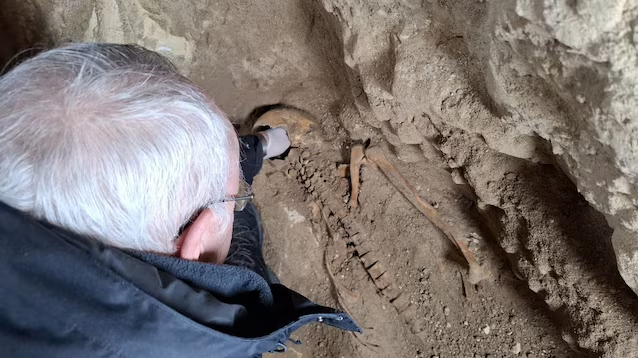
More than three and a half centuries after the death of the heroic French soldier, the mystery of the place of his burial could perhaps finally be solved, given the discovery of some bones under the collapsed floor of a church in Maastricht, that of Saints Peter and Paul in the Wolder district.
Wim Dijkman, a retired archaeologist who spent 28 years searching for the (always unknown) musketeer’s burial site, was called by deacon Jos Valke in a flash.
The skeleton was buried right near the altar, in consecrated ground, and in the tomb there was a French coin of the time. On it the hit of a bullet right at chest level is clearly visible, like the one that killed the valiant warrior. That’s why we immediately thought it was him.
The skeleton is currently in an archaeological institute in Deventer for high-level investigations and in a laboratory in Munich a team of researchers is carrying out analyzes on a DNA sample which will be compared with those provided by the descendants of d’Artagnan’s father to verify the possible presence of a match. Dijkman said:
All kinds of analyzes and investigations are underway, both at home and abroad. We want to be absolutely certain that it is d’Artagnan.
Who was the man behind the real D’Artagnan
Charles de Batz-Castelmore was born between 1611 and 1615 in the castle of Castelmore, in Gasconya historic region located on the border between France and Spain. Of provincial and modest nobility, in the 1630s he left his native land to arrive in Paris, taking his mother’s name, “D’Artagnan”, for a question of prestige (his mother was in fact the daughter of the lord of Artagnan, a municipality in Occitania).
In 1635 it became part of the Musketeers of the Guard under Louis XIII, and in 1657 he assumed command. With his charisma and his formidable military skills, he soon became Cardinal Mazarin’s trusted man and the “operational” right-hand man of Louis XIV.
It was he who carried out the sensational arrest of the French finance superintendent Nicolas Fouquet in 1661. Fouquet was in fact investigated for embezzlement of public funds and, above all, treason. In fact, the politician was not particularly clever, because he shamelessly displayed a wealth superior to that of the king, unleashing his anger and envy following a sumptuous party in the castle of Vaux-le-Vicomte. That was just the straw that broke the camel’s back.
As Captain-Lieutenant of the Musketeers, D’Artagnan reorganized the corps making it a military elite, and at the same time for a certain period he was also governor of Lille, although he preferred the battlefield to bureaucracy.
The brave musketeer died struck by a musket bullet 25 June 1673during the siege of Maastrichta turning point in the Dutch War which saw France and England between the United Provinces (now the Netherlands). Despite his death, the siege was a triumph of military strategy on the part of his company, especially thanks to the parallel trenches designed by the engineer Sébastien Le Prestre de Vauban.
His valiant death consecrated him as a heroic fighter ready to do anything for his homeland, also inspiring the pen of Alexandre Dumas, becoming the protagonist of his most famous novel, “The Three Musketeers” of 1844.
Dumas’ book has since been adapted into film several times, with d’Artagnan played by actors of the caliber of Douglas Fairbanks, Michael York, Chris O’Donnell, Logan Lerman and François Civil. The character became so famous that he even became a sword-wielding beagle in the early 1980s animated series “The Dogs and the Three Musketeers.”