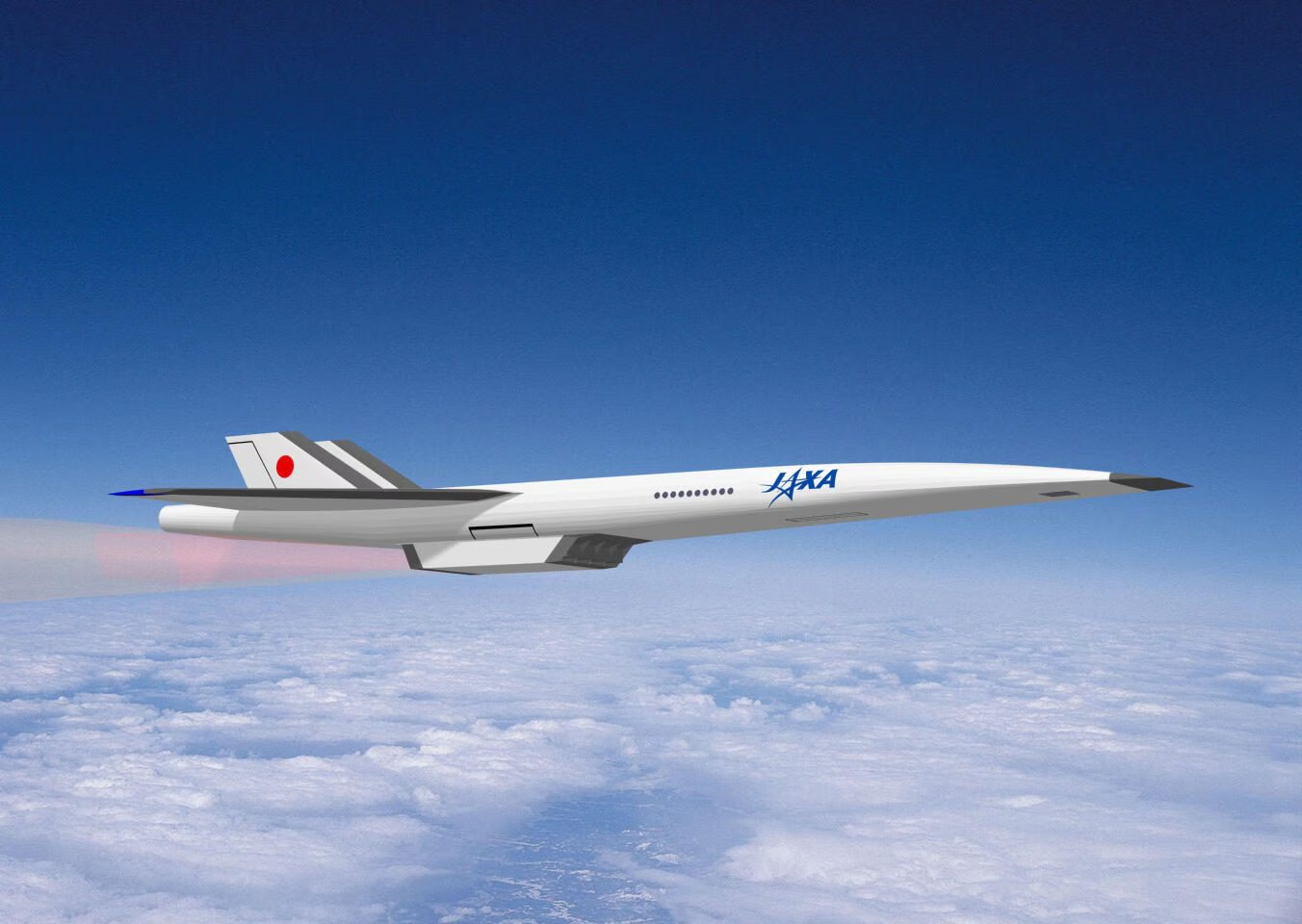
The Japanese Space Agency (Japan Aerospace Exploration Agencyalso known as JAXA) successfully conducted a ground combustion test for the Japan’s first hypersonic experimental aircraftcapable of simulating flight conditions at Mach 5 (five times the speed of sound), reaching approximately 5,400 km/h and reaching an altitude of approximately 100 km. To be clear, a normal airliner generally flies between 9,200 and 12,200 meters above sea level, at a maximum speed of around 1,000 km/h.
The experiment, conducted in April 2026 together with the University of Wasedaat the University of Tokyo and the University of Keiomakes the hypothesis of being able to cross the Pacific Ocean, between America and Asia, in just 2 hours more concrete. The final objective, clearly, is to allow the entry into service of the first hypersonic passenger plane: according to rumours, however, the project will not be operational before 2040.
The technical characteristics of the experimental aircraft
The main challenge of a hypersonic aircraft is the heat. At Mach 5, the compression and heating of the air brings the temperature around the airframe to around 1,000°C, enough to destroy materials and electronic components. For this, the experimental aircraft was designed with a lightweight, heat-resistant structure, combining heat-resistant materials and heat-shielding structures. The goal was to achieve that the interior of the aircraft (including equipment) remained operational during the flight simulated, despite extreme external temperatures: the test was concluded successfully.
The other big challenge concerns the relationship between the body of the aircraft and the engine, which in this specific case is a motor statoreactor (commonly called ramjet) powered by hydrogen. On a normal airplane, the two elements are designed almost independently. At hypersonic speeds, however, this no longer works: The way the air flows around the fuselage directly affects the engine, and the engine in turn changes the behavior of the aircraft in flight. It’s a system where everything influences each otherand for this reason the fuselage and engine must be designed and controlled as if they were one.
The history of the project: it could become reality after 2040
The project was not born from the enthusiasm of the moment. This specific one research program, focused on integrated control between fuselage and propulsion, was started in 2013funded by the Japan Society for the Promotion of Science, with Waseda University as the lead institution and JAXA as the lead partner.
The test of April 2026 was built at the JAXA Space Center in Kakuda, with a experimental aircraft of about 2 meters: Specifically, scientists conducted combustion experiments in a hypersonic wind tunnel that simulated flight conditions at Mach 5, using the Jet Engine Test Facility. This experiment confirmed the validity of the integrated design of aerodynamics, propulsion and structure.
The next step, according to Waseda University, will be to carry out new flight experiments at Mach 5 by mounting the hypersonic aircraft on a sounding rocket or similar vehicle. Only after this test will the program be able to enter the next phase, which could lead to the development of a hypersonic passenger plane. However, the timing is realistic: lCommercialization is expected after 2040with at least 15 years of work still ahead.