Some sports are born from games or traditions and become real competitions. In Finland, Wife Carrying is an obstacle course carrying a person on your shoulders, while Mobile Phone Throwing consists of throwing an old phone as far as possible. In England, Cheese Rolling involves chasing a wheel of cheese rolling down a hill.
In the United States, the Mudpit Belly Flop rewards diving into the mud that creates the most splashes, while the Pillow Fight is a tournament-style pillow fight. In New Zealand the Sheep Shearing Championships measure speed and precision in wool shearing.
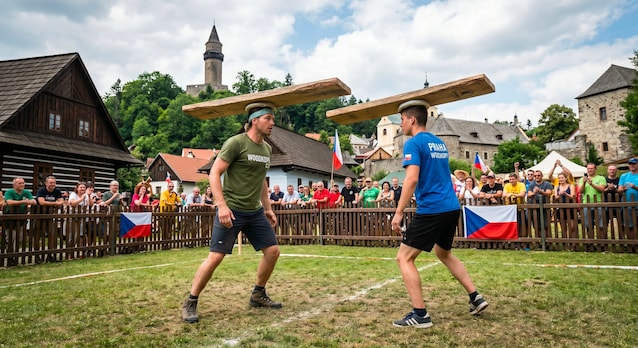
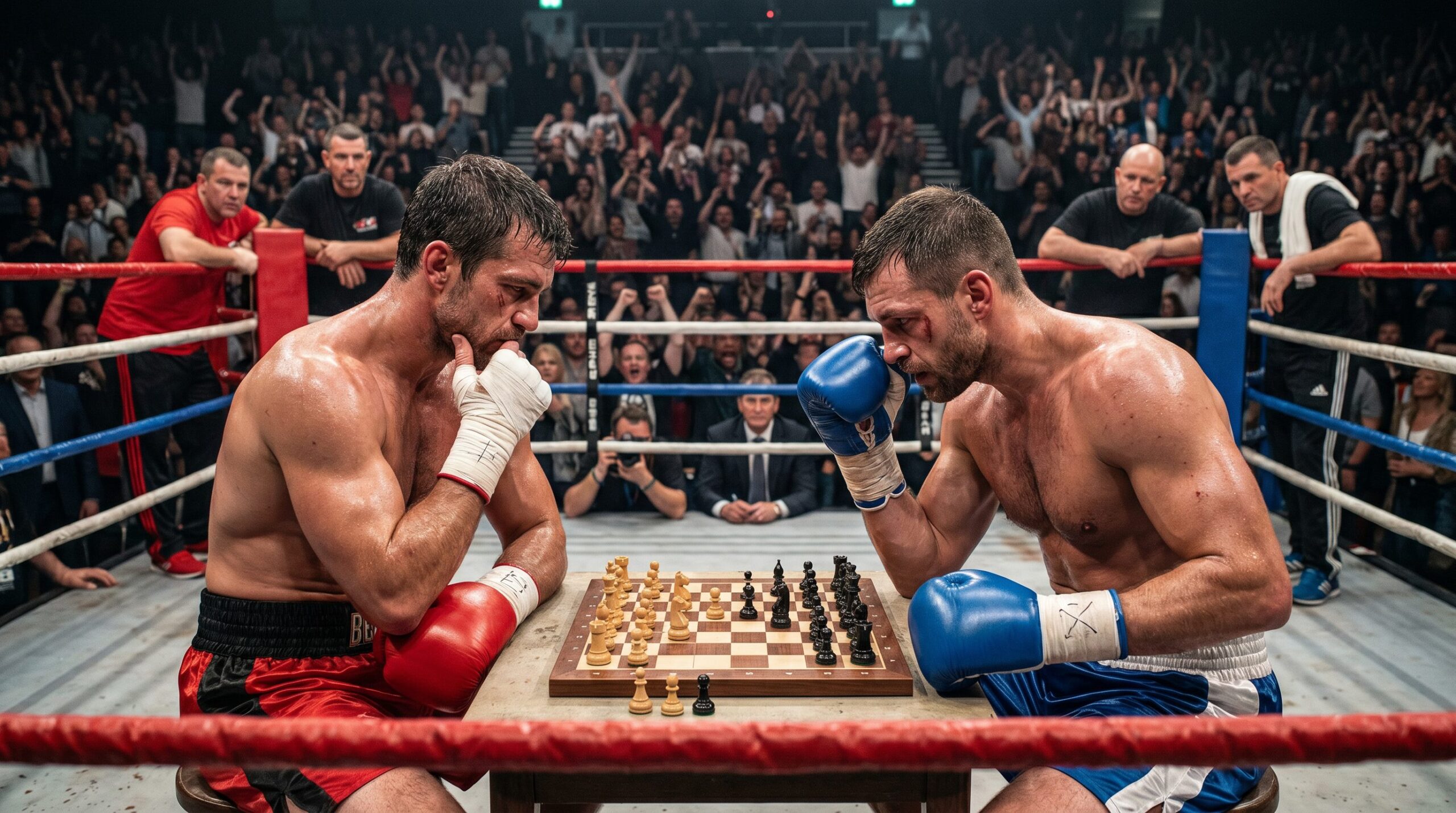
In Europe Fingerhakeln is a challenge of finger strength, in Timbersports people compete in cutting wood with professional tools, while Chess Boxing alternates boxing and chess and Woodkopf requires balance with a board on the head.
- 1Wife Carrying, transporting your wife to Finland
- 2Mobile Phone Throwing, the launch of the phone in Finland
- 3Cheese Rolling, launch of English cheese
- 4Mudpit Belly Flop in the United States
- 5Pillow Fight, pillow fight
- 6New Zealand Sheep Shearing Championships
- 7Fingerhakeln, finger fight
- 8Timbersports, challenge between lumberjacks
- 9Chess Boxing, chessboxing
- 10Woodkopf in the Czech Republic
Wife Carrying, transporting your wife to Finland
Wife Carrying is a couples competition in which a competitor must run along an obstacle course carrying a partner in the shortest time possible. The official course measures 253.5 meters and alternates sand, solid obstacles and a pool of water approximately one meter deep.
Despite the name, the “wife” does not necessarily have to be such: she just needs to be at least 17 years old and weigh a minimum of 49 kg (otherwise an extra load is added). The origins of this discipline are often traced back to Finnish tradition and the figure of the brigand Herkko Rosvo-Ronkainen, who according to a popular legend trained his men to run carrying weights during raids in villages. Today it is a fully organized competition: since 1992 an annual world championship has been held in Sonkajärvi in July, with official regulations and categories.
Among the prizes for the winners there are Finnish design objects, awards for the most original costumes and, above all, a decidedly curious reward, namely a quantity of beer proportionate to the weight of the partner transported.
Mobile Phone Throwing, the launch of the phone in Finland
Mobile Phone Throwing is a competition in which the person who throws a phone as far as possible wins. Born in Finland around 2000, it has curious origins: an interpreting company proposed that employees throw away old cell phones to “reduce stress”, giving rise to the first competitions which later evolved into real world championships which take place every year in Savonlinna.
The world record belongs to the German Tom Philipp Reinhardt, who threw a phone a distance of 135 meters. The races include multiple categories: pure distance, freestyle and team or junior events. Finally, the phones used must have a minimum weight (generally over 200 grams) and are provided by the organization. The rules are simple but strict: the competitor cannot cross the throwing line and the phone must land within the valid area.
Cheese Rolling, launch of English cheese
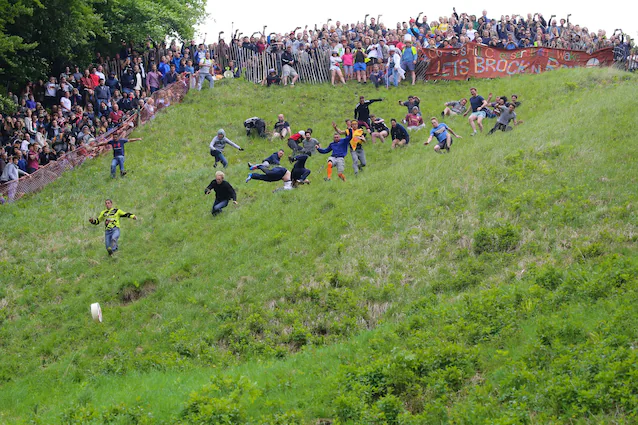
The Cheese Rolling takes place every year in Gloucester, England, along Cooper’s Hill where a 4kg wheel of Double Gloucester cheese is started with a one second head start and rolls down a slope of approximately 180 metres. Participants chase it at full speed, but the extreme slope makes falls and rolls practically inevitable. Whoever manages to reach the finish line at the bottom of the hill first, winning the cheese, wins.
Mudpit Belly Flop in the United States
The Mudpit Belly Flop is one of the most bizarre sports born in the United States, linked to the so-called Redneck Games, a fun competition that took place in Georgia between 1996 and 2012.
The competition consists of a simple belly dive into a pool of artificial mud: participants launch themselves free body with the aim of creating as many splashes as possible. It’s not the speed or technique that counts, but the impact of the jump. The pool is specially prepared and must have sufficient depth to guarantee a spectacular dive, which is evaluated based on the “performance” of the sketch produced.
Pillow Fight
Pillow Fight (pillow fighting) is a true discipline born in North America, whose first structured league, the Pillow Fight League, was born in 2004 in Toronto thanks to former drummer Stacey P. Case, during a concert in which the dancers on stage started throwing pillows at each other.
The matches took place in the ring with precise rules (no prohibited blows, only pillows), lasted about 5 minutes and, in case of a tie, the referee decided; the league spread to several North American cities before closing in 2011.
The Pillow Fight Championship was then born in the United States, which made the sport more structured: 3-round matches of 90 seconds, reinforced pillows of around 1 kg and categories by weight and experience. The first official event in 2022 saw winners Istela Nunes and Hauley Tillman, rewarded with approximately $5,000 and a belt.
New Zealand Sheep Shearing Championships
The Sheep Shearing Championships are a competition born from an agricultural activity and now widespread internationally. The main event is the Golden Shears World Shearing Championships in Masterton, New Zealand, which has been running since 1961 and is also followed on TV. The main competition consists of shearing the greatest number of sheep in the shortest time possible, following precise techniques evaluated by the judges. The competitions are divided into categories and can be individual or in pairs.
Among the best-known records stands out that of the New Zealand couple David Fagan and Sir David Wallace, who in 1999 together sheared 1,637 sheep in 9 hours. The World Cup takes place every 2-3 years and has been hosted by eight different countries: New Zealand, England, Australia, Wales, Ireland, South Africa, Norway and France.

Fingerhakeln, finger fight
Fingerhakeln, or finger fighting, is a typical Bavarian and Austrian tradition that has become a real sporting competition. Participants, divided by weight and age, sit facing each other and pull a leather ring using a single finger. The objective is to drag the opponent over the table: whoever manages to do it first wins.
Despite its unusual appearance, the discipline requires intense training, with specific exercises for finger strength and pain resistance. In fact, injuries such as cuts, fractures or dislocations are common. The origins are not entirely certain, but it is thought that Fingerhakeln was born in the 19th century as a traditional method of resolving disputes between people quickly and “physically”, before becoming a regulated sport.
Timbersports, challenge between lumberjacks
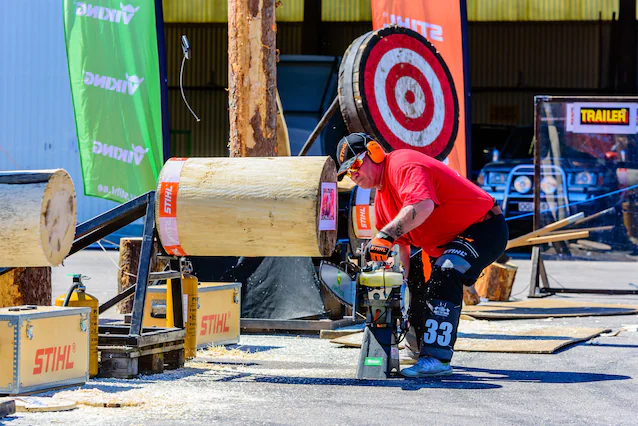
According to legend, Timbersports were born in 1870 in Ulverstone, when two woodcutters competed to see who could fell a tree the fastest. Since then, competitions have spread, until the birth of the first official rules in 1890 and, later, the definition of the six main disciplines still in use today.
The competitions include six main disciplines, including axe, saw and chainsaw cutting, as well as the famous Springboard, in which a trunk is cut while balancing almost 3 meters from the ground. The main tournaments are the Individual World Championship, the European Nations Cup and the Champions Trophy, with events also followed on TV and online. Winners receive cash prizes of up to $100,000 in major competitions.
Chess Boxing, chessboxing
Chess Boxing is a hybrid sport that alternates rounds of boxing and chess matches. The idea was born by Dutch artist Iepe Rubingh, inspired by a comic novel, in which a boxing match was followed by a game of chess between the two opponents.
The matches take place in alternating rounds: chess rounds and boxing rounds, up to 11 rounds in total, with victory by checkmate or knockout. The first world championship was held in Amsterdam in 2003 and was won by the creator Rubingh. Today the discipline is regulated by the World Chess Boxing Organization (WCBO).
Woodkopf in the Czech Republic
Woodkopf is a sport born in the Czech Republic, whose name literally means “wooden head”. The idea was born in 1992 during a cultural festival in Prague and then spread to various areas of the country.
In Woodkopf, players must balance a wooden board on their head and move around a fenced field trying to knock their opponent’s board down, without direct contact. The board weighs approximately 3-4 kg and can be made to fall by hitting it or making someone else’s balance difficult. Victory comes when you manage to make your opponent’s board fall twice.