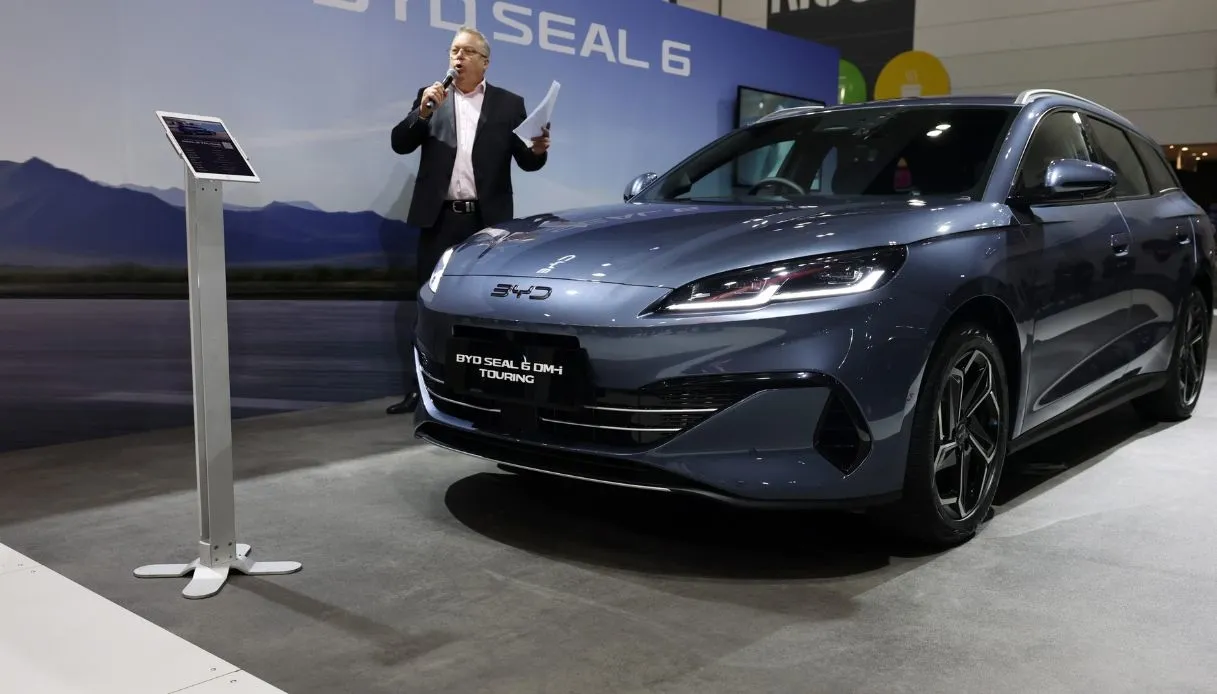
In recent years, the advance of Chinese manufacturers in the European automotive market – initially considered outsiders – has turned into a challenge for the continent’s large historic groups. Of all of them, BYD is probably the brand that is accelerating its growth more than any other and is now aiming for an even more ambitious goal: to no longer be perceived as a manufacturer that exports cars to Europe, but to become a truly European manufacturer.
The strategy has been clearly outlined by the company and is developed over a five-year time horizon. A plan that involves production, models, infrastructure, commercial network and brand positioning.
BYD’s growth in Europe is already a reality
During 2025 BYD recorded a growth in sales in Europe of 270%, reaching almost 188 thousand registrations. The brand has now firmly entered the ratings of European motorists looking for an alternative to traditional manufacturers, in a now favorable market context.
According to the latest data for May 2026, car registrations in the area consisting of the European Union, the United Kingdom and EFTA increased by 3.6% compared to the same month in 2025, while in the first five months of the year growth reached 4.5%.
Electrified vehicles are driving the sector above all. Fully electric cars saw an increase of 40% year-on-year in May and more than 30% in the January-May period, reaching a market share of 20%. And it is precisely in this sector that Chinese car manufacturers are gaining ground at an impressive speed. Overall they reached a 12% share of the European market, almost double compared to a year ago. BYD, in particular, has surpassed another Chinese giant such as SAIC Motor in volumes, confirming its ability to expand.
BYD’s plan: produce cars directly in Europe
One of the central elements of BYD’s strategy concerns the localization of production. The company has understood that to be considered European it is not enough to sell cars on the continent. We need to produce them locally, create local employment and integrate into existing industrial supply chains.
For this reason the first major investment is represented by the new factory in Szeged, Hungary. The production lines are expected to come into operation by the fourth quarter of 2026, marking a historic transition for the group.
But the project doesn’t stop here. BYD is already evaluating the opening of a second European production site, with particular interest in Spain and Southern Europe more generally.
The most interesting aspect is that the group does not seem oriented towards building plants from scratch. The preferred strategy would be the acquisition of existing factories belonging to automotive groups that currently find themselves managing excess production capacity. In this way we want to reduce start-up times, using already qualified personnel and quickly integrating into local supplier networks.
Models designed for European motorists
For years, many Chinese manufacturers have tried to export vehicles designed primarily for the domestic market to Europe. BYD seems to have chosen a different path. The company has in fact understood that the European consumer has specific needs and that the transition towards electric mobility proceeds at different speeds from country to country.
Despite the growth of battery-powered cars, many motorists continue to express doubts regarding range and the availability of charging infrastructure. For this reason BYD has also decided to focus on plug-in hybrids, such as the new Dolphin G DM-i, defined as the first car developed specifically for the European market.
The model combines a 1.5 petrol engine with an electric component and is offered in two configurations:
- version with 7.42 kWh battery and electric range of approximately 40 kilometres;
- version with 18.3 kWh battery and range of up to 105 kilometers in fully electric mode.
The starting price of 28,790 euros places the car in the heart of the European compact segment, where competition is particularly intense. In this way BYD does not want to exclusively impose pure electric, but to offer solutions in line with the real preferences of motorists.
New commercial network and charging infrastructure
Another element considered essential to become a European manufacturer concerns local presence. Selling cars doesn’t just mean offering a competitive product. It means guaranteeing assistance, maintenance, availability of spare parts and adequate infrastructure.
This is why BYD is investing in an increasingly widespread commercial network and in the development of fast charging systems. In fact, among its projects is the creation of the FLASH Charging network, intended to support the diffusion of the group’s electric vehicles.
In Italy a first step has already been taken in Bologna, where a 1,500 kW ultra-fast charging station developed through the premium brand Denza has come into operation. In fact, the availability of infrastructure represents one of the decisive elements in convincing motorists to abandon traditional engines.
BYD’s strategy is not limited to the mass market. The group also wants to preside over the premium segment, traditionally dominated by German brands such as Mercedes, BMW and Porsche.
In this context, Denza, the group’s high-end brand, plays a central role. With models like the Z9 GT, BYD aims directly to compete with the large European sedans and sports cars, demonstrating that it wants to cover the entire spectrum of the automotive market.
The goal is to be present in all categories, from city cars to family SUVs, up to high-performance flagships. This approach is reminiscent of that adopted in the past by large global automotive groups, capable of offering products for every segment of customers.
Why BYD’s plan worries European manufacturers
The advance of Chinese manufacturers comes at a particularly delicate moment for European manufacturers. In May 2026, the main groups on the continent, including Volkswagen, Stellantis and Renault, recorded results below the average market growth.
Chinese companies, by contrast, are rapidly increasing their presence. BYD’s expansion demonstrates how competition is no longer based solely on price. Today the comparison concerns technology, electrification, speed of product development and ability to adapt to consumer needs. If the five-year plan were to achieve its objectives, BYD could transform itself from an importing brand to a structural protagonist of the European automotive industry.