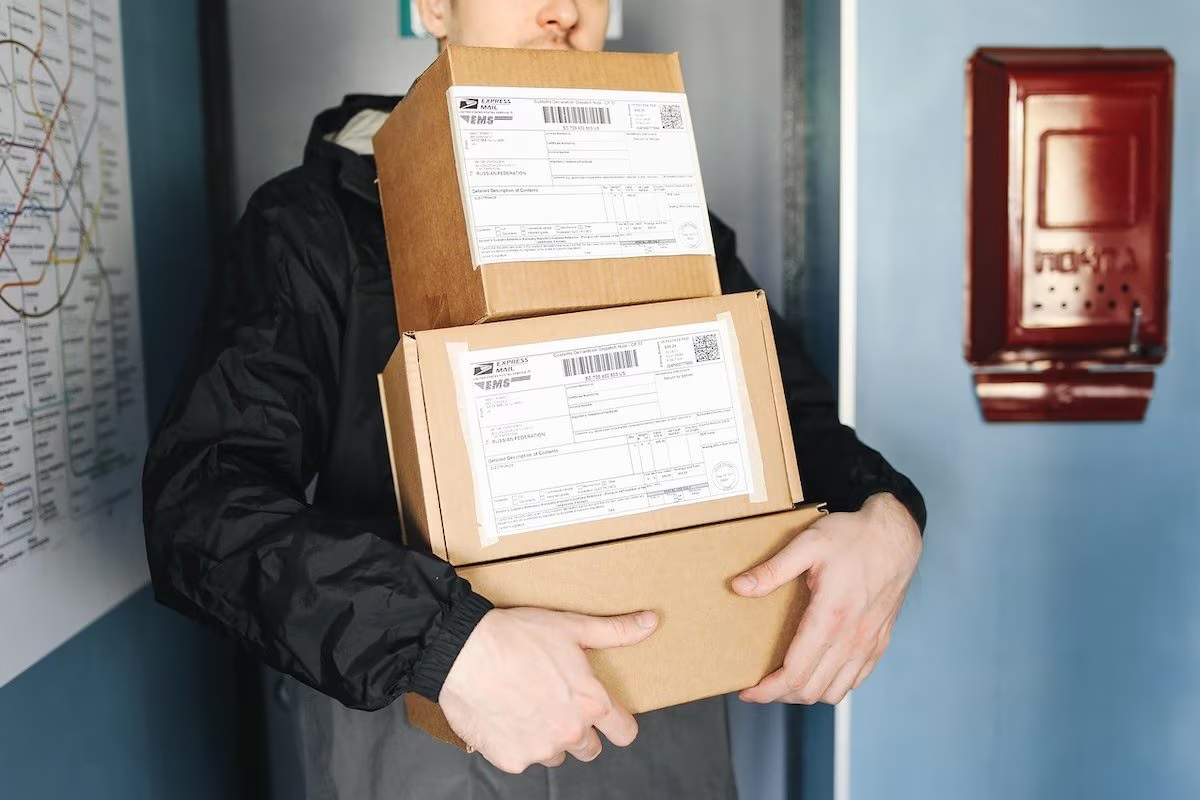
The 2 euro Italian tax on parcels with a value of less than 150 euros, coming from non-EU countries, will no longer come into force on 1 July, but has been postponed to 1 October 2026. This was decided by the Council of Ministers, with a decree-law approved on the proposal of President Giorgia Meloni together with a compact front of ministers, from Giorgetti to Salvini, from Urso to Calderone. If you love shopping and do it often on large Chinese e-commerce platforms, such as AliExpress, SHEIN or Temu, the news therefore concerns you directly.
On July 1st, however, the European tax of 3 euros will still come into force: this about-face will avoid, at least for the moment, the overlap between the two duties.
What is the double tax on Chinese parcels and how much will we pay
It all stems from a phenomenon that is clear to everyone: small parcels coming from non-EU countries have literally exploded within the European Union: according to some estimates made by the European Commission, the volume of these parcels has doubled every year since 2022 until reaching the record figure of 4.6 billion “mini-parcels” arriving on European soil in 2024. Of these, 91% come from China. Brussels therefore decided to intervene, introducing a European duty of 3 euros on every shipment with a value of less than 150 euros.
Be careful, however: the 3 euro duty does not apply to the entire contents of the package, but to every single product category inside it. This means that, if two different product categories coexist in a package, the tax applied will be 3 euros for the first category to which another 3 euros will be added for the second, for a total of 6 euros applied to the package.
And as if this wasn’t enough, Italy had decided to add its own management tax of 2 euros to this European measure, the so-called handling feewhich from 1 July should have covered the costs related to the sorting, handling and customs clearance of goods in the logistics hubs.
Because from July 1st we will pay 3 euros more if the 2 euro tax has been postponed
As mentioned, on 1 July the European tax of 3 euros that we mentioned before will still come into force (which will remain in force until 1 July 2028, when the new European customs system for online purchases should be implemented), with the consequent abolition of the customs exemption introduced in 1992 and which until now had allowed the entry of small parcels without applying duties.
Postponing the Italian tax of 2 euros to October 1st, therefore, allows us to avoid an overlap between the two duties.
It is interesting to note that the decision announced by the Government had been preceded in recent days by some criticisms made by various experts and bodies, including Confetra, the Italian General Confederation of Transport and Logisticswho had sounded the alarm directly to Minister Giorgetti, bringing a merciless calculation to the table. With the tax in force, total revenue for the state would have stopped at 127.6 million euros between July and November. Without the tax, the traffic would have remained at Italian ports (rather than passing through other EU countries where the 2 euro tax is not present) and the public coffers would have collected 153.1 million euros.
Carlo De Ruvo, President of Confetra, expressed his opinion on this aspect, explaining clearly a few days ago, before the Government announced the postponement of the application of the 2 euro tax to October:
The numbers demonstrate that we are facing a fiscal paradox. Maintaining the tax does not lead to an increase in public revenue, but translates into a negative balance in just the five months considered. The handling fee, in fact, does not increase revenue, but reduces it, simultaneously damaging businesses and state coffers.