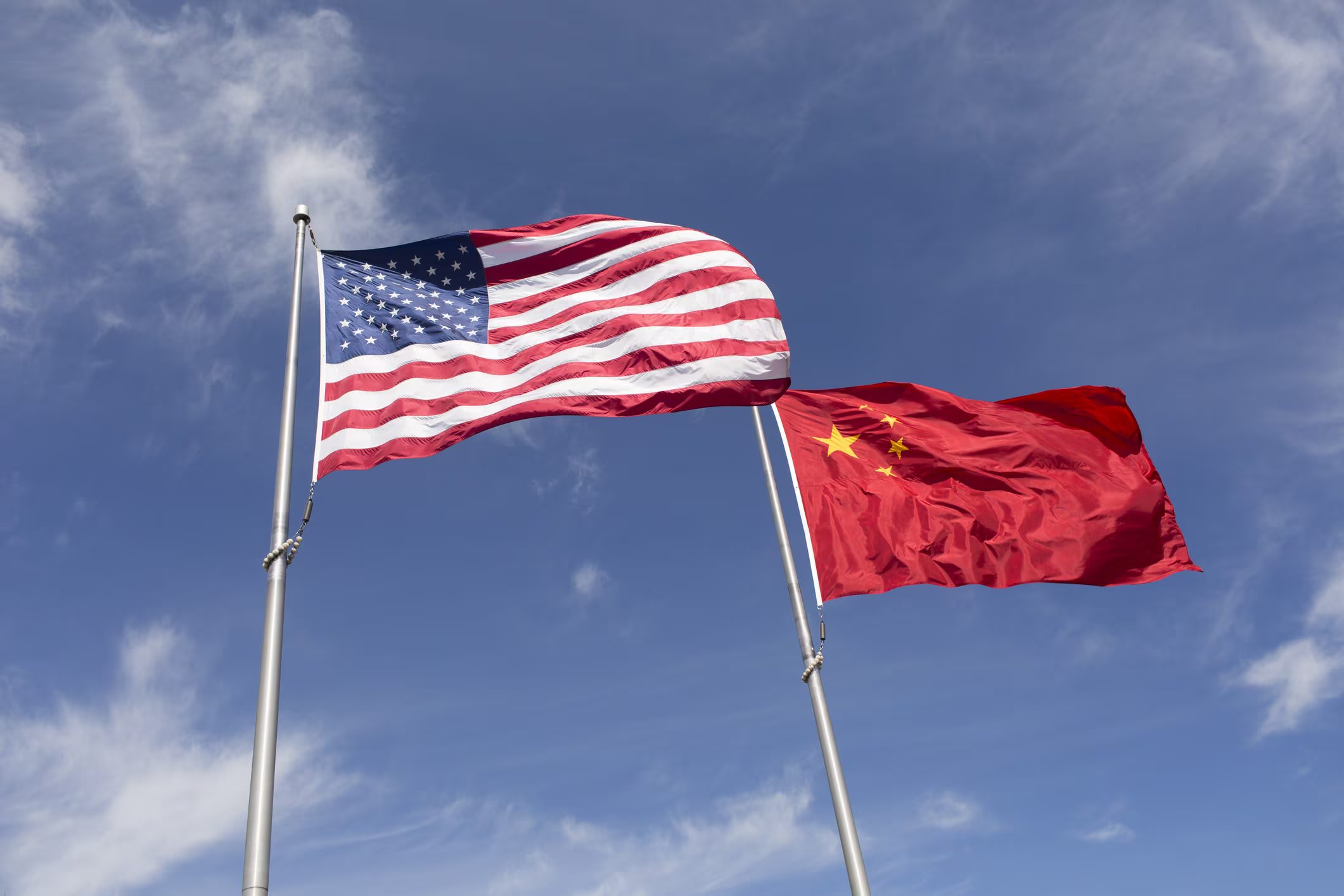
The history of relations between China and the USA has been a complex path, going from an initial philosophical admiration to the alliance in the Second World War, up to today’s geopolitical clash, in which these two antithetical systems compete for economic and technological hegemony.
From the first contacts to the “Open Door” policy
When the USA was born in 1776, the Qing dynasty was still reigning in China. Initially, the American Founding Fathers looked with deep admiration for the Far East, whose prosperity and meritocracy widespread in the world of army officers.
Already in 1784 the first peaceful commercial contacts were inaugurated.
However, everything came to a head during the 1800s, when the European powers, with their military and technological supremacy, began to force China to sign the “Unequal treaties” (totally disadvantageous economic agreements). .
The ancient Celestial Empire is soon forced to grant enormous trade privileges to the Western powers, as well as authorizing the import of opium. This drug, forcibly imposed by British warships, quickly spread among the Chinese population, destroying the country’s social fabric and draining its gold and silver coffers.
For China it was the beginning of a profound crisis and a long period of economic subjugation, defined in today’s school textbooks as “Century of humiliation”.
Arriving late on the scene, Washington attempted to impose the policy of “Porta Aperta” (Open Door Policy), searching safeguarding China’s sovereignty and territorial integrity and promoting better fairness in trade relations.
All of this not out of generosity, but to prevent Europeans and Japanese from dividing China into exclusive colonies, blocking access to American goods.
The idea, which later failed, was to prevent the Asian theater from suffering the fate of Africa, which was entirely divided among the Western colonizers.
1912-1970: Wars, betrayals and iron curtains
In 1912 a violent revolution overthrew the imperial dynasty, which had been in power for more than 200 years, transforming the Forbidden City into a museum. China thus became a Republic, which in 1928 was unified by the nationalist leader Chiang Kai-shek.
The USA immediately supported him from an anti-Japanese and anti-communist perspective. It was precisely the American defense of China from the Japanese invasion that triggered the economic blockade against Tokyo, culminating in the attack on Pearl Harbor in 1941 and the entry of the USA into the Second World War.
The victory of 1945 guaranteed China a permanent seat at the UN, but the peace did not last long: soon the civil war between Chiang Kai-shek’s nationalists and Mao Zedong’s communists. In 1949 Mao wins and the nationalists flee to the island of Taiwan.
In Washington the shock is total; the question arises in the public debate: “Who lost China?” (Who lost China?). At the height of the Cold War, the USA decided to apply “containment”: relations with Beijing were frozen, the UN seat was frozen (leaving it to Taiwan) while a rigid trade embargo was imposed.
American fears of a monolithic communist bloc (sealed by the Mao-Stalin pact of 1950) are confirmed by Korean War (1950-1953)which splits the country in two. Throughout the 1960s the hostility was total, fueled by the Chinese occupation of Tibet, Mao’s support for the Viet Cong in Vietnam and the first Chinese atomic test in 1964.
Ping-pong diplomacy, the thaw and explosion of markets
The turning point came at the end of the sixties with the Sino-Soviet crisis: Beijing and Moscow end up clashing militarily on the borders. American President Richard Nixon understands that he can exploit the rift to isolate the USSR from China.
The thaw comes from sport: in April 1971 the American table tennis team was invited to Beijing (theping-pong diplomacy”), paving the way for Henry Kissinger’s secret trip in July. The results are immediate: in October Mao’s China obtains a permanent seat at the UN by expelling Taiwan, in 1972 Nixon historically flies to Beijing and the January 1, 1979 official diplomatic relations arrive.
From here begins a phase of very strong commercial normalization.
In the 2001 China joined the WTO (the World Trade Organization): in the space of fifteen years (1980-2004) Chinese exports to the United States went from 5 to 231 billion dollars.
Despite the affairs, the thorns remained: China did not democratize and Taiwan claimed its political independence (celebrating its first presidential elections in 1996), while Beijing redeemed Hong Kong from the British in 1997, closing the European colonial era and the “century of humiliation” forever.
The new strategic competition in the 21st century
Today we are in the midst of what Nobel Prize winner Joseph Stiglitz consecrated as the “Chinese Century”. In just a few decades, China has become the “factory of the world”, overtaking Japan in 2010 as the world’s second largest economy and aiming to overtake the USA.
At the same time, Beijing has begun massive military rearmament and the construction of artificial islands to control the Pacific.
In the early 2010s, the smiles between American President Barack Obama and his Chinese namesake Xi Jinping and the signing of the Paris Climate Agreement seemed promising, but behind the facade the tension was already very high.
The US soon accused China of unfair competition, patent theft and human rights violations; Beijing responded by accusing America of wanting to sabotage its rise and meddle in its internal affairs. The battle was thus divided into three moves:
- Obama’s “Pivot to Asia”: The USA is shifting the geopolitical axis from Europe to the Pacific, redeploying ships and military resources to stem Beijing’s expansionism in the South China Sea.
- Trump’s trade war (2018): America breaks the rules and applies billions of tariffs on Chinese goods. Beijing responds point by point. It is the beginning of the open trade war.
- Biden’s Chip War: The clash becomes technological. Whoever controls advanced microchips and Artificial Intelligence controls the future. Washington blocks the export of semiconductors to Beijing and isolates the Chinese giants (such as Huawei), aiming at decoupling (decoupling) to eliminate industrial dependence on China.
Trump 2.0 and the (open) epilogue of an infinite challenge
The geopolitical chess game has accelerated further with Donald Trump’s return to the White House for his second term. If anyone thought that the 2018 trade war was just a parenthesis, today’s reality has demonstrated the opposite: the second chapter of the Trump administration has left an even stronger shock.
Washington’s new course has raised the stakes, threatening and applying even heavier customs tariffs on Beijing’s goods, with the declared aim of bringing manufacturing back to American soil and eliminating the trade deficit with the Dragon.
However, what made the history of this new phase was the swing between the very tough clash and the attempts at direct dialogue at the top.
Despite the inflammatory statements and the cross accusations of espionage and cyber-activism, the face-to-face and bilateral summits between Donald Trump and Xi Jinping have shown the world a very clear dynamic: the two superpowers are now too interconnected to ignore each other, but too distant to be able to trust.