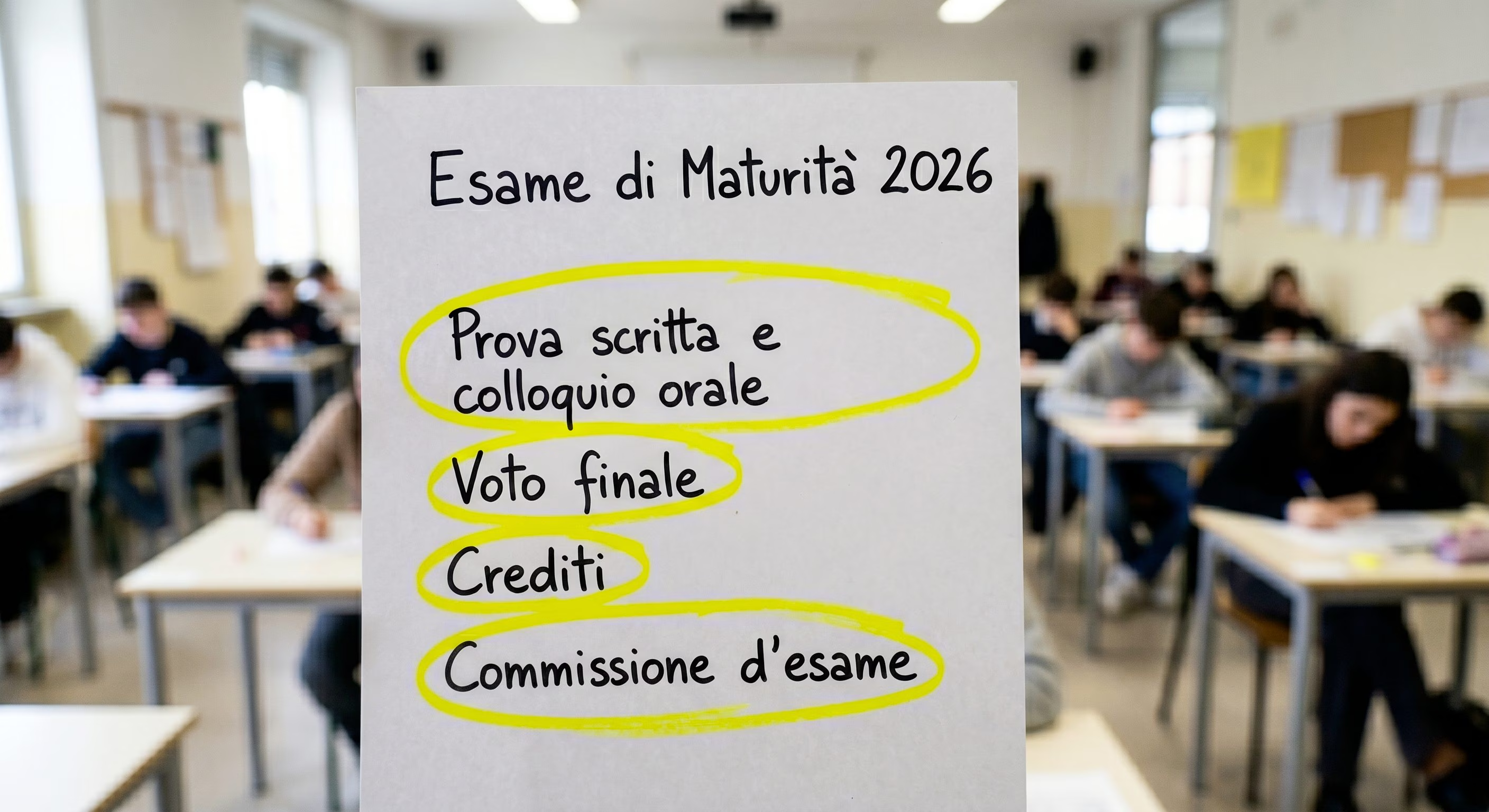
There are only three days left until the start of the first written test of the 2026 Maturity, which will involve 527,607 students in total: on 18 June 2026 at 08:30 high school graduates will have to tackle the Italian topic (here are the possible tracks that could be released based on the 2026 anniversaries). This year, however, there are some new features for the State Exam, starting with the name, which once again officially becomes “Maturity Exam”.
The most important changes concern above all the oral test, which becomes officially mandatory to obtain final promotion, while the number of oral subjects drops to 4 (two assigned to internal commissioners and two to external commissioners). The interview will no longer start from an idea provided by the commission, but male and female students will have to present a brief reflection on their scholastic and personal career.
How the new oral exam for the 2026 Maturity exam works
The most significant innovation of the new Maturity Exam concerns the oral interview, as also reported on the website of the Ministry of Education and Merit. The change compared to 2025 is substantial: until last year, the oral exam generally spanned 6 final year subjects (one per commissioner) and started from an initial starting point (texts, documents, experiences) proposed by the commission, with free multidisciplinary connections. From 2026 it will focus on 4 specific disciplines – two assigned to internal professors and two to external commissioners – identified by the Ministry itself in January 2026 and already communicated to students.
The objective of the test is to ascertain the achievement of the student’s educational, cultural and professional profile.
The way in which the oral test will begin will also change: there will no longer be starting materials proposed by the commission, but the interview will begin with a brief reflection by the candidate on his/her scholastic and personal path, also in light of what is reported in the Curriculum of the student and the student.
At that point, we will get to the heart of the exam with questions and insights into the four disciplines provided. During the test, the candidate is also asked to critically analyze the experiences carried out in the context of school-work training activities (the new official name of the former PCTO, the Paths for Transversal Skills and Orientation), presenting them through a short report or a multimedia work and connecting them to the course of study followed.
During the interview, the commissioners will verify civic education skills, as well as a brief commentary on the written tests.
There is also a particular case to point out: if during the final ballot the candidate achieved a conduct grade of 6/10, the interview will also include the discussion of a critical essay on active and supportive citizenship, assigned by the class council at the time of the ballot (and therefore before the start of the written tests).
The latest innovation, perhaps the most important compared to previous years, concerns the compulsory nature of the oral exam (never specified until now): high school graduates will only be able to graduate if they have taken all the required tests, therefore both the written tests and the oral interview. Even the so-called “silent scene” will be equivalent to a failure.
How the written tests are carried out: dates, structure and commissions
In terms of written tests, the structure remains substantially stable compared to 2025: there are 2 tests for almost all students (with the exception of the EsaBac, EsaBac techno courses and the international option sections, which also include a third test). The calendar is as follows: the first written test takes place on Thursday 18 June 2026 from 8.30 am and lasts six hours. The second written test, which will focus on the disciplines characterizing the course of study, is set for Friday 19 June 2026 and will have a different duration depending on the school area.
As mentioned, a significant change concerns the composition of the examination commissions. Until 2025, each commission (matched to two classes) was composed of an external president, three internal commissioners and three external commissioners for each class. From 2026 the commission will become more streamlined: it will be chaired by a president external to the school institution, with two external members (shared between the two classes) and two internal members for each of the two combined classes. In essence, we go from 7 to 5 members per class.
The credit count, the final grade and the weight of the conduct
The school credit system maintains the same structure as in recent years, with the final grade of the 2026 Maturity exam which will be expressed in hundredths. More in detail, students will be able to obtain a maximum of 40 points of school credits (accumulated over the last three years), a maximum of 20 points for each of the two written tests (therefore 40 in total) and a maximum of 20 points for the oral interview.
The minimum score to pass the exam is always 60/100, but the additional score will change: the Commission will be able to award up to a maximum of 3 points to candidates who have achieved at least 90 points between credit and exam tests. Compared to 2025, when the bonus could reach up to 5 points, the integration margin is reduced.
Even the behavioral rating acquires a decidedly greater weight than in the past. The evaluation of conduct, in fact, contributes to the determination of the school credit and the decree provides a precise rule: the highest score within the credit range due (based on the average grade) can only be assigned if the conduct grade is equal to or higher than 9/10. With an 8 in conduct, for example, for the fifth year the maximum credit drops from 15 to 14 points. The high school graduates who have obtained a 6 in conduct, they will instead have to submit a critical essay on issues of active citizenship.