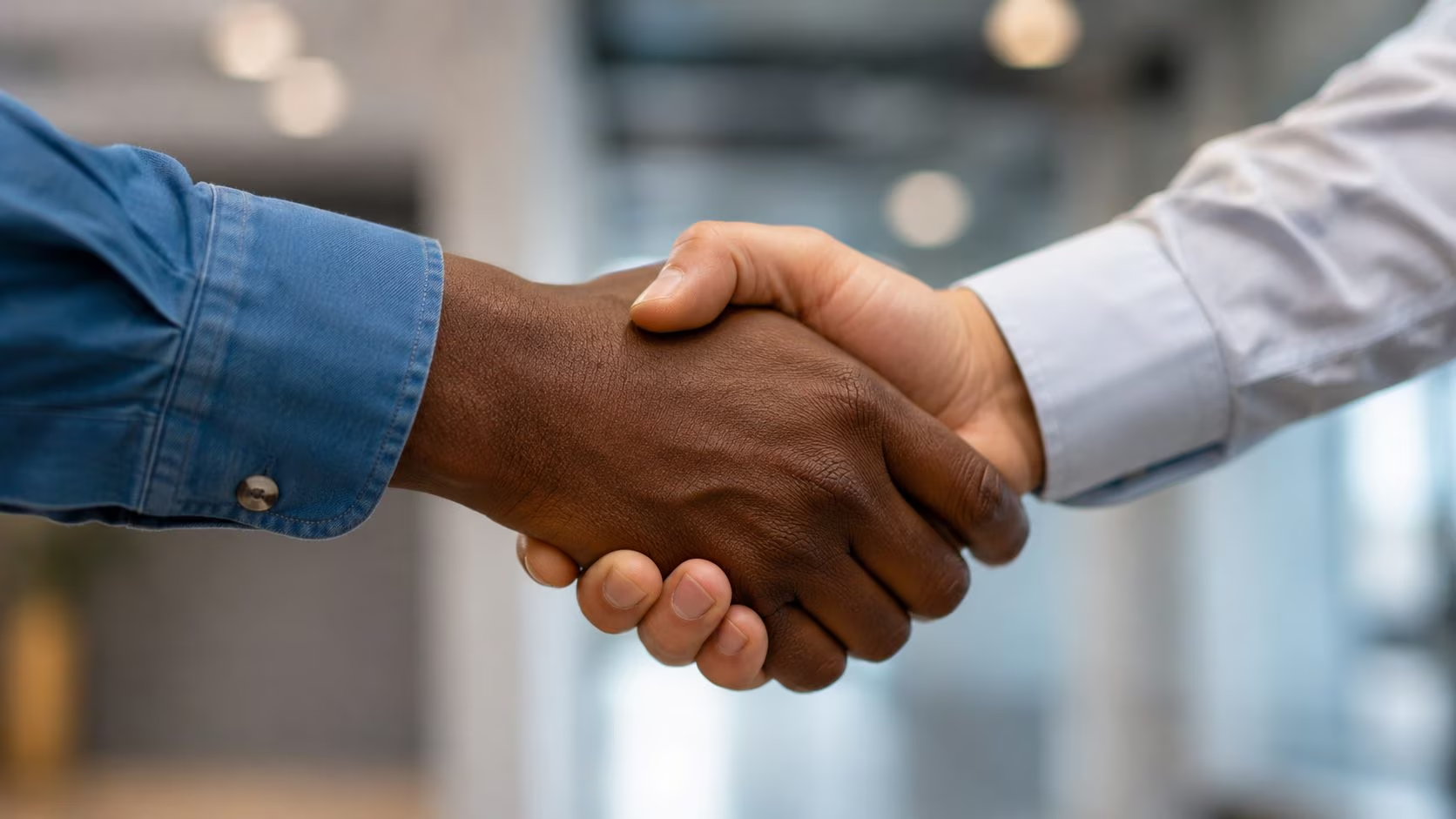
Today, shaking hands is an official gesture that we make in formal contexts, with which we introduce ourselves for the first time or with which we stipulate agreements in diplomatic contexts. What seems to us to be a habitual action actually has very ancient origins: the handshake, even if in different contexts, has always brought with it a subtext of respect, peace and honest exchange, which also characterizes today’s use of the gesture as a benevolent greeting of welcome and equality.
About 5,000 years ago the Assyrian and Babylonian kings shook hands as a sign of alliance, the Romans did so on the occasion of exchanges of hospitality and as a symbol of marriage. From the Middle Ages onwards, the handshake took on official legal value to seal contracts of different types – and served to demonstrate that the right hand was unarmed. It was then officially the Quakers – who in the 17th century rejected ecclesiastical hierarchies – who transformed the handshake into a real greeting between equals, a meaning also adopted during the French Revolution and which has come down to us.
Shaking hands in antiquity, a ritual symbol of respect
The first depictions in which the gesture of shaking hands is noted date back to over 5,000 years ago: the iconography of ancient Mesopotamia shows us divinities and sovereigns shaking hands as a symbol of equality and respect. For example, at the Iraq Museum, the national museum of Iraq in Baghdad, what is believed to be “the oldest handshake in history” is preserved: it is an Assyrian bas-relief that shows King Shalmaneser III shaking hands with the Babylonian ruler Marduk-zakir-shumi I to establish an alliance.
Another ancient testimony of the handshake is the stele located in the sanctuary of Nemrut Dağı, in Turkey, which depicts king Antiochus I (2nd century BC) shaking hands with Hercules, as a sign of alliance and respect between a human sovereign and a demi-god.
The handshake in Greece and Rome, a practice of alliance and peaceful exchange
First in ancient Greece and then in ancient Rome, the handshake – in Latin dexiosis or dextrarum iunctiomeaning joining of hands – retains the meaning of making alliances and agreements, and becomes part of social rituals such as marriage. In fact, during the ritual the spouses joined their hands, sealing their union.
The handshake was also a practice in the hospitality sector: objects such as the hospitalis carda real “card” made of bronze, ivory, bone or other material, on which a handshake could be depicted. When the card was exchanged, the host and the guest had entered into their agreement of peaceful exchange of services.
Shaking hands, therefore, increasingly takes on the meaning of respect and alliance salvation: if you shake hands you agree, you are aligned, you will respect each other and you will hold each other’s lives dear, a concept that is valid both in marriage and in hospitality.
The handshake becomes an official gesture of greeting and agreement
Since the Middle Ages the handshake, called touch handbecame a gesture with legal value: shaking hands meant in all respects entering into a commercial agreement, an alliance.
Shaking hands, in short, was like stipulating a verbal contract: this value remained over the centuries, and led the handshake to take on a more popular meaning of a gesture to be made when one was in agreement with one’s interlocutor.
Subsequently, in England and then in America during the 17th century, the Quakers – a Christian movement that stands out for the absence of dogmas and sacraments, based on personal and interior contact with God – adopted the handshake as a form of egalitarian greeting. Precisely because they did not recognize dogmas and hierarchies, the Quakers chose “hand touching” as a sign of social equality and predisposition for exchange.
It was then with the French Revolution, at the end of the 18th century, that the handshake became to all intents and purposes a “popular” gesture: the revolutionaries adopted it – in opposition to the bow – which indicated subjection, as an expression of equality and brotherhood when meeting.