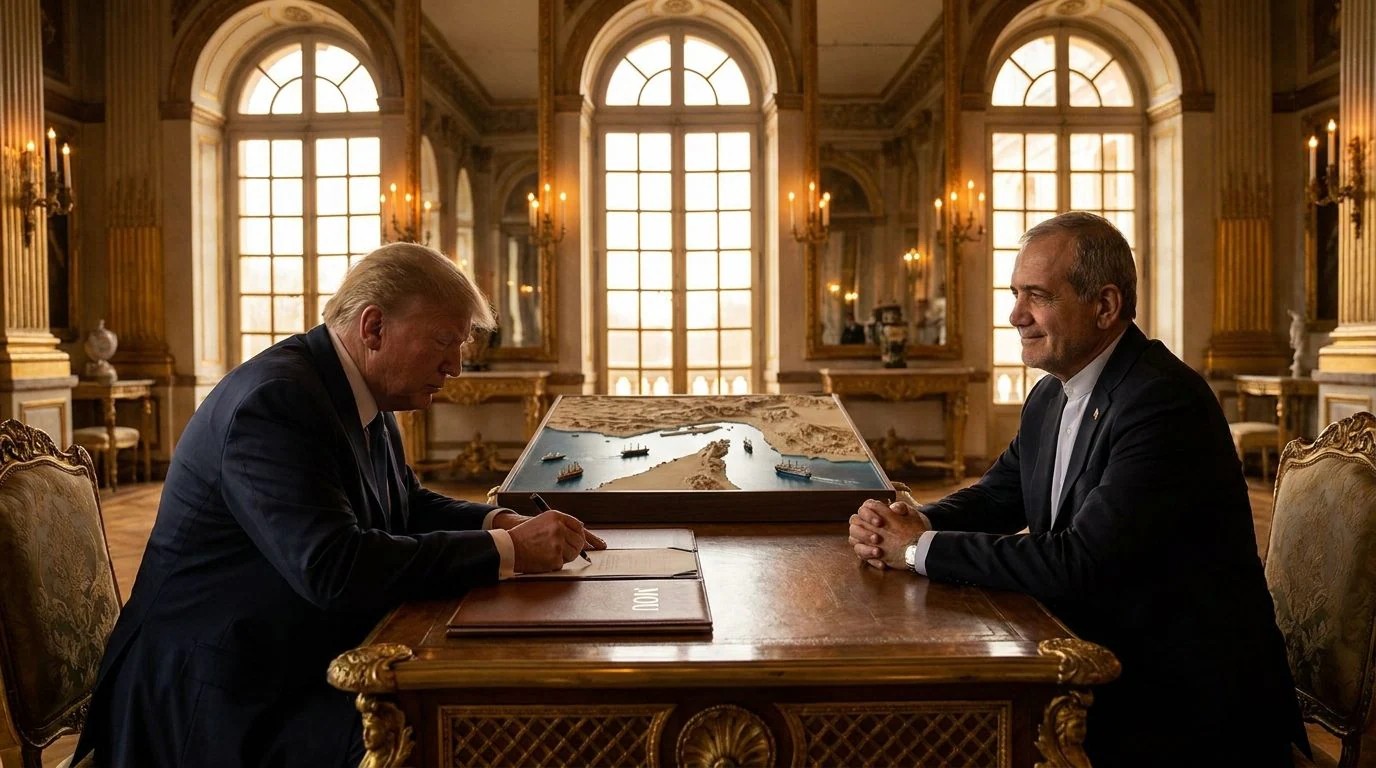
The official signing of the so-called Memorandum of Understanding (MOU) between the United States of America and the Islamic Republic of Iran has arrived which has put an end, at least for the moment, to the hostilities between the two countries.
For many, this is only a temporary truce, aimed at reopening the Strait of Hormuz. If this MOU were to actually be the starting document of a real peace treaty, it would be a full-blown strategic victory for Iran, giving us a Middle Eastern reality made up of new geopolitical scenarios that are radically different from everything we have been used to seeing until now.
The moment of signing took place in France, in the evocative setting of the Palace of Versailles, on 18 June, after almost four months of hostilities inaugurated on 28 February 2026 with the American and Israeli military aggression against Iran and its network of allies/proxies in the Middle Eastern area.
The full text of the agreement: the 14 points of contention
Overall, the document countersigned by the parties, represented by American President Donald J. Trump on one side and his Iranian counterpart Masoud Pezeshkian, is divided into 14 points which should regulate, albeit briefly, all the areas of conflict existing today between the USA and Iran.
Several analysts have tried to create a parallel between these and the 14 points enunciated by Thomas Woodrow Wilson at the end of the First World War, but it is almost certainly a curious coincidence. The Gordian knot of the whole story revolves around the unblocking of the Strait of Hormuz, blocked by the Iranians since the first days of the war with consequent serious repercussions for the world economy.
The other points of the Memorandum essentially represent corollaries that Washington had to grant to Tehran to once again obtain freedom of navigation through this strategic naval artery. Here is the summary of the 14 points agreed by Washington and Tehran:
- Cease-fire: Immediate and permanent end to military operations on all fronts (explicitly including Lebanon) and commitment not to start new hostilities.
- Sovereignty: Mutual respect for territorial integrity and sovereignty, with a commitment to non-interference in internal affairs.
- Timings: Commitment to negotiate and reach a final peace agreement within a maximum of 60 days (extendable by mutual agreement).
- End of the US naval blockade: The United States will begin to immediately lift the naval blockade against Iran (to be completed within 30 days) and also commits to withdraw its forces from Iran’s vicinity 30 days after the final agreement is signed.
- Reopening of the Strait of Hormuz: Iran is committed to ensuring safe and free passage (without tolls) for commercial ships through the Strait of Hormuz for the duration of the 60-day negotiation period.
- Future management of Hormuz: Iran will conduct dialogues with the Sultanate of Oman and other Persian Gulf states to define future administration and maritime services in the Strait, in compliance with international law.
- Funds for reconstruction: The United States and regional partners will create a plan of at least 300 billion dollars for the reconstruction and economic development of Iran.
- Lifting of sanctions: The United States is committed to ending all sanctions against Iran (including those of the UN Security Council, the IAEA and unilateral American ones) according to deadlines that will be defined in the final agreement.
- Nuclear commitment: Iran reaffirms that it has no intention of producing or acquiring nuclear weapons.
- Enriched material: The US and Iran agree to resolve the issue of enriched nuclear material through mechanisms agreed in the final treaty (e.g. through down-blending supervised by the IAEA).
- Maintaining the status quo: During the negotiations, Iran will maintain its nuclear program, and in exchange the US will not impose new sanctions or increase its troops in the region.
- Exceptions for oil exports: The US Treasury Department will immediately issue waivers to allow Iran to resume exports of crude oil, petrochemicals and related international banking services.
- Unfreezing frozen assets: The United States will make all previously frozen or restricted Iranian funds and assets fully available and usable.
- Start of negotiations: As soon as the two sides have begun to implement the key points of the memorandum (such as naval unblocking, the opening of Hormuz and oil waivers), negotiations for the final treaty will formally begin.
Tehran’s triumph and Islamabad’s joy
To date, the agreement stands as an Iranian strategic victory. Not only did the Pasdaran and the regular Armed Forces (Artesh) manage to prevent any American attempt to reopen Hormuz by force on the ground, but they managed to exert sufficient pressure on a political level to push Trump to give up his objectives (for the moment) and come to terms.
Iran sees its role as hegemonic power in the Persian Gulf area confirmed, with all due respect to all the Arab countries in the region which have been completely marginalized. Not only that, if analyzed with a magnifying glass, the points of the agreement specifically addressed to Iran (such as the issue of the ban on the development of nuclear weapons) represent little more than formal promises that can be largely managed or ignored by Persian diplomacy. Conversely, the parts of the agreement addressed to Washington represent a slew of concessions that no presidential administration, not even Obama’s, had ever even contemplated.
The international status of the Islamic Republic of Pakistan was also strengthened. Thanks to its skilled mediation capacity, Islamabad has managed to gain credibility both towards Western chancelleries and towards the palaces of power of Middle Eastern reason, where until now it played a secondary role.
It is not clear whether the “Country of the Pure” has hegemonic ambitions in the lands of the Middle East, however the “geopolitical shores” that it has managed to gain there will be very useful to it in view of a very probable new war against India after the defeat suffered in May 2025 during the so-called “88 Hour War”.
The embarrassment of Washington and Jerusalem
For both Washington and Jerusalem (the latter has already announced that it does not feel bound by any agreement), it represents a total defeat, when compared to the triumphalist proclamations with which both President Trump and Israeli Prime Minister Benjamin “Bibi” Netanyahu had inaugurated the military campaign.
Although the American and Israeli armed forces have undoubtedly caused serious material damage to the “Iran country system”, in practice they have completely failed to apply the pressure necessary to obtain a political change in the leadership of Tehran, which was the objective they had when going on the warpath.
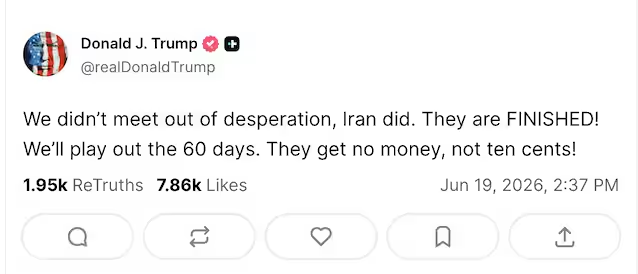
Probably the most humiliating point for Washington to digest was its acceptance of a commitment to pay Iran $300 billion, framed as a “reconstruction and economic development plan” for Iran, funded by the United States and regional partners. In practice these are “war damages”, but at a diplomatic level Washington has avoided this wording which would have been politically disastrous. “We weren’t the ones who asked for the meeting out of desperation: it was Iran,” Trump wrote this afternoon on his social network, Truth. “They’re finished! We’ll let the whole 60 days go by. They won’t have a penny, not a cent,” he added.
True peace or simple truce?
It is a common opinion in the world of analysts that the MOU does not represent the first step towards the establishment of a stable and lasting peace regime but, rather, represents only a mere truce in anticipation of the return of hostilities.
On the American side, there is an urgent need to reopen Hormuz and avoid the more immediate effects of the economic crisis, especially in a context in which the United States has all eyes on it due to the Football World Cup and the celebrations of the 250th anniversary of the Declaration of Independence of 1776. The electoral issue is also not at all negligible. In fact, mid-term elections will take place in the USA on November 3rd, while parliamentary elections for the renewal of the Knesset (Parliament) should take place in Israel on October 27th and holding these electoral appointments in a “state of war” situation could cost both Trump and Netanyahu dearly.
The fact is that for the “machines” that dominate the political life and strategic horizons of entities such as the USA, Israel and the Arab countries of the Gulf themselves, the prospect that Iran, through the progressive implementation of the 14 points of the MOU, could become a candidate to become the hegemonic country of the Middle East and the fifth superpower (thanks to the dominance of oil flows) together with the USA, Russia, China and India, seems today to be a very remote prospect and too bitter to be contemplated lightly.