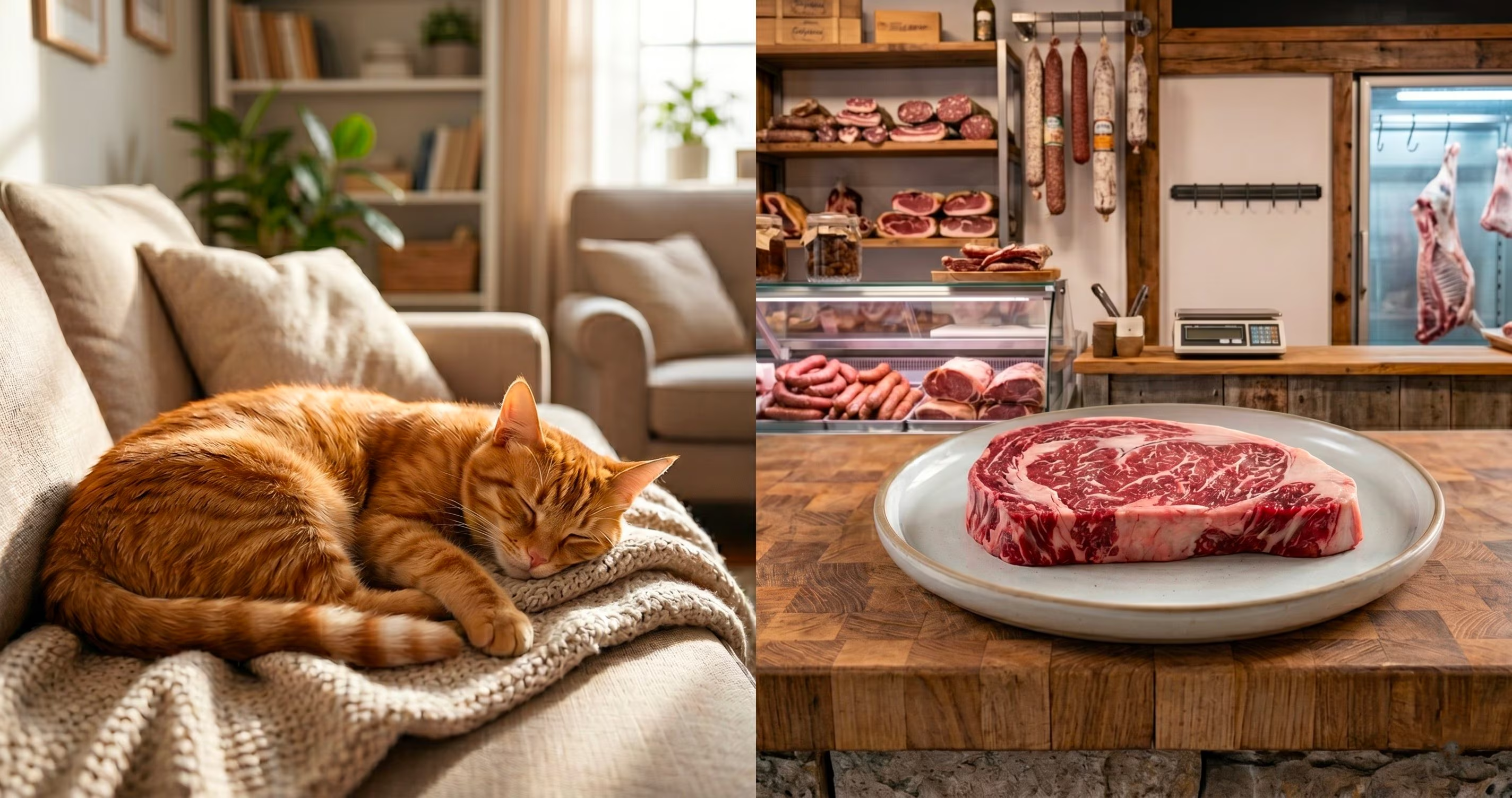
In Italy there is a famous popular saying that labels i “Vicentini magnagatti”. This expression, born from historical anecdotes and regional rivalries, today arouses a mixture of irony and perplexity precisely because the cat occupies a very particular position in our imagination: it is a domestic animal, considered a life partner and a member of the family. The distinction between animals to eat and pets is not written in nature, but derives from millennia of cultural evolution, social conventions and domestication: consequently, the idea of using cats as food appears to most of us not only unusual, but morally unacceptable.
Yet, at that same table, we may have no difficulty consuming pork, veal or rabbit. Why are some animals considered family members while others end up on the plate? And how do we explain the fact that what is unthinkable in one society can be perfectly normal in another? The most immediate answer could be that there are animals naturally destined for affection and others naturally destined for food. However, anthropologists and sociologists have been showing for decades that the issue is much more complex. The categories of “companion animal”, “farmed animal” or “sacred animal” do not simply derive from the nature of animals, but are the result of historical, cultural and social processes.
Animals and food, a cultural construction
One of the most important contributions to understanding this phenomenon comes from the British anthropologist Mary Douglas. In his famous volume Purity and Danger (1966), Douglas analyzes the food taboos present in various societies, i.e. those prohibitions that lead a community to consider certain foods unacceptable or impure. According to the author, these bans are not irrational at all. On the contrary, they help maintain the symbolic order, that is, the set of rules and meanings through which a society distinguishes what is appropriate from what is not, what is pure from what is impure.
For this reason, what a culture considers edible does not only depend on the characteristics of the food, but also on the meanings attributed to it. From this perspective, what a society considers edible is not a universal given. The disgust we feel when faced with certain foods does not necessarily arise from biological reasons, but from cultural learning. In other words, we learn from childhood which animals can be eaten and which cannot.
When the economy influences society
If Douglas places the emphasis on symbolic classifications, the American anthropologist Marvin Harris proposes a different explanation. An exponent of cultural materialism, Harris argues that many food beliefs and taboos are linked to ecological and economic factors.
In his works Cows, Pigs, Wars and Witches (1974), Good to Eat (1985) e The Sacred Cow and the Abominable Pig (1987), Harris seeks to show how seemingly irrational practices can have an adaptive logic.
One of the best-known examples concerns the ban on consuming pork present in Judaism and Islam. According to Harris, raising pigs in the arid territories of the Middle East was not very convenient: pigs need water, do not graze like sheep and goats and compete with humans for many food resources. In this context, religious prohibition would have helped discourage an economically disadvantageous practice.
Similar reasoning is applied to the sacredness of the cow in India. Harris argues that protecting cattle provided real benefits to farming communities: the animals provided labor for plowing, milk, and manure that could be used as fertilizer or fuel. The sacred character attributed to cows would therefore have favored the conservation of an essential resource for the economic survival of the population.
Animals are “good to think”: the response of structural anthropology
While influential, Harris’ interpretation has been the subject of much criticism. Among the major authors who provide a different interpretation is Claude Lévi-Strauss, founder of structural anthropology. In the volume Le Totémisme aujourd’huithe author makes a famous statement: animals are “good to think about before eating”.
In other words, the relationship we have with animals does not only depend on their economic or nutritional usefulness: animals are also symbols through which societies express values, beliefs and ways of seeing the world.
Just think of the dove, often associated with peace or the lion, a symbol of strength and courage. In these cases, the meaning attributed to the animal goes far beyond its biological characteristics or its possible practical usefulness. For Lévi-Strauss, understanding the relationship between humans and animals therefore also means understanding the system of meanings that a society builds around them.
A similar perspective is also found in the work of anthropologist Clifford Geertz, who defines culture as a network of meanings constructed by human beings. From this point of view, understanding why an animal is eaten or protected means understanding the symbolic system in which it is inserted.
Carnism: an invisible ideology
Social psychologist Melanie Joy in the book Why We Love Dogs, Eat Pigs, and Wear Cows (2010) introduces the concept of carnism. It is defined as the belief system that leads people to consider it normal to eat some animals and not others. According to the author, in contemporary societies this ideology is often invisible because it is perceived as natural and inevitable.
Eating cows, pigs or chickens appears normal not because these species possess intrinsic characteristics that make them suitable for human consumption, but because social conventions have placed them in the category of edible animals.
According to Joy, the central point is not to establish which animals are right or wrong to eat, but to understand why some food choices are perceived as normal and others as unthinkable. Precisely because carnism is widely shared, it is rarely recognized as one cultural vision among many possible: instead it tends to present itself as simple common sense.
The concept of carnism is not universally accepted by scholars and is mainly discussed in the context of animal ethics. However, it offers a useful tool for thinking about how our food preferences are influenced by cultural norms that we rarely question.
Animals as family members
In recent decades, especially in urbanized Western societies, the relationship with pets has undergone profound transformations.
Sociologists and scholars of Human-Animal Studies, including Adrian Franklin (Animals and Modern Cultures1999) and Donna Haraway (The Companion Species Manifest, 2003), have highlighted how dogs and cats have progressively gone from being considered property or work tools to being perceived as real members of the family.
The increase in veterinary expenses, the spread of services dedicated to animals, the celebration of funerals and the emergence of the phenomenon of pet parenting testify to this cultural change.
What appears natural today – considering the dog an emotional companion – is actually the result of relatively recent historical transformations. In other times and in other societies, the same animal could occupy very different positions within the social order.
Beyond the distinction between humans and animals: multispecies anthropology
A final current of studies that we intend to mention to broaden the reflection is multispecies anthropology, born in the last twenty years. It challenged an assumption that had long guided Western thought: the idea that humans and animals belong to clearly separate spheres.
In the Companion Species Manifesto (2003), Donna Haraway argues that humans and dogs have literally co-evolved throughout history. It would therefore not just be a domestication relationship, but a mutual transformation that has modified both animals and human beings. For this reason Haraway prefers to talk about companion species (companion species), underlining how our identities are the result of long interspecific coexistence.
An even more radical criticism comes from anthropologist Philippe Descola. In the volume Par-delà nature et culture (Beyond nature and culture, 2005), Descola shows that the separation between humanity and animality, which in the West appears almost obvious, actually represents a historically situated vision of the world. Many indigenous societies of the Amazon, Siberia or North America attribute to animals intentionality, relational capacities and forms of subjectivity that blur the boundary between human and non-human.
A question of culture, not nature
The differences between what we eat and what we protect cannot be explained by a single cause. Economic and environmental conditions, highlighted by Marvin Harris, certainly play an important role. At the same time, as Mary Douglas, Claude Lévi-Strauss and many other scholars show, animals are inserted into symbolic systems that attribute different meanings to them. For this reason the same animal can be considered food in one society, sacred animal in another and a member of the family in a third.
All societies, therefore, establish complex relationships with the animal world. What changes are the cultural categories through which these relationships are organized.
Observing these differences means recognizing that many of our deepest beliefs about what is normal, natural, or acceptable are actually the product of history and culture. And precisely for this reason they can appear surprising, incomprehensible or even contradictory in the eyes of those who grew up in a different context.