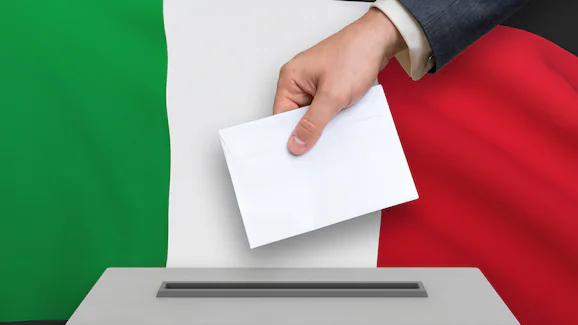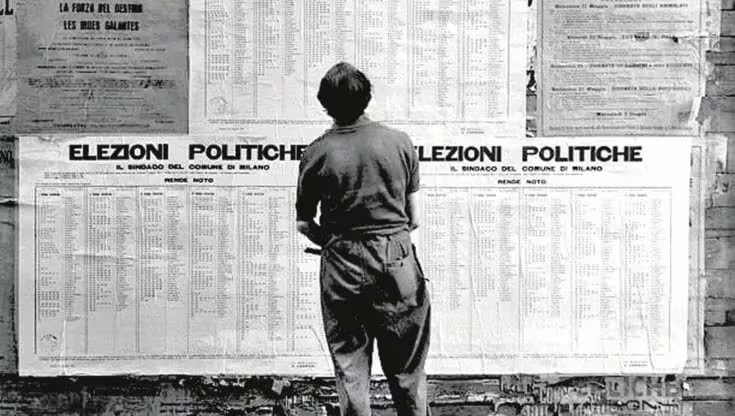
On 18 and 19 April 1948, Italian citizens were called to elect the first parliament of the newly formed Republic. The elections were conditioned by the Cold War, because the main contenders were parties that referred to the two blocs that emerged on the world scene: on the one hand the Christian Democrats, supported by the United States and the Church, on the other the Popular Democratic Front, made up of the socialist and communist parties, ideologically close to the Soviet Union. The elections sanctioned the success of the DC and marked the beginning of its dominance over Italian politics. The vote was influenced by foreign interference, in particular from the United States, which however has never been fully clarified.
Political context: a continent divided between two worlds
After the Second World War, Italy was involved in the dynamics of the Cold War. As we know, Europe found itself divided into two blocks: a Western one, led by the United States, and an Eastern one, dominated by the Soviet Union. The division was established, in fact, in international conferences held in the final stages of the war and was based, in principle, on the advances of the armies (the countries liberated by the Soviets became part of the allies of the USSR, the others of the American bloc).
Italy was part of the Western bloc, because it had been liberated by the Anglo-Americans who, together with the partisans, had defeated the Nazis and fascists. After the war, American soldiers continued to be stationed in the national territory.
The United States enjoyed the support of one of the most important parties, the Christian Democrats. However, there were also parties in the country that looked favorably on the Soviet Union: the Communist and Socialist Parties.
Until 1947 the pro-American and pro-Soviet parties, which had jointly led the fight against fascism and Nazi occupation, had governed together. In May 1947 the Christian Democrats, at the instigation of the US authorities, decided to oust the social-communists from the government. Two sides were thus created: the one led by the DC and the prime minister, Alcide De Gasperi, who enjoyed the support of the United States and the Vatican; that of the communists and socialists, supported by the Soviet Union and led by Palmiro Togliatti, secretary of the PCI.
The electoral campaign: the first media challenge
On January 1, 1948, as we know, the Constitution of the Republic came into force, which entrusted legislative power to a Parliament composed of the Chamber and the Senate. The first elections were called for April 18 and 19. 574 members of the Chamber and 237 members of the Senate had to be elected (to which were added the senators by right). The electoral system was proportional and the country was divided into constituencies on a territorial basis.
The main lists were those of the DC and the Democratic-Popular Front, which brought together socialists and communists. However, smaller lists were also present: the National Bloc of Freedom of liberal ideology; the National Monarchist Party; the Socialist Unity list, against the alliance with the communists; the neo-fascists of the Social Movement.
The electoral campaign was very heated. The result was unpredictable, because in the 1946 elections for the Constituent Assembly, the only ones held after the fascist dictatorship, the two blocks had obtained similar percentages of votes: the DC 35%, the socialists and communists (who presented themselves separately) 39% overall.
During the 1948 electoral campaign, the representatives of the two blocs accused each other of being traitors. Furthermore, the Church, aligned in support of the DC, interfered heavily: many parish priests used religious celebrations to campaign and made the faithful believe that voting for the Popular Front was a mortal sin. In a deeply religious society like that of the 1940s, the threats of the priests had a strong effect.
US interference was also heavy: since 1947 the United States had been financing Italy with funds from the Marshall Plan and in the electoral campaign they passed the message according to which, to continue to have funding, it was necessary to vote for the DC.
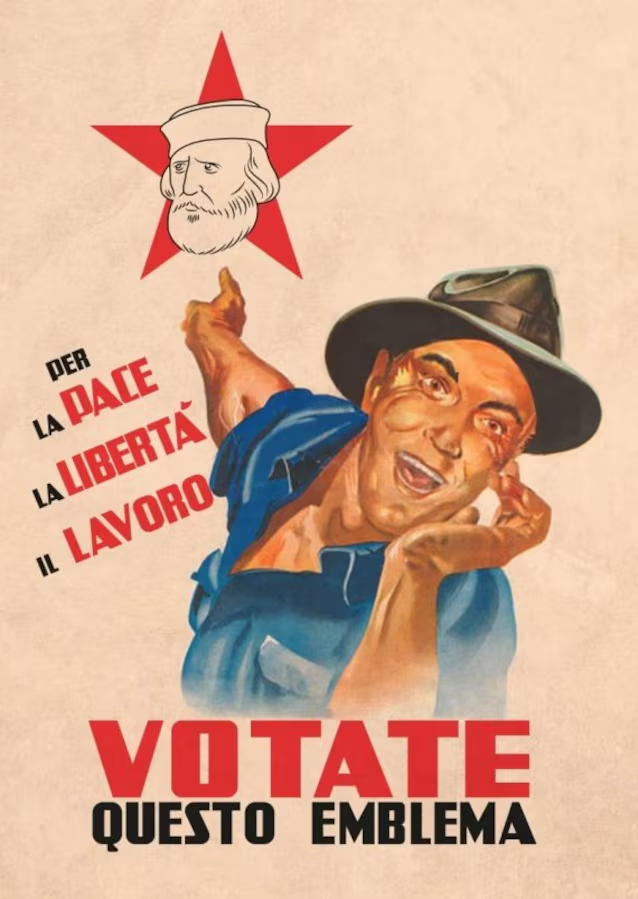
The Soviet Union, for its part, financed the Communist Party, but did not intervene directly in the electoral campaign because it was aware that Italy belonged to the Atlantic bloc.
The results: De Gasperi’s triumph
On 18 and 19 April the voter turnout was very high: over 92% of those entitled to vote. The outcome of the vote was clearly in favor of the Christian Democrats. The data for the Chamber were as follows:
For the Senate, the results were similar in all respects: the DC obtained 48.11% of the votes and 131 seats, while the Popular Front stopped at 30.76% of the votes and 72 seats. The DC prevailed in much of the country and demonstrated that it had its stronghold in Veneto, in some areas of Lombardy and in some sectors of southern Italy. The Popular Front prevailed in some regions of central Italy: Emilia-Romagna, Tuscany, Umbria and Marche.
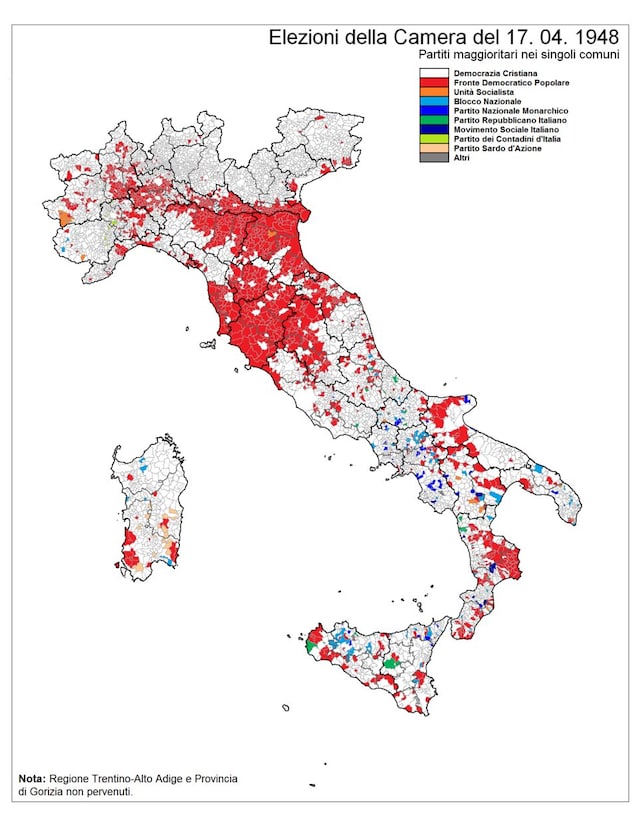
After the vote, the DC formed a government together with other centrist parties, giving rise to a hegemony on the Italian political scene that would last until the 1990s. Furthermore, the elections confirmed Italy’s membership of the Atlantic bloc, which would no longer be questioned.
The interference of the CIA
According to statements released by members of the CIA in recent years, the United States did not limit itself to supporting anti-communist parties through legal means, but also interfered in the vote in other ways, providing funding, and perhaps weapons, to the DC. It is also likely that the CIA had a plan in place to prevent left-wing parties from taking power if they won the elections. However, the documents on the matter have never been declassified and the role of the American services has never been fully clarified.