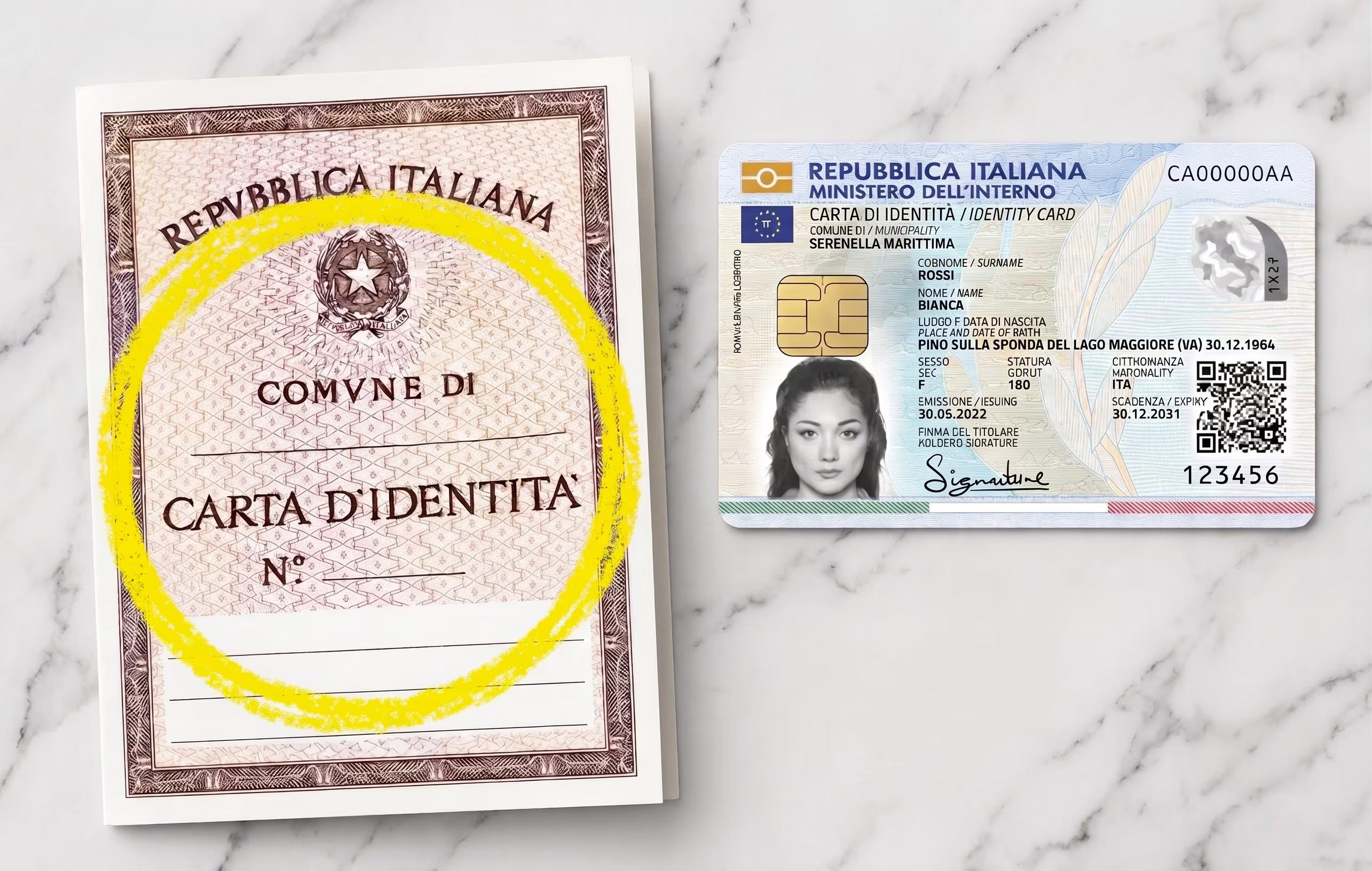
The paper identity card will also be valid beyond 3 August 2026: confirmation comes directly from the Council of Ministers, through press release no. 178. Paper documents, therefore, will remain valid until their natural expiry, but only “for certain purposes and in relations with the Public Administration and with entities that provide public services”.
It still remains to be understood what the government means by “certain purposes” and, above all, whether the paper identity card can be used outside Italy: the stop to validity starting from 3 August, in fact, was ordered to implement EU Regulation 2019/1157, which requires all member states to gradually eliminate identity documents that do not comply with European security standards (not guaranteed by paper identity documents).
At the same time, in the event that Municipalities have difficulty managing the volume of requests for electronic identity cards, a temporary identity document may be issued. In essence, those who urgently need an identity document, but risk not receiving it because the registry is not able to immediately guarantee the electronic version, will be able to obtain a temporary alternative that can be used in the meantime.
What to do at this point? The advice is to make an appointment to issue the CIE at the registry office of your municipality of residence or domicile, so as to avoid problems in the case of travel abroad – for those who have a passport, this can still be used in the event of expatriation.
What we know about the extension of the Italian paper identity card
The press release issued at the end of the Council of Ministers no. 178 reports:
Finally, to guarantee the effectiveness of the identity document, it is established that paper identity cards that have not yet expired retain their validity until natural expiry, even beyond the deadline of 3 August 2026, for certain purposes and in relations with the public administration and with entities that provide public services. Pending the issuance of the electronic identity card, the municipalities will also be able to issue a temporary identity document.
The measure, however, was not described in detail by the Council of Ministers, having been included in a press release which also contains urgent provisions regarding sports and major events (such as the interventions linked to UEFA EURO 2032, which will be held between Italy and Turkey, but also the celebrations for the 800th anniversary of the death of Saint Francis of Assisi and the visit of Pope Leo XIV to the island of Lampedusa, scheduled for 4 July 2026).
The Government, therefore, will still have to specifically clarify which circumstances fall under the definition of “certain purposes” and, above all, whether Italian citizens who still possess a paper identity card will be able to continue to use it within the borders of the European Union and in the Schengen area.
The Government’s decision coincides with the summer period
The decision was taken by the Council of Ministers with the aim of avoiding further inconvenience to citizens and, above all, to municipal offices. The deadline of August 3, in fact, fell in the middle of the summer period, a time when the staff of administrative bodies is extremely limited due to holidays and a possible wave of requests concentrated in a few weeks could have created severe slowdowns.
At the moment it is not clear how many paper identity documents are still in circulation: according to the State Printing and Mint Institute, over 63 million electronic identity cards have so far been issued, out of a total of 66,184,301 residents – of which 6,735,577 reside abroad – indicated by the National Registry of the Resident Population (updated to 10 June 2026). According to these data, therefore, approximately 3 million paper identity cards still remain to be exchanged in the next 3 months.
Unlike the paper identity card, in fact, the CIE is printed exclusively by the State Printing and Mint Institute, which is based in Rome, and in normal situations requires a minimum of 6 working days to be delivered.
In any case, the mandatory transition to electronic identity cards is justified by concrete security reasons and by an international harmonization of recognition systems. The CIE, in fact, integrates advanced protection technologies that not only make counterfeiting more difficult, but also allow border controls to be speeded up thanks to the MRZ system (Machine Readable Zone). This is a section printed on the document with alphanumeric strings automatically readable by electronic systems, which guarantees rapid and accurate control of personal data.