In recent years a silent transformation is redesigning the landscape of our country: Italy has in fact become to all intents and purposes a nforestry action, 36% covered by forest. According to the Foreste in Comune report, carried out in June 2026 by PEFC Italia together with UNCEM and Legambiente on the basis of data from the Forestry Map of Italy and the National Forest Information System (SINFor), the Italian forest area has largely exceeded the threshold of 100 thousand square kilometers (almost 11 million hectares), equal to approximately a third of the entire national territory.
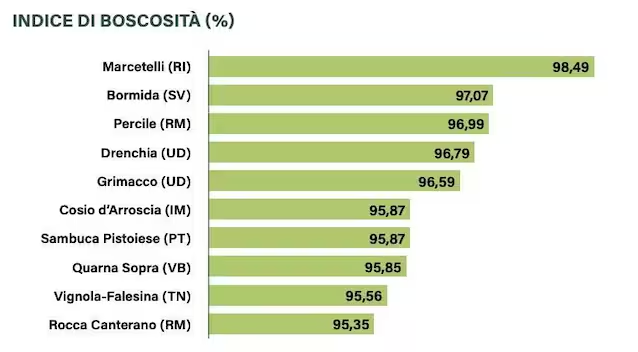
To get an idea: it’s as if the whole of Austria was covered in Italian trees. Among the municipalities with the largest forest area are Marcetelli, in the province of Rieti, with 98.4% of the area covered by woods, followed by Bormida, in the province of Savona, and Percile, Rome. Gubbio, in the province of Perugia, holds the record for absolute extension of forest area (26,804.26 hectares).
The historical overtaking: forests beat agriculture in Italy
Starting from 2020, the forest areas in Italy have exceeded in extension the areas intended for agriculture (the so-called UAA, Utilized Agricultural Surface), which in the period between 2000 and 2020 decreased by 21.5%. Between the 19th and 20th centuries we had reached an all-time low, with an average woodland index (i.e. the ratio between forest area and land area) of just 12%.
Compared to 1970, when forests covered around 6 million hectares, today the extent of our forests has almost doubled, reaching 11 million. To find a similar territorial balance, with the forest dominating the cultivated fields, we need to go back almost a thousand years, to the Middle Ages. All this did not happen following a forced planting operation organized by the state, but was a largely spontaneous process. As the president of PEFC Italia Marco Bussone writes in the introduction to the report, we have become a Forestry Nation “almost without our knowledge, and perhaps even in spite of ourselves”.
Why forests increase: human abandonment
The main driver of this reforestation was abandonment by man. In recent decades, the exodus towards the cities and the depopulation of mountain and rural areas have left many territories empty and abandoned: marginal agricultural land, old pasture meadows and tree crops that no longer yield as much as the fruit chestnut groves, once essential for the mountain economy, have been left to themselves: nature, in a very short time, has “reclaimed” those spaces, reconquering slopes and valleys that man had laboriously stolen from it in the previous centuries.
This is nothing new: after the fall of the Roman Empire, between the 5th and 9th centuries, the demographic collapse, wars, plagues and depopulation of the countryside triggered what historians call the “woodland reaction” throughout the peninsula, a spontaneous and widespread reconquest of the forest on the agricultural land that the Romans had cultivated in previous centuries. In the Po Valley, alders, poplars and willows reappeared in the marshy areas, oaks returned to dominate vast areas that are now completely agricultural and even animals that had long disappeared such as beavers, wild boars and bears found their habitat again.
The historian Henri Desplanques (1911-1983) hypothesized that at the end of the Middle Ages the woodiness index of the peninsula could still be between 60% and 75% of the territory. Then, starting from the 10th-11th century, demographic growth and the expansion of the Municipalities triggered a phase of very intense land clearing; between the 10th and 14th centuries the population of Western Europe almost doubled and the forest cover was reduced by 50%. Deforestation continued in the following centuries, accelerating further with the industrial revolution and the reclamations of the 19th and 20th centuries, until it reached the historic minimum of 12% of woodland between the 19th and 20th centuries.
Today we have risen to 36%, with a mechanism that closely resembles that of the Early Middle Ages: the difference is that in the Middle Ages the return of the forest was the sign of a civilization in crisis, while today it can become an opportunity.
How Italian forests and the most wooded municipalities are distributed
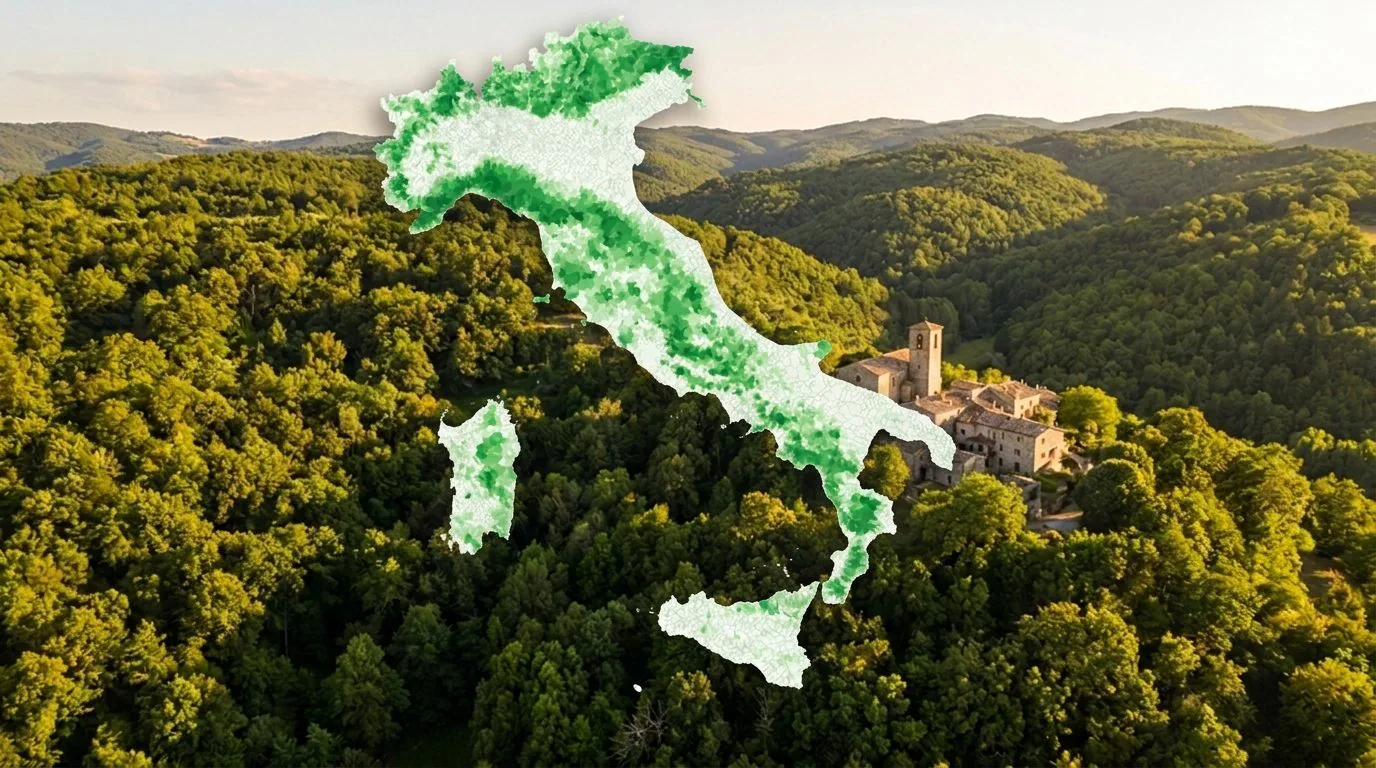
The distribution of forests is not uniform: the territorial concentration is very clear and the report documents it for the first time on a municipal scale, municipality by municipality: out of almost 7,900 Italian municipalities, approximately half have a marginal or non-existent presence of forests, with a woodland index of less than 20%. And more than two-thirds of the Italian population lives in these same municipalities, for which, the report underlines, the relationship with the forest is substantially extraneous to daily life.
On the contrary, the vast majority of our forestry heritage is found in the mountains: 3,596 mountain municipalities, which represent 47.8% of the national surface area but host just 13.5% of the population, concentrate 75.7% of the entire Italian forestry surface area. In short, more than three-quarters of the national forest is found in the 3,149 municipalities where the woodiness index exceeds 40% and the forest is the prevalent form of land cover. For 495 municipalities (where just 1% of the population lives) the forest actually covers over 80% of the territory.
A geographical gem: the “greenest” municipality in Italy is Marceltelli, in the province of Rieti, with a woodiness index of 98.49%: practically a bell tower and a few houses that emerge from an expanse of trees. In second place Bormida, in the province of Savona, with 97.07%, followed by Vignola-Falesina in Trentino (96.99%). Gubbio, in the province of Perugia, it holds the record for absolute extension of forest area with 26,804.26 hectares. At the other extreme, Rome has a woodiness index of 0.33% and Ravenna of 0.53%.
A natural heritage that is decisive for well-being and the economy
Between 2019 and 2025, in what experts call the “Season of Awakening”, the people who moved from the cities to the mountains exceeded those who made the reverse journey by 100,000. In the UNCEM Mountains Italy 2025 Report, many highly wooded municipalities record a largely positive migratory balance. This is because the forest today also means for many better quality of life, well-being and contact with nature: elements increasingly sought after by those who decide to change their lives, work remotely or invest in a new project.
The Foreste in Comune report demonstrates with data and underlines that high woodland can in fact coexist with attractiveness on a social level and dynamism on an economic level: in the 1,113 mountain municipalities with the highest GDP per capita, where over 40% of the mountain population lives, as much as 32.25% of the mountain forest area is found. Almost half of these economically dynamic areas have over 60% of their territory covered by forests.
The data relating to biodiversity and positive environmental impact are also noteworthy. Italian forests are home to 117 tree species and 10 of the 14 forest categories that the European Environment Agency considers most representative of the continent’s ecological variability: a true biodiversity hotspot at European level. For this reason, there is a network of protections among the most stringent in Europe: 100% of the Italian forest surface is subject to landscape restrictions, 87% is covered by hydrogeological restrictions and 28% is protected for its naturalistic value. The property, however, is 63% private, a fact that makes the management of the forestry heritage particularly complex.
To have a European yardstick: in the European Union forests cover on average 39% of the territory, but with enormous differences between one country and another. The six Member States with the largest forested areas, which alone account for two thirds of all EU forests, are Sweden (69%), Finland (74%), Spain (37%), France (32%), Germany (33%) and Poland (31%). Italy, with its 36%, is positioned just below the community average: a figure that, even just twenty years ago, would have seemed unthinkable.
The positive effects on the climate and the need to organize shared management
The presence of forests also has positive effects on human life: for example, the greenery of the municipality of Marceltelli provides services from air purification to aquifer recharge, from soil erosion protection to flood mitigation, from carbon dioxide sequestration to timber and mushroom production. Throughout Italy, the organic carbon stored in our country’s forest ecosystems is equal to 1.24 billion tons. Thanks to the growth of trees, 12.6 million tonnes of carbon are fixed every year, which corresponds to an absorption of 46.2 million tonnes of CO₂ from the atmosphere.
The benefits and opportunities are obvious, but this enormous quantity of greenery must be managed, so as not to expose it to risks (from fires to problems such as hydrogeological instability) and to enhance the economic and environmental potential it offers. The Consolidated Law on Forests and Forestry Supply Chains (TUFF), approved in 2018, laid the foundations for a reform of the sector, but implementation is still incomplete. As all the authors of the report point out, management will be arranged by Territorial Communities, the Green Communities, to bring together skills, businesses and ecosystem services.